The above is a picture of two ESA astronauts, André Kuipers and Frank de Winne, training underwater at a Houston NASA facility. The ESA is actively recruiting astronauts as it explores its Moon mission options, with cooperation (like the training above) and more concrete indications of plans to work together on the moon becoming more and more common as of late.
Friday, August 15, 2008
Picture of the Week: What Ocean?
The above is a picture of two ESA astronauts, André Kuipers and Frank de Winne, training underwater at a Houston NASA facility. The ESA is actively recruiting astronauts as it explores its Moon mission options, with cooperation (like the training above) and more concrete indications of plans to work together on the moon becoming more and more common as of late.

Tuesday, August 12, 2008
NASA abandons accelerated Orion 2013 plan (News)
 Yesterday, it was announced that NASA was abandoning its idea for an ambitious, accelerated launch of its next-gen Orion spacecraft, pushing back the date a year. While the announced launch date is March of 2015, they were hoping to get the craft up and launched as soon as 2013; now they are looking an an internal date of 2014 (with the 'announced' launch date still sitting pretty on 2015).
The Orion craft seats 4-6 astronauts (with the current Space Shuttle typically carrying 7), and is the craft planned to carry NASA's astronauts to the Moon (with Orion being launched by the Ares rockets, subsequent to a seperate launch of the lunar lander, Altair; both craft have been spotlighted here recently). Meanwhile, other nations have their own equivalents brewing...

Sunday, August 10, 2008
MoonPop: "Fly Me to the Moon"
This song has been stalking me as of late (today it was the song on the music player of my favorite--and totally not moon-related--coffeehouse's website...my first time at the website, and it's that song of all the possible choices for me, moon blogger/frequent patron...weird), and so without further adieu, here's a little spotlight onto the lunar entry into pop culture made famous by Frank Sinatra: "Fly Me to the Moon".
The song, written as a pop standard by Bart Howard in 1954, was actually orginally titled "In Other Words", but that oh-so-catchy first line eventually became the title. It was first recorded by Kaye Ballard, and after numerous others had recorded versions, Sinatra recorded his own iconic whirl on it in 1964.
Since then, it has been covered by countless more artists, inspired punny movie titles, and (of course) actually been sung in space.
I've got a whole playlist of moon tunes that I swing to while blogging away here, that I'll share as soon as I figure out a practical way for it to be more interactive (e.g. listenable) right here at the blog...:) But, for now, enjoy that video above and the litany of links I've provided for ya as per usual :)
Thursday, August 7, 2008
Picture of the Week: Peek-A-Boo
 That is a picture of a Lunar Reconnaissance Orbiter (LRO) mockup, with the Narrow Angle Camera being looked at by a team member identified as 'Cathy' (which, looking at the team's members, is probably the Deputy Project Manager Catherine Peddie).
The LRO is the first major mission of the Vision for Space Exploration era of NASA, with an expected launch of February 27, 2009. It's mission is largely one of documentation, with a more in-depth look at the selenology and selenodesy of the moon in preparation for the set-up of colonies there before 2030 or so. In addition to what will assuredly be lots of neat, pretty pictures, the LRO will send back valuable information about radiation, water, and other key environmental elements that may or may not be present on the moon.
Monday, August 4, 2008
CNN Article/Video Interviews with Odyssey Moon Ltd.'s Bob Richards
As part of their ongoing "Just Imagine" feature, CNN put up a written interview and a couple of video features on Bob Richards, CEO of Odyssey Moon Ltd., and both his company and the Google Lunar X Prize it's competing for in general. (Mr. Richards actually posted a comment on this very blog last month, which [to be honest] thoroughly surprised me at the time, haha.)
All three pieces give an interesting (and more intimate than is typical) view into the commercial venture aspect of colonization, which falls under what one could call the integration of the moon into our societies. The private sector reaching the moon may well become more significant that the actual governmental colonization efforts, as far as the Moon's presence and influence in our daily lives; and it's happening a lot sooner.
"In 2020 the moon is going to be part of our human society, of our economic sphere. Human beings will be there. I think the private sector will outpace governments for a while, but the governments will be working in concert and we will be establishing a moon base, prospecting for resources, we'll be trying to understand how we can utilize the moon for the benefit of life on Earth."
-Bob Richards, from a CNN interview
Check out all three pieces as linked above, especially the three-and-a-half minute "The Reality of Space" feature. It's some of the highest-quality material I've come across, and is a great preview of what I'm sure will be a flood of constant coverage over the next twenty years and beyond, as well as an interesting (albieit brief) portrait of an important figure in the integration process.
Wednesday, July 30, 2008
Picture of the Week: A Titanic Discovery (News)
 That is a picture of a place the Moon could one day be seen as an important stepping stone to: Titan, the largest of the many moons of Saturn. Long suspected to have water, today it was announced that Titan is officially the second celestial body ever found to have stable liquid on its surface (the first being the one you're sitting on, of course).
The lake, also officially the first non-Earthen lake ever found, is called Ontario Lacus and is comprised of liquid ethane. It shares a similar shape and size to Lake Ontario here on Earth; hence the name.
Someday, the many Titan colonists will harken back to the old days when the lunar pioneers set the stage for them. Moon colonization may seem like a blip at a point when we've began settling bodies with the potential of Titan and Europa.
Saturday, July 26, 2008
One Giant Leap for Plantkind?
According to a nifty Wired.com blog article, NASA scientists put forward the idea this week of launching plants to the moon and watching their growth carefully, as a way of studying the potential effects of long-term habitation (low gravity, radiation, etc.).
 Moon colonist?

Moon colonist?Check out the linked article for a full rundown of thaliana's moon-faring resume.
Interesting things could potentially happen when you mix plants and lunar radiation/soil/etc., but regardless, this is an idea that is a potential wonder of effectiveness through simplicity.
Wednesday, July 23, 2008
Russian/European Joint, Manned Spacecraft Design Unveiled (News)
The replacement for the oft-used Russian Soyuz craft was unveiled today, and it is a joint project by the European Space Agency and the Russian Federal Space Agency(Roscosmos):
 Designed by Russian space firm RKK Energia, this is a craft planned to be used for lunar missions, effectively being the counterpart to NASA's Ares/Orion lunar-mission tag team (which I profiled briefly here at Luna C/I back in May). In NASA's case, the Ares is the launch module and the Orion the manned portion; this new craft is a manned craft, with the launch vehicle undetermined and (as noted in the linked BBC news article) possibly being either an entirely new vehicle or a modified existing Russian rocket.
 The Russian-European plans to collaborate are not a set-in-stone agreement, and so the ESA does have a backup plan to continue should the partnership with Roscosmos fall through. Still, it's promising to see signs of this sort of high-level collaboration working, as opposed to, say, tense and outright competition that could lead to cynical (perhaps silly?) 'war in space' scenarios. In my view, if there's a time for humanity to start moving on from the more petty social-geopolitical problems of Earth, this is it. Do we really need to go start churning out terms like "lunapolitical conflict"?
But, for the time being, we have developments like this tentative Euro-Russian agreement (and other cooperation efforts) to nudge things towards what I see, at least for now, as a positive direction.
Monday, July 21, 2008
Magnetic Attraction
 One concern that gets voiced about lunar colonization is the levels of radiation colonists could be exposed to, and how much of a threat that is (and whether there is sufficient methods of protection against it).
"We really need to know more about the radiation environment on the Moon, especially if people will be staying there for more than just a few days."
-Harlan Spence, astronomy professor at Boston University
Mapping out and investigating the levels of radiation is one the central goals of NASA's Lunar Reconnaissance Orbiter (LRO) mission, the first tentpole mission of the landmark Vision for Space Exploration/Constellation era.
Various remedies and shields have been suggested, including isolated magnetic fields (like Reiner Gamma, pictured above; these are speculated to be a result of crater- and other ejecta), spherical man-made shields (pictured below), and even the Earth itself.
 I personally trust in human ingenuity to come up with something, and the lack of effects on the Apollo astronauts seems promising (though many seem to think that indicates the whole Apollo landing was actually a hoax). At the very least, the commercial motivation for a company to come up with something that could enable colonization (and therefore utilization of groundbreaking resources) could eventually (or very quickly) become too strong to be ignored.
To cap, here's a segment on the subject from a NASA video (Destination Tomorrow), courtesy of Youtube:
Saturday, July 12, 2008
MoonPop: "WALL-E" (News)
"Outlet Mall, coming soon!"
-A 'Buy N Large Corp'. billboard on the Moon, next to the American Flag at Mare Tranquillitatis, in the film "WALL-E"
I had a chance last week to finally catch Pixar's latest masterwork, "WALL-E". Much like with "Iron Man" earlier this summer, a movie that a whole heck of a lot of people ended up seeing happened to also be a movie with a look at the Moon; and in WALL-E's case, a look specifically at the Moon colonization and the potential outcomes of it.
It's a simple, and brief, moment in the film, but a memorable one: In a fly-by of the Moon, the site of the American flag in the Sea of Tranquility is seen as having a billboard adjacent to it advertising a future outlet mall (which, given the circumstances and setting of the film, the builders apparently never did get around to).
The placement of the sign directly next to the flag site could suggest that the fictional Buy N Large Corporation in the film was intending to plow right over the site for their new mall; or that they simply plopped that sign down there for attention.
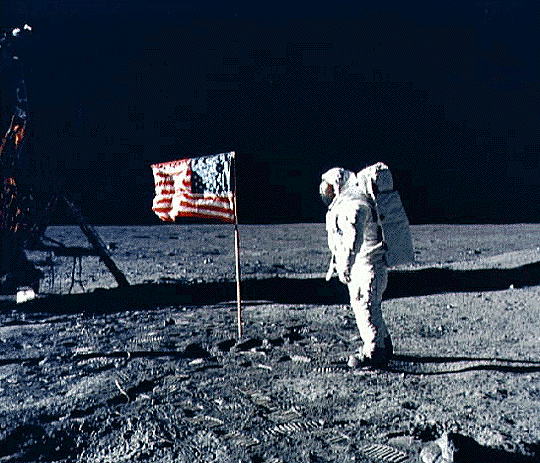
The strange thing about all of this is that this isn't really that far from the truth, as things are developing now. The Sea of Tranquility is rich in Helium-3, a resource extremely rare on Earth but plentiful on the Moon that could be valuable for fusion power. So within 15-20 years, we could very well be seeing mining operations going up right next to the Apollo landing sites.
With the generation of kids seeing WALL-E today being the ones who will have the newscasts of their lives dominated by Moon colonization, it should be interesting to see how this one moment in an extremely visible film gets referenced and remembered, as commerical development of the Sea of Tranquility and the rest of the Moon becomes an imminent reality (and potentially, a major public debate).
Thursday, July 10, 2008
Picture of the Week: That's No Space Station...

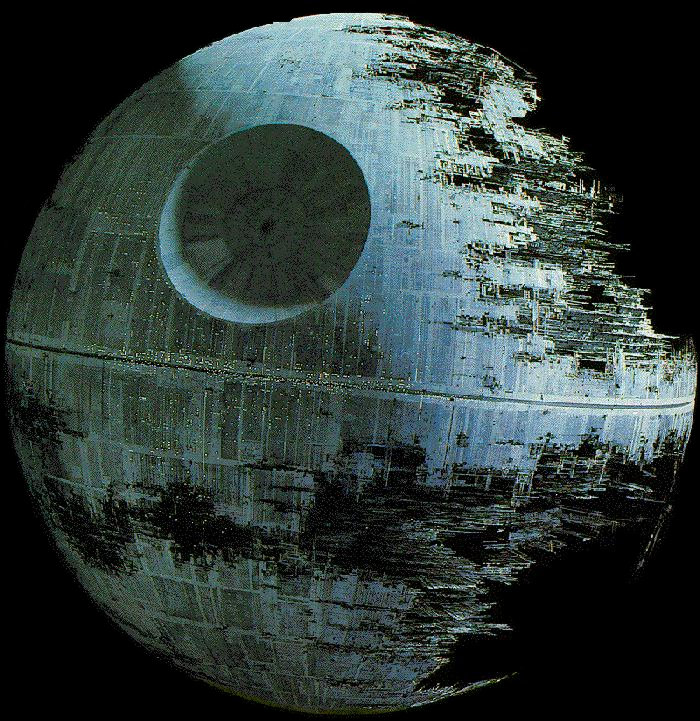
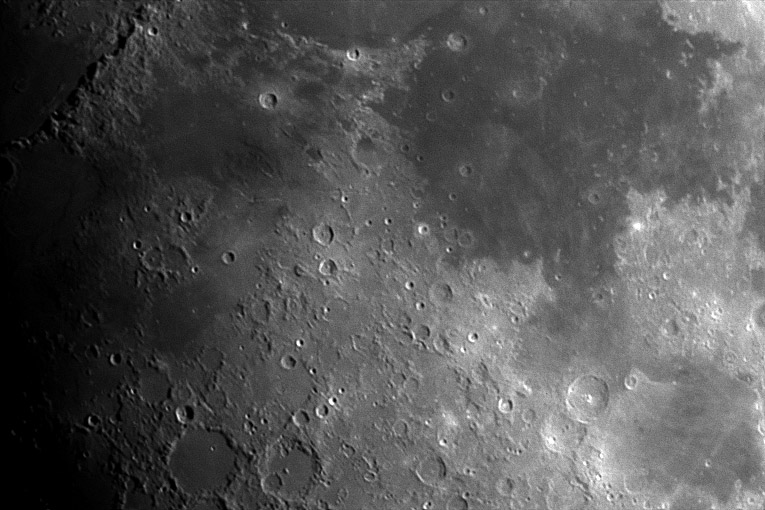
Reversing the astute observation of Obi-Wan Kenobi, this Death Star-like image is not of a space station (of course), but of Shackleton crater near the Moon's south pole.
Along with Malapert mountain, this is considered one of the leading candidates for the location of an initial moon colony; while it's interior is in perpetual shadow, the rim is a Peak of Eternal Light, which is (as you can probably imagine) a solar panel's dream, providing an ideal source of energy for a base.
Tuesday, July 8, 2008
It's a Bird! It's a Plane! It's...a Lunar Penguin?
Like the plot of Batman Returns going out and having a wild affair with a Harsh Mistress, rocket-powered Penguins may soon be bounding across the moon.

According to this and the article referenced there, though, this Penguin actually looks nothing like a penguin. Everyone loves penguins though, and with all the Antarctic work being done related to the moon it only makes sense that penguins should have their place on Luna, allegorically or not.
The lunar penguin is a robotic explorer, developed by defense contractor Raytheon, with the ability to jump as high as a kilometer (and over great distances) as it completes missions (searching for frozen water, etc.).
With the moon's landscape being unusually harsh, hopping may very well be a prime mode of robotic lunar travel. One thing is for sure: we're going to be seeing a wide variety of proposals (and actual rovers/robots) over the next 10 to 20 years.
Sunday, July 6, 2008
Youtube: Sergey Brin on the Google Lunar X Prize
I have now, as you see, emerged out of the blogging stone age and have figured out how to embed videos in here. (It wasn't hard.)
The gentleman speaking in the video is Sergey Brin, co-founder of Google, talking about the Google Lunar X Prize and sort of the inspirations and motivations for the sponsorship/prize.
Talking to people I know and always getting blanks on Moon Colonization/Integration, I sometimes forget that important people are out there that take this seriously, and it's not as fringe as my other interests sometimes are, despite the seemingly 'radical' nature of the subject. So, it's always a cool and interesting reminder to see someone like a Sergey Brin, a Stephen Hawking, or a John McCain actually out there talking about this.
Wednesday, July 2, 2008
Picture of the Week: Fetch, Rover
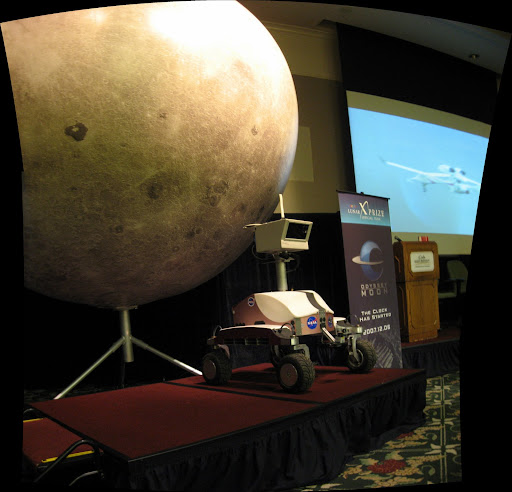 In a little toss to WALL-E's opening this past week, the Picture of the Week is a mock-up of what a Google Lunar X Prize rover might end up looking like (EDIT: See comments for the full skinny, but the good folks at Odyssey Moon Ltd. note this is an actual prototype, with the photo being from their media conference about being named the first Lunar X prize team. Thank you Mr. Richards for the comment and the further details :) ). Such a rover would have to be capable of completing a 'Mooncast', consisting of 360º photos, both HD and near-real time video, and transmission of specific data in order for the competing group to earn the $20 million prize. Additional $5 million prizes can be earned by coming in second and/or completing additional challenges, such as roving certain distances and surviving a frigid lunar night.
I personally find the giant model of the moon there to left of it almost as exciting as anything else. Put me in the same room as that thing, and I'd be all over it.
Sunday, June 29, 2008
NASA Gets a Buzz: Aldrin Speaks Out on the New Space Race (News)
The Telegraph has interviewed Buzz Aldrin, second man on the moon and outspoken advocate of moon colonization, with some interesting results.

 "To me it's abysmal that it has come to this: after 50 years of Nasa, and after putting about $100 billion into the space station, we can't get our own astronauts to our space station without relying on the Russians."
-Buzz Aldrin, on the U.S. having to hitch rides on the Russian Soyuz to reach the ISS
Buzz appeals for the next U.S. President to embrace the Vision for Space Exploration (John McCain did so earlier this month) and expressed concern that the U.S. was already falling behind. Last month, according to the interview article, NASA's Constellation head Rick Gilbrecht "that Chinese astronauts were on schedule to get to the moon by 2017 or 2018" (on a manned mission to being work on a base), a good two or three years faster than the U.S. He also criticizes the lack of investment in commercial efforts, and NASA's lack of encouragement of tourist-effort-friendly technologies and policies.
As far as concern over getting to the Moon again before China (as opposed to concern over them actually building a base first), I think it's not really that significant a loss if China puts men/women on the Moon before we do in this century. Getting a base up first would be nice, yes, but nitpicking (for its own sake) on actually setting foot on Luna again first is probably excessive. We already own the record, and whoever comes along next isn't that important; though, Aldrin's concern could be primarily that it would mark the beginning of a trend.
Or, perhaps China getting back to the moon first would do us some good, pinch us out of our sleep. A little kick in the rear might light that patriotic fire is us again (and yes, that's Buzz himself in that last link).
In the meantime, it should be interesting to keep an eye on what ol' Buzz continues to do in his quest of advocacy...
Wednesday, June 25, 2008
Picture of the Week: A Model Example

That is a model of Malapert and the surrounding area (click for larger image), created by high school students for a project with NASA's Tom Riley of the Goddard Space Center. Labeled on there is Mount Malapert itself (a Peak of Eternal Light, which as you can imagine is good for solar power) on the right, the South Pole below it, and to the upper left the students' proposed spot for a settlement. The Malapert area is a leading candidate for the location of NASA's moon base, which'll be up and running by 2030.
Also, there's a section rather curiously marked "The Cold and the Dark". A quick google on that turns up a book about the aftermath of nuclear war...hmm.
Monday, June 23, 2008
Hotel on the Moon?
"Enjoy the view - enjoy low gravity - enjoy your stay"
-The Hotel Lunatic website
In my meanderings across the sphere of the Moon's presence on the internet, I came across this one particularly eccentric little corner: the Hotel Lunatic.
It's a draw-up (and a Dutch draw-up, at that) of a lunar hotel concept. There's an interactive section where you can check out different aspects of the 'proposed' towers, and a design aspects list noting that a "good view of the Earth", a "beacon effect" for people landing on the Moon, and an optimal view of the lunar surface (which probably isn't too hard).
It's an interesting and whimsical look into the possibilties of integration on the moon. Waste away on Margarita 1 and take in the sights of the Sea of Tranquility (though, realistically, a hotel would be located someplace not on a mare, as the maria will be big mining targets and that doesn't typically make for great scenery).
"The rimea Prinz area has been transformed into a nature reserve to preserve the beauty of the moon and not to be polluted by footprint ect."
-The Hotel Lunatic FAQ
And once again, I see that I'm not the only one with an eye on the idea of preservation on the Moon. I get the impression in my readings and research that there's a latent consciousness and want for lunar preservation, which is interesting, as the environmentalism movement began around the time NASA's and other space programs declined (though of course, national parks had been established long before). Barren as the moon is, this was not something I took as a guarantee.
Now, whether a conservation movement, or nations' and companies' desire to get as much out of the Moon as they can (and out of their investment) ends up having more leverage as far as what actually gets developed on the moon, we shall see...
Friday, June 20, 2008
Ice, Ice, Baby (News)
Right up there as a big ol' classic red headline on Drudge Report today was the news that NASA has confirmed that the Phoenix lander on Mars has turned up ice.

That may become one of the more legendary space photos ever taken. It turns out that there's apprently a whole sheet of ice right there under that dirt; e.g., as that linked article quotes Peter Smith:
"If you got a giant broom and swept if off, it's a big ice sheet."
-Peter Smith, Phoenix Principal Investigator, of the University of Arizona, Tucson
The existence of Lunar Ice is still doubtful, but the confirmation of ice on Mars shines a little more possibility into its existence. Even without ice on the moon, at the very least we now know we can ship water back to there from Mars, unorthodox as that may seem...
Wednesday, June 18, 2008
Huge Moon Tonight (News)
If you want to see Mare Tranquillitatis and the other features of the moon in their full glory with ye old naked eye, tonight is the night.
With the summer solstice coming along, this particular horizon-hugging full moon appears unusually large; this is referreed to rather simply as the "Moon Illusion".
For the time of your own local Moonrise, hit up this link. Fun fact: apparently, the moon's never actually full, but hey, it's full enough for me.
Monday, June 16, 2008
Picture of the Week: Antarctiluna
 As red as that is, that (of course) is not Mars but our beloved Luna, seen over Antarctica.
Antarctica and the Moon have fates that are intertwined in this era (as Modest Mouse have illustrated), as both are frontiers and similarily hostile environments. Antarctica has become known as "the closest place to Mars", and as a result, has become a testing ground for habitats for Lunar and Martian colonization.
Within 20-50 years (when I'll be 44-74), the population of humans on the Moon could well exceed that of those on Antarctica, which is an odd thought.
Subscribe to:
Posts (Atom)

 Posts