Today is the one-year anniversary of the announcement of the first Google Lunar X PRIZE team, Odyssey Moon (with the Google Lunar X PRIZE itself having been announced in August of last year).
It's also the 25th anniversary of my birth (haha), possibly a large part of why I remember the date ;)
Check out the Google Lunar X PRIZE's excellent and increasingly active Youtube channel here, as well as their excellent Launch Pad blog.
Showing posts with label Odyssey Moon. Show all posts
Showing posts with label Odyssey Moon. Show all posts
Saturday, December 6, 2008

Sunday, November 16, 2008
Picture of the Week: MoonOne, A Space Odyssey

That (by way of the Google Lunar X Prize site) is a new rendering of Odyssey Moon's competing lander, MoonOne.
Most details about MoonOne have been under wraps; recently, Odyssey Moon scored a partnership with NASA itself for technical support in the development of the craft.
Check out this neat MSNBC gallery for renderings of many of the other teams' crafts :)
Friday, October 31, 2008
Odyssey Moon Announces NASA Partnership (News)
Right on the heels of Astrobotic's big announcement of the details of their commerical missions, there's big news out of Odyssey Moon, Ltd., another Google Lunar X Prize competitor and major private lunar venture.
Odyssey Moon put forth a media release announcing a deal between them and NASA, with Odyssey Moon paying NASA for technical support on their MoonOne (M-1) Google Lunar X Prize mission. This agreement was reached through a Reimbursable Space Act Agreement, signed at the Ames Research Center in Silicon Valley. As that above link notes, the difference between a 'reimbursable' and a 'non-reimbursable' Space Act Agreement is whether or not there is a transfer of funds from the private entity (here, Odyssey Moon) to NASA, with NASA providing "data, facilities and services to the paying entity."
An important element of the agreement is that Odyssey Moon will then "share its technical data from its engineering tests and actual lunar missions with NASA", as the release puts it. So in exchange for getting initial support from NASA, Odyssey Moon's operational (and efficiency, a crutch of the value of the private space sector) knowledge will be utilized by NASA it it's own colonization efforts.
Leonard David over at LiveScience.com had the inside scoop on the agreement; check out his blog post for neat insider tidbits from his own experiences at Ames and from elsewhere.
Odyssey Moon put forth a media release announcing a deal between them and NASA, with Odyssey Moon paying NASA for technical support on their MoonOne (M-1) Google Lunar X Prize mission. This agreement was reached through a Reimbursable Space Act Agreement, signed at the Ames Research Center in Silicon Valley. As that above link notes, the difference between a 'reimbursable' and a 'non-reimbursable' Space Act Agreement is whether or not there is a transfer of funds from the private entity (here, Odyssey Moon) to NASA, with NASA providing "data, facilities and services to the paying entity."
An important element of the agreement is that Odyssey Moon will then "share its technical data from its engineering tests and actual lunar missions with NASA", as the release puts it. So in exchange for getting initial support from NASA, Odyssey Moon's operational (and efficiency, a crutch of the value of the private space sector) knowledge will be utilized by NASA it it's own colonization efforts.
Leonard David over at LiveScience.com had the inside scoop on the agreement; check out his blog post for neat insider tidbits from his own experiences at Ames and from elsewhere.
Wednesday, September 24, 2008
Former Director of Kennedy Space Center Joins Odyssey Moon (News)
Odyssey Moon, Ltd. (a high-profile 'private commercial lunar enterprise', and the first official team that was announced for the Google Lunar X Prize) has announced through a media release that Jay Honeycutt, former Director of the Kennedy Space Center, has joined their team as their director of U.S. operations.
"I believe the private sector has an important role to play in a permanent lunar program and Odyssey Moon has put together some pretty impressive people and plans to help make this happen. We look forward to working with NASA and other space agencies as both partners and customers in this effort.”
-Jay Honeycutt
That quote from the media release reminds me of what Barack Obama suggested in his space plan-- 'amplifying NASA's reach' with the private sector. Mr. Honeycutt there is speaking along much the same lines.
Other lunar enterprise companies, such as Astrobotic (also a Google Lunar X Prize contestant), express serving as a partner for government (as opposed to, say, strictly commercial) as part of their goals and general gameplan. It should be interesting to watch as NASA and the private sector mix and mingle further, and to see to what extent NASA ends up partnering with the private sector (and what positive impacts that could have, especially in an era of a lagging economy and potentially squeezed government budgets).
"I believe the private sector has an important role to play in a permanent lunar program and Odyssey Moon has put together some pretty impressive people and plans to help make this happen. We look forward to working with NASA and other space agencies as both partners and customers in this effort.”
-Jay Honeycutt
That quote from the media release reminds me of what Barack Obama suggested in his space plan-- 'amplifying NASA's reach' with the private sector. Mr. Honeycutt there is speaking along much the same lines.
Other lunar enterprise companies, such as Astrobotic (also a Google Lunar X Prize contestant), express serving as a partner for government (as opposed to, say, strictly commercial) as part of their goals and general gameplan. It should be interesting to watch as NASA and the private sector mix and mingle further, and to see to what extent NASA ends up partnering with the private sector (and what positive impacts that could have, especially in an era of a lagging economy and potentially squeezed government budgets).
Monday, August 4, 2008
CNN Article/Video Interviews with Odyssey Moon Ltd.'s Bob Richards
As part of their ongoing "Just Imagine" feature, CNN put up a written interview and a couple of video features on Bob Richards, CEO of Odyssey Moon Ltd., and both his company and the Google Lunar X Prize it's competing for in general. (Mr. Richards actually posted a comment on this very blog last month, which [to be honest] thoroughly surprised me at the time, haha.)
All three pieces give an interesting (and more intimate than is typical) view into the commercial venture aspect of colonization, which falls under what one could call the integration of the moon into our societies. The private sector reaching the moon may well become more significant that the actual governmental colonization efforts, as far as the Moon's presence and influence in our daily lives; and it's happening a lot sooner.
"In 2020 the moon is going to be part of our human society, of our economic sphere. Human beings will be there. I think the private sector will outpace governments for a while, but the governments will be working in concert and we will be establishing a moon base, prospecting for resources, we'll be trying to understand how we can utilize the moon for the benefit of life on Earth."
-Bob Richards, from a CNN interview
Check out all three pieces as linked above, especially the three-and-a-half minute "The Reality of Space" feature. It's some of the highest-quality material I've come across, and is a great preview of what I'm sure will be a flood of constant coverage over the next twenty years and beyond, as well as an interesting (albieit brief) portrait of an important figure in the integration process.
All three pieces give an interesting (and more intimate than is typical) view into the commercial venture aspect of colonization, which falls under what one could call the integration of the moon into our societies. The private sector reaching the moon may well become more significant that the actual governmental colonization efforts, as far as the Moon's presence and influence in our daily lives; and it's happening a lot sooner.
"In 2020 the moon is going to be part of our human society, of our economic sphere. Human beings will be there. I think the private sector will outpace governments for a while, but the governments will be working in concert and we will be establishing a moon base, prospecting for resources, we'll be trying to understand how we can utilize the moon for the benefit of life on Earth."
-Bob Richards, from a CNN interview
Check out all three pieces as linked above, especially the three-and-a-half minute "The Reality of Space" feature. It's some of the highest-quality material I've come across, and is a great preview of what I'm sure will be a flood of constant coverage over the next twenty years and beyond, as well as an interesting (albieit brief) portrait of an important figure in the integration process.
Wednesday, July 2, 2008
Picture of the Week: Fetch, Rover
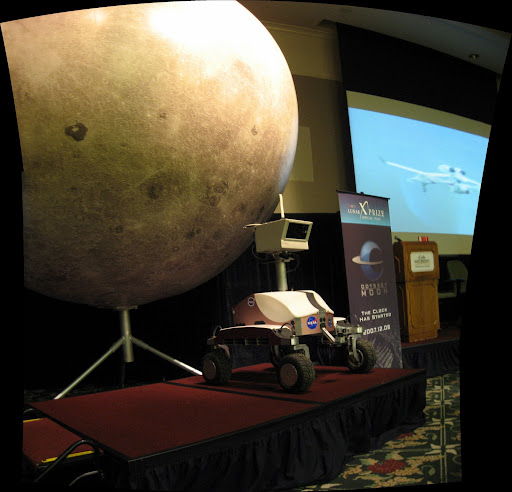 In a little toss to WALL-E's opening this past week, the Picture of the Week is a mock-up of what a Google Lunar X Prize rover might end up looking like (EDIT: See comments for the full skinny, but the good folks at Odyssey Moon Ltd. note this is an actual prototype, with the photo being from their media conference about being named the first Lunar X prize team. Thank you Mr. Richards for the comment and the further details :) ). Such a rover would have to be capable of completing a 'Mooncast', consisting of 360º photos, both HD and near-real time video, and transmission of specific data in order for the competing group to earn the $20 million prize. Additional $5 million prizes can be earned by coming in second and/or completing additional challenges, such as roving certain distances and surviving a frigid lunar night.
I personally find the giant model of the moon there to left of it almost as exciting as anything else. Put me in the same room as that thing, and I'd be all over it.
Sunday, April 13, 2008
"Integration"
If you'll go ahead and turn your eyes to the top of the blog, and note the lovely little header, you'll see the blog title states this is about "Colonization and Integration of the Moon".
Everyone's familiar with the idea of colonization, but is this "Integration" business?
Integration is simply the term that seemed to best describe efforts that aren't exactly colonization, but that do increase the integration of the moon with our society here on Earth; e.g., having our human remains from Earth put to rest on the moon. While no one's colonizing the moon there, it is becoming a part of our lives perhaps in an even greater way than colonization itself would cause.
The other day, I was rather startled to see I'm not the first to use the phrase "integration" (or, "integrated" to be exact) in this context. From Odyssey Moon, Ltd:
"Moon 2.0 will begin with robotic explorers that will deliver new knowledge about the Moon and the Earth. They will be followed by people with the goal of permanently integrating the Moon into Earth’s economic and social spheres, creating a two-world system for human growth and prosperity."
"Moon 2.0" being the alternate name used to describe the Google Lunar X Prize. The way they put it wraps the concept up in a pretty nice little nutshell: creating that two-world system, though in my eye, that will technically happen before we actually ever colonize the Moon itself (while they state humans on the moon will have integration as a goal, e.g. in their future).
Integration will extend far beyond the ashes effort, and could range to include things like resources from the moon being used on Earth, being able to own your own piece of the moon, Lunar webcams for our amusement, and God knows what else that could happen along (and soon). Interesting things always happen when entrepeneurs storm new territory...
Everyone's familiar with the idea of colonization, but is this "Integration" business?
Integration is simply the term that seemed to best describe efforts that aren't exactly colonization, but that do increase the integration of the moon with our society here on Earth; e.g., having our human remains from Earth put to rest on the moon. While no one's colonizing the moon there, it is becoming a part of our lives perhaps in an even greater way than colonization itself would cause.
The other day, I was rather startled to see I'm not the first to use the phrase "integration" (or, "integrated" to be exact) in this context. From Odyssey Moon, Ltd:
"Moon 2.0 will begin with robotic explorers that will deliver new knowledge about the Moon and the Earth. They will be followed by people with the goal of permanently integrating the Moon into Earth’s economic and social spheres, creating a two-world system for human growth and prosperity."
"Moon 2.0" being the alternate name used to describe the Google Lunar X Prize. The way they put it wraps the concept up in a pretty nice little nutshell: creating that two-world system, though in my eye, that will technically happen before we actually ever colonize the Moon itself (while they state humans on the moon will have integration as a goal, e.g. in their future).
Integration will extend far beyond the ashes effort, and could range to include things like resources from the moon being used on Earth, being able to own your own piece of the moon, Lunar webcams for our amusement, and God knows what else that could happen along (and soon). Interesting things always happen when entrepeneurs storm new territory...
Friday, April 11, 2008
Ashes to Ashes, Dust to Moondust
As many have heard through various news outlets lately, a company (Celestis) is now offering to send human remains to the Moon or the Moon's orbit. Celestis actually describes it universally as "Luna", e.g. the "Luna Service", which I guess sounds more romantic.
First thing I noticed with Celestis' Luna Service is it is through a partnership with Odyssey Moon, Ltd. and Astrobotic Technology, Inc., with the general lean being to go for the Google Lunar X Prize, worth a cool $30 million.
Commerical ventures to the Moon are, as you can tell, a reality, and in fact may very well be far more important in implications than any governmental effort. This ashes effort may go down as a large, early step down a historic and critical path.
For now, though, let's look at the practical matters of having our remains on and around Luna.

For an easy $10,000, you can have one gram of remains transported to the moon (or, as they note, attempted to be transported to; the remains get a free! re-flight if the mission fails). For two participants (e.g., husband/wife), or for more remains (7g instead of 1g), the cost is higher, up to $30,000 (well, $29,985).
As the Yahoo!/Reuters article linked above notes, Celestis projects 1,000 capsules will go on the first flight, with 5,000 on later flights. Half a dozen have already registered remains for the first flight. The service was inaugurated some time ago, in 1999, for the remains of Dr. Eugene Shoemaker. Celestis is itself a company of Space Services, Inc. which has already had other ventures, such as Name a Star.
The thing I wonder about personally with the remains is, where exactly are they headed? Looking at Earth's history with this kind of thing, and from my perspective of having recently finished my Bachelor's in Urban Studies and Planning...I respect the idea of putting remains on the Moon, but the track record for future respect to their location is not a pretty one (and so proper identification of their location becomes critical). And therein lies one of the first Lunar Environmental Planning issues: How, exactly, to prevent the resting place of these remains from being turned into a waste dump, or a base for a country or company unaware of the location's significance, or something else similarly inappropiate.
It seems like a no-brainer now that we'd be able to avoid something like that with such a high-profile and newsworthy venture, but mankind really is a race never to be underestimated, especially when we're building things.
Whenever we as a race get in a big rush to pioneer somewhere, the little things (like preserving the sanctity of people's remains) often get passed over in the excitement of the moment (just like Neil Armstrong's missing A). Let's see what we can do this time to make sure these little oversights remain a habit of mankind on just Earth, and not on other celestial bodies :)
For now, though, we have an exciting project to keep our eye on and to entertain our daydreams. And, really, who knows what they'll come up with next? :)
Subscribe to:
Posts (Atom)

 Posts
Posts


