Showing posts with label Integration. Show all posts

Thursday, October 30, 2008

Astrobotic Technology Announces Details Galore on Series of Commercial Moon Missions (News)

Today, Astrobotic Technology (a leading contender for the Google Lunar X Prize) announced a new series of missions as part of their commercial efforts.

"Astrobotic will robotically explore the Moon’s high-interest areas on a commercial basis, collecting information required to design future outposts and to answer scientific questions about the Moon and Earth."
-David Gump, President of Astrobotic, from their announcement

As part of the announcement, Astrobotic released a White Paper (a 'white paper' being an a report or guide that addresses problems and how to solve them, typically seen in business and politics) detailing their program and goals.

In addition to their initial effort for the $20 million Lunar X Prize, TranquilityTrek (which, as David Gump told Space.com for their article today, was "very clear" that it was "going to cost more to win the prize than the prize itself"), Astrobotic will follow with five more missions:
  • Three polar rovers;
  • A lunar lander; and
  • A lunar dozer (see below).

Rovers and landers are pretty commonplace ideas, but the 'dozer' was a new one to me. With some digging (excuse the pun), I found an example: NASA's Lunar Chariot prototype, which could build roads, dig trenches, or even mine minerals. There's even some video of it in action, kicking ass and taking names on Earth:


The White Paper has oodles of details on their exact mission plans, particularly the diagram on page 3.

With the X Prize TranquilityTrek slated for Q2 2010, they've got their South pole scout (headed for the rim of Shackleton Crater, long considered a prime location for a moon colony) shooting for Q3 2011, with two more missions (a North Pole scout and a 'Moon Quake 1" seismic and weather collection mission at Shackleton) set for 2012 and an Ice Surveyor mission going deep into Shackleton itself, followed by the Lunar Dozer mission also at Shackleton Rim, both being conducted in 2013.

So, for Astrobotic alone, that's 6 total lunar missions in the next four years. Exciting times. And this, of course (and as the White Paper notes), is just the initial slate. Most or all of the rovers will include HD video broadcasting, it sounds like, so we'll all have a front row seat, to boot.

The general goal of the missions is to build a data library to facilitate other organizations' (e.g., NASA; Barack Obama, in his space plan, talked of "amplifying NASA's reach" with the private space sector) and companies' missions with information for sale, such as detailed terrain maps, allowing future colonial efforts to simply buy the information from Astrobotic at a lower cost that it would take for the efforts to collect the data themselves.

Check out that 4-page White Paper and Astrobotic's site for the full skinny on their efforts, and keep an eye here for frequent updates and analysis as they (and other similar companies, such as fellow Google Lunar X Prize competitor Odyssey Moon, Ltd.) progress rapidly towards their mission slate :)

Sunday, October 5, 2008

Eternal Flame? Phoenix Lander Lasting Longer Than Expected

NASA's robotic Mars lander, Phoenix, made news recently as it was snowed on. Let the Martian snowmen and snowball fights commence.

But, a subplot to this event and just as notable in the long run, is that the Phoenix lander has lasted much longer than anticipated.

Originally expected to last 90 Martian days (also known as "sols"; Martian hours, minutes, and seconds are 2.7% longer than Earth ones), the lander has operated for 120+. The Martian winter is settling in, and with the lander being at a pole, that means a long, cold dark and the probable end of the lander's lifespan.

Considering that everything from the $30 million Google Lunar X Prize up through Helium-3 mining and moon base surveying and construction will be completed by similar robotic rovers and other heroic robots, the fact that as high-profile a rover as the Phoenix has proven much more durable than anticipated is great news for any and all forthcoming efforts to integrate, and then colonize the Moon.

Rovers proving more durable means that everything on Luna will get explored, built on, and mined that much faster and more efficiently (and more efficiency itself speeds things up again by freeing up R+D, etc. cash). If rovers and other equipment prove to consistently outperform expectations like the Phoenix has, then the pace of the Moon's integration into our Earthbound society is going to get really wild.

The Phoenix lander's perserverance has shone a bright light of promise into the future of robotic Martian, Lunar, and other missions.

Tuesday, September 30, 2008

SpaceX Becomes First Private Company to Launch Rocket Into Orbit (News)

This past Sunday (September 28th), the private company Space Exploration Technologies (widely known as SpaceX, and based out of Hawthorne, CA) became the first private effort to ever launch a liquid-propelled rocket into orbit.

Their Falcon 1 craft successfully made it into orbit on what is actually the fourth attempt by SpaceX (kudos to their perserverance and pioneering spirit). Here's a video (with raw sound, but incredible visuals) of the launch, including images from the Falcon 1 itself:


Falcon 1 was launched from Omelek Island, a U.S. territory in the Marshall Islands.

With SpaceX's goal to "reduce the cost and increase the reliability of space access by a factor of ten", this (combined with other recent efforts) is a huge sign that a private space boom really is coming, and coming fast. This is a historic step, amazingly coming right on the heels of events like the Chinese spacewalk. It's been an incredible couple of weeks.

Of course, orbit is just the beginning. Once we've got a private space boom in full swing (or even before), there'll be more than just a few private efforts with their eyes fixed on the Moon.

Monday, September 22, 2008

Japan Moving Forwards on Space Elevator (News)

Up until now, the space elevator (a high-concept, low-cost alternative way of moving goods from the Earth and other planetary surfaces out of gravity fields and into space) was something that 'could' be done, that some were 'thinking' of doing, a project for 'someone, someplace' to take on 'someday'.

News from the Times Online today (and subsequently hitting the legendary front page of Drudge Report) is that the Japan Space Elevator Association (official website, which is entirely in Japanese) is moving forwards on actually building a space elevator, with a conference ("JpSEC2008") set for later this year to establish a specific timetable.

This is much sooner than I personally had anticipated; to see such concrete initiative on the concept in 2008 is a big, and really exciting, step. Though it still sounds like they're essentially in the planning stages, to have such large media exposure for their effort/conference is a major event in its own right.

Keep an eye here at Luna C/I for updates on the JSEA's progress as they continue to gain steam, and be sure to check out my earlier features on Space Elevators for the full skinny on the concept :)

Tuesday, September 16, 2008

Neat Youtube Video: Michio Kaku on the Space Elevator

The above is a video I came across featuring a great look at space elevators from Michio Kaku , a technology that could greatly amplify the speed and efficiency of moon colonization efforts, both through moving supplies off the Earth and for actually building these on the Moon itself for exports.

Check out the video for an excellent explanation of the whole concept, as well as my original look at space elevators and this example of a space elevator company (Black Line Ascension).

Tuesday, September 9, 2008

Picture of the Week: It's A Miner Thing, and They're a Miner King

From the University of Wisconsin-Madison's Fusion Technology Institute (by way of the European Space Agency) comes an artist's rendition of a Helium-3 miner.

Helium-3 is a resource that is rare on Earth, but plentiful on the moon. It's drawn a lot of interest, including officially from China and Russia, as the primary fuel for fusion power, which is something of the ultimate power source: clean and efficient, one shuttle's load of Helium-3 from the Moon would be roughly enough to power the United States for one year. And that's just one load!

While fusion probably won't turn up until around 2050, that's about the time we're expected to be running out of fossil fuels and potentially in need of a new energy source. So, the idea among Russia, China, the U.S., and potential commercial efforts would be to get a headstart on collecting the fuel by stockpiling it early, and developing some kind of dominance over the resource in order to gain leverage (and massive profits).

So, as a result, even though we might not be seeing fusion power itself for a while, we'll be seeing (and hearing about) miners like the one above much sooner.

Monday, August 4, 2008

CNN Article/Video Interviews with Odyssey Moon Ltd.'s Bob Richards

As part of their ongoing "Just Imagine" feature, CNN put up a written interview and a couple of video features on Bob Richards, CEO of Odyssey Moon Ltd., and both his company and the Google Lunar X Prize it's competing for in general. (Mr. Richards actually posted a comment on this very blog last month, which [to be honest] thoroughly surprised me at the time, haha.)

All three pieces give an interesting (and more intimate than is typical) view into the commercial venture aspect of colonization, which falls under what one could call the integration of the moon into our societies. The private sector reaching the moon may well become more significant that the actual governmental colonization efforts, as far as the Moon's presence and influence in our daily lives; and it's happening a lot sooner.

"In 2020 the moon is going to be part of our human society, of our economic sphere. Human beings will be there. I think the private sector will outpace governments for a while, but the governments will be working in concert and we will be establishing a moon base, prospecting for resources, we'll be trying to understand how we can utilize the moon for the benefit of life on Earth."
-Bob Richards, from a CNN interview

Check out all three pieces as linked above, especially the three-and-a-half minute "The Reality of Space" feature. It's some of the highest-quality material I've come across, and is a great preview of what I'm sure will be a flood of constant coverage over the next twenty years and beyond, as well as an interesting (albieit brief) portrait of an important figure in the integration process.

Sunday, July 6, 2008

Youtube: Sergey Brin on the Google Lunar X Prize

I have now, as you see, emerged out of the blogging stone age and have figured out how to embed videos in here. (It wasn't hard.)

The gentleman speaking in the video is Sergey Brin, co-founder of Google, talking about the Google Lunar X Prize and sort of the inspirations and motivations for the sponsorship/prize.

Talking to people I know and always getting blanks on Moon Colonization/Integration, I sometimes forget that important people are out there that take this seriously, and it's not as fringe as my other interests sometimes are, despite the seemingly 'radical' nature of the subject. So, it's always a cool and interesting reminder to see someone like a Sergey Brin, a Stephen Hawking, or a John McCain actually out there talking about this.

Wednesday, July 2, 2008

Picture of the Week: Fetch, Rover

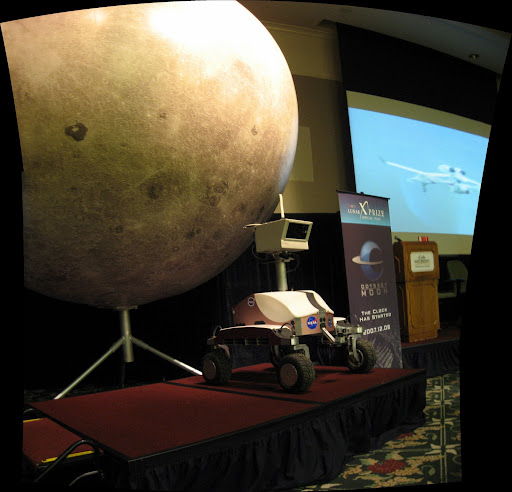
In a little toss to WALL-E's opening this past week, the Picture of the Week is a mock-up of what a Google Lunar X Prize rover might end up looking like (EDIT: See comments for the full skinny, but the good folks at Odyssey Moon Ltd. note this is an actual prototype, with the photo being from their media conference about being named the first Lunar X prize team. Thank you Mr. Richards for the comment and the further details :) ). Such a rover would have to be capable of completing a 'Mooncast', consisting of 360ยบ photos, both HD and near-real time video, and transmission of specific data in order for the competing group to earn the $20 million prize. Additional $5 million prizes can be earned by coming in second and/or completing additional challenges, such as roving certain distances and surviving a frigid lunar night.

I personally find the giant model of the moon there to left of it almost as exciting as anything else. Put me in the same room as that thing, and I'd be all over it.

Monday, June 23, 2008

Hotel on the Moon?

"Enjoy the view - enjoy low gravity - enjoy your stay"
-The Hotel Lunatic website

In my meanderings across the sphere of the Moon's presence on the internet, I came across this one particularly eccentric little corner: the Hotel Lunatic.

It's a draw-up (and a Dutch draw-up, at that) of a lunar hotel concept. There's an interactive section where you can check out different aspects of the 'proposed' towers, and a design aspects list noting that a "good view of the Earth", a "beacon effect" for people landing on the Moon, and an optimal view of the lunar surface (which probably isn't too hard).

It's an interesting and whimsical look into the possibilties of integration on the moon. Waste away on Margarita 1 and take in the sights of the Sea of Tranquility (though, realistically, a hotel would be located someplace not on a mare, as the maria will be big mining targets and that doesn't typically make for great scenery).

"The rimea Prinz area has been transformed into a nature reserve to preserve the beauty of the moon and not to be polluted by footprint ect."
-The Hotel Lunatic FAQ

And once again, I see that I'm not the only one with an eye on the idea of preservation on the Moon. I get the impression in my readings and research that there's a latent consciousness and want for lunar preservation, which is interesting, as the environmentalism movement began around the time NASA's and other space programs declined (though of course, national parks had been established long before). Barren as the moon is, this was not something I took as a guarantee.

Now, whether a conservation movement, or nations' and companies' desire to get as much out of the Moon as they can (and out of their investment) ends up having more leverage as far as what actually gets developed on the moon, we shall see...

Sunday, April 13, 2008

"Integration"

If you'll go ahead and turn your eyes to the top of the blog, and note the lovely little header, you'll see the blog title states this is about "Colonization and Integration of the Moon".

Everyone's familiar with the idea of colonization, but is this "Integration" business?

Integration is simply the term that seemed to best describe efforts that aren't exactly colonization, but that do increase the integration of the moon with our society here on Earth; e.g., having our human remains from Earth put to rest on the moon. While no one's colonizing the moon there, it is becoming a part of our lives perhaps in an even greater way than colonization itself would cause.

The other day, I was rather startled to see I'm not the first to use the phrase "integration" (or, "integrated" to be exact) in this context. From Odyssey Moon, Ltd:

"Moon 2.0 will begin with robotic explorers that will deliver new knowledge about the Moon and the Earth. They will be followed by people with the goal of permanently integrating the Moon into Earth’s economic and social spheres, creating a two-world system for human growth and prosperity."

"Moon 2.0" being the alternate name used to describe the Google Lunar X Prize. The way they put it wraps the concept up in a pretty nice little nutshell: creating that two-world system, though in my eye, that will technically happen before we actually ever colonize the Moon itself (while they state humans on the moon will have integration as a goal, e.g. in their future).

Integration will extend far beyond the ashes effort, and could range to include things like resources from the moon being used on Earth, being able to own your own piece of the moon, Lunar webcams for our amusement, and God knows what else that could happen along (and soon). Interesting things always happen when entrepeneurs storm new territory...