Showing posts with label private sector. Show all posts

Wednesday, December 3, 2008

President-Elect Obama names Bill Richardson (Space Commerce Supporter) U.S. Secretary of Commerce (News)

One small step by Barack Obama; one giant leap for the private space boom?

Today, President-Elect Barack Obama officially announced Gov. Bill Richardson of New Mexico as his choice for Secretary of Commerce; Richardson is an outspoken supporter of the idea of private space commerce.

Here's a few telling quotes from Richardson on space, this first one being from a 2006 USA Today article about the spaceport he initiated construction of in New Mexico during his terms as governor (Spaceport America):

""Richardson says he told his aides: "Go after the big one. Go after 5,000 jobs and something to be remembered for. Go after [Sir Richard] Branson and the spaceport. Politicians are known for talking about 9/11 and gloom and doom, and I like to infuse people with visions of the future and space. It's bold and risky, but people turn on to that."'"
-"New Mexico goes a little pie in the sky with spaceport idea", by Kevin Maney, USA Today

'Infusing people with hopeful visions' is definitely in the Obama style, and in his case, Richardson was using the private space industry's possibilties to do that. A preview of future Obama policy, perhaps?

Next is a quote from a Space.com article by Leonard David from late November 2008 about Richardson's space enthusiasm, as it relates to his then-rumored candidacy for the Commerce post:

"Richardson was asked about any possible post he might play in an Obama White House. The New Mexico governor played it a little coy, but said:

"Here's what I want to be sure of ... that the Obama administration is pro-commercial space ... that the administration is pro-space, pro-government space, pro-commercial space," Richardson observed.

Richardson said that "it's in the interest of our national space industry that commercial space could properly develop ... so I will be an advocate wherever I am ... hopefully here, still as governor of New Mexico ... you never know.""
-"Obama Vetting Bill Richardson, Space Enthusiast" by Leonard David, Space.com

So the man who stated he will be a commercial space advocate 'wherever he is' and that believes in 'infusing people with visions of future and space' is now the U.S. Secretary of Commerce, being essentially in charge of guiding the administration's economic policy.

For anyone interested in the development of a private space boom, this is a dream scenario, and a strong indicator that Obama is very serious about some of the things that he stated in his detailed campaign space plan:

"In achieving this vision, Obama will reach out to include international partners and to engage the private sector to amplify NASA's reach. Obama believes that a revitalized NASA can help America maintain its innovation edge and contribute to American economic growth."
-Barack Obama's space plan

Just how much could the private space boom "contribute to the American economic growth"? Here's another quote from the USA Today spaceport article which gives you an idea:

"[New Mexico] should understand this is a long-haul investment," says space business analyst Charles Lurio. "Spaceflight is poised for explosive market growth — analogous to PCs (in the 1970s). But exactly how that growth occurs, and in what form, is as uncertain as it was for PCs in the '70s."

"Explosive market growth", analogous to the now-ubiquitous PCs? That sounds like something America could use right now, and with Obama's appointment of dedicated industry supporter Richardson, it sounds like it's something we could be starting to see in the very near future. :)

Monday, November 24, 2008

Picture of the Week: A Mysterious Development...

This relatively unassuming rendering caught my eye when searching for something completely different (the International Lunar Network--features coming soon on that), and it was a small detail in the image that struck me, and sent me on a magical mystery tour of the web for more info:

Up on the carrier there, the label (in this NASA rendering) says:

Lunar Development Corporation.

As a 24-year-old with an Urban Planning degree, seeing such a particular phrase on a NASA rendering really got my attention. And what I've found has surprised me: this 'Lunar Development Corporation' could not only be a massive player in our colonization of the moon, but this reference on an official NASA image has proven to be highly mysterious.

A quick search on "lunar development corporation" dug up some gold (or helium-3, if you will):
  • A detailed paper on public-private partnerships (PPP), including the concept of a singular Lunar Development Corporation (I'll provide a full analysis of this paper as a marquee feature within the next two weeks);
  • A mildly dated (February 2007) article from Space.com on methods of solidifying public; investor; and other support for lunar plans, which it notes could (in part) be accomplished by instituting "a public-private lunar development corporation" (again, singular).

Among other things, mostly odds and ends.

This became extremely strange upon finding the original source of the image; I first encountered it via a mostly unrelated ThomasNet article. Then, after some digging based on the ThomasNet description, I found the image in the Wikipedia article on Moon Colonization.

Taking the hunt to NASA itself, a search for "lunar development corporation" on their main site turned up....nothing. Hmm. I then applied my method for finding that Wikipedia repeat of the image to NASA's new official images site, NASAImages.org, and found the image with a full (and revealing?) description.

The archived image's original source is this page, which has the same description alongside it.

That description is potentially very revealing, by just how unrevealing it is. Nowhere is the appearance of "Lunar Development Corporation" mentioned, as the brief text talks only about the rover and cargo lander.

A search on NASA's site for "lunar development corporation" turns up only a brief mention of "the new Houston-based Lunar Development Corporation" being listed as founded apparently by the Artemis Society's Gregory Bennett (a bio which does not mention this LDC in any form), and a Google or other search turns up no official site or mention of the entity in any form..

...yet it appears on the cargo lander on this official NASA image.

This may be explained by a small detail, from the end of the image's description:

"This image was produced for NASA by John Frassanito and Associates. Technical concepts from NASA's Planetary Projects Office (PPO), Johnson Space Center (JSC). "

Here's the website for John Frassanito and Associates, but a search for "Planetary Projects Office" and/or alongside "Johnson Space Center" turns up...nothing (except more concept images). NASA has a plethora of official sites for its various departments, but yet this Houston space center's "PPO" does, apparently, not.

A little more hunting at the Johnson Space Center site turns up a reference that the PPO became the "Planetary Missions and Materials Branch", a search for which, again, fails to turn up an official site. Searching the JSC's site brought up more odds and ends, including a newsletter (Lunar News issue number 62) from 1998, so it looks like "Planetary Mission and Materials Branch" may have been a name that was changed again, though to what, I'm not sure.

In fact, closer inspection of the original image's page confirms it is from 1994.

So after all that adventure, it may just be an old and outdated concept. Still, the prominence of the "Lunar Development Corporation" on the rendering (and others, it turns out), combined with the dual facts that the rendering is from "technical concepts, and the lack of mention of the Corporation in the image descriptions despite it being so readily apparent in them, suggest that "Lunar Development Corporation" was an element of the technical concepts not entirely intended to be released; e.g., an innocuous leak.

I'm going to do some further investigating, sending off some emails, and I'll post an update in the very near future about whether the Lunar Development Corporation could be something currently being worked on (as it is featured in concept images that are alongside much more current ones in the galleries). Stay tuned... :)

Sunday, November 23, 2008

SpaceX Sucessfully Tests Falcon-9 Engines (News)

In a significant step for the private space boom, leading company SpaceX successfully test-fired their Falcon 9 craft's engines today:

While their current programs have their eye on low-earth orbit, long-term SpaceX is looking at trans-Lunar capabilities for their Falcon vehicle family, as is demonstrated in their Falcon Lunar Capability Guide (expect a detailed analysis of that report here at Luna C/I within the next week :) ).

SpaceX's crafts are designed to be much more cost effective and reliable than past, government rockets, "up to a factor of ten".

Check out SpaceX's website--it is quite spiffy, being both very sharp graphically and stuffed full of great, accessible information; they really set a bar for space boom/base race web development. Also, check out the breathtaking Earth-to-orbit video of their historic Falcon 1 launch earlier this year, and their really, really crisp photos from that event.

Check back here later this week for that in-depth analysis of the SpaceX Falcon Lunar Capability Guide :)

Wednesday, November 5, 2008

What President Obama Means for Moon Colonization and Private Space Policy (Immediate Action?)

A few months back I did an in-depth analysis of Barack Obama's detailed space plan, but now that he is officially the President-Elect of the United States (and therefore, given the timing of his term, one of the most important figures ever in mankind's integration and colonization of the moon; it is within his first four-year term that the Google Lunar X Prize should be won, and that Astrobotic alone has 6 lunar surface missions planned), it's time to take a look at what change he might bring on early on in his administration.

One thing Obama's space plan detailed that we could see forming perhaps even before he takes office, is the return of the National Aeronautics and Space Council (here's an obviously in-progress Wiki article on it's previous incarnations, which were from 1953-1973 and 1989-1993; beyond that, online background is lacking).

"There is currently no organizational authority in the Federal government with a sufficiently broad mandate to oversee a comprehensive and integrated strategy and policy dealing with all aspects of the government's space- related programs, including those being managed by NASA, the Department of Defense, the National Reconnaissance Office, the Commerce Department, the Transportation Department, and other federal agencies."
-Barack Obama's Space Plan

The Council was a White House entity to help coordinate these sorts of agenices, something that is arguably needed more now than it was in the Space Race era, with the booming private space sector (from Armadillo and Astrobotic to Odyssey Moon and Virgin Galactic, with numerous inbetween) being around, as Obama puts it, to "amplify NASA's reach":

"In achieving this vision, Obama will reach out to include international partners and to engage the private sector to amplify NASA's reach. Obama believes that a revitalized NASA can help America maintain its innovation edge and contribute to American economic growth."
-Paragraph 3 of the Obama Space Plan

As has been much discussed, economic growth is something America could use right about now, and so having a council that strengthens coordination of private and government space efforts (something already underway, an example being the agreement between Odyssey Moon and NASA announced just last week) could in turn, strengthen the role in a recovering American economy of a thriving space sector. The council would greatly amplify the 'amplification of NASA's reach'.

"And that's a major debate I'm going to want to convene when I'm president of the United States. What direction do we take the space program in?"
-Barack Obama, on a couple of occasions on the campaign trail

An interesting blog post from an Obama supporter on the official Obama site talked about the idea of a new National Space Council from a political and practical perspective:

"A National Space Council could be critical to advancing such interagency issues on climate change, space communications, technical innovation, and the commercial uses of space. ...We are missing opportunities because no agency is charged with helping space industries in the way that the Federal government helped the infant aviation industry before World War II."
-Blog post by Gary Oleson on the official Obama campaign site

His post also notes that historically, the National Space Council was chaired by the Vice President; Vice President-Elect Joe Biden was as recently as October involved directly in Obama's space policy, as the sponsor of a waiver to allow the U.S. to buy Soyuz craft from Russia until the Orion craft is ready, something Obama spoke in favor of and then became involved with. Biden also was outspoken as a space advocate in the last days of campaign (though I'm sure Florida had something do to with that).


With Obama already starting to put his Cabinet together, we could see movement on the new National Space Council's creation within the next few weeks and months. The space program certainly is something hopeful and inspiring that Obama could mix in with all the grim challenges, which would be politically invaluable, especially if there's a lot of emphasis on the possibilities of lunar policy (with the Moon, of course, visible to every American on a regular basis as an impromptu symbol of hope).

Keep an eye here for frequent updates as Obama's presidential space policy begins to take even further shape, and check out my original analysis of his space plan for more details on that.

Friday, October 31, 2008

Odyssey Moon Announces NASA Partnership (News)

Right on the heels of Astrobotic's big announcement of the details of their commerical missions, there's big news out of Odyssey Moon, Ltd., another Google Lunar X Prize competitor and major private lunar venture.

Odyssey Moon put forth a media release announcing a deal between them and NASA, with Odyssey Moon paying NASA for technical support on their MoonOne (M-1) Google Lunar X Prize mission. This agreement was reached through a Reimbursable Space Act Agreement, signed at the Ames Research Center in Silicon Valley. As that above link notes, the difference between a 'reimbursable' and a 'non-reimbursable' Space Act Agreement is whether or not there is a transfer of funds from the private entity (here, Odyssey Moon) to NASA, with NASA providing "data, facilities and services to the paying entity."

An important element of the agreement is that Odyssey Moon will then "share its technical data from its engineering tests and actual lunar missions with NASA", as the release puts it. So in exchange for getting initial support from NASA, Odyssey Moon's operational (and efficiency, a crutch of the value of the private space sector) knowledge will be utilized by NASA it it's own colonization efforts.

Leonard David over at LiveScience.com had the inside scoop on the agreement; check out his blog post for neat insider tidbits from his own experiences at Ames and from elsewhere.

Thursday, October 30, 2008

Astrobotic Technology Announces Details Galore on Series of Commercial Moon Missions (News)

Today, Astrobotic Technology (a leading contender for the Google Lunar X Prize) announced a new series of missions as part of their commercial efforts.

"Astrobotic will robotically explore the Moon’s high-interest areas on a commercial basis, collecting information required to design future outposts and to answer scientific questions about the Moon and Earth."
-David Gump, President of Astrobotic, from their announcement

As part of the announcement, Astrobotic released a White Paper (a 'white paper' being an a report or guide that addresses problems and how to solve them, typically seen in business and politics) detailing their program and goals.

In addition to their initial effort for the $20 million Lunar X Prize, TranquilityTrek (which, as David Gump told Space.com for their article today, was "very clear" that it was "going to cost more to win the prize than the prize itself"), Astrobotic will follow with five more missions:
  • Three polar rovers;
  • A lunar lander; and
  • A lunar dozer (see below).

Rovers and landers are pretty commonplace ideas, but the 'dozer' was a new one to me. With some digging (excuse the pun), I found an example: NASA's Lunar Chariot prototype, which could build roads, dig trenches, or even mine minerals. There's even some video of it in action, kicking ass and taking names on Earth:


The White Paper has oodles of details on their exact mission plans, particularly the diagram on page 3.

With the X Prize TranquilityTrek slated for Q2 2010, they've got their South pole scout (headed for the rim of Shackleton Crater, long considered a prime location for a moon colony) shooting for Q3 2011, with two more missions (a North Pole scout and a 'Moon Quake 1" seismic and weather collection mission at Shackleton) set for 2012 and an Ice Surveyor mission going deep into Shackleton itself, followed by the Lunar Dozer mission also at Shackleton Rim, both being conducted in 2013.

So, for Astrobotic alone, that's 6 total lunar missions in the next four years. Exciting times. And this, of course (and as the White Paper notes), is just the initial slate. Most or all of the rovers will include HD video broadcasting, it sounds like, so we'll all have a front row seat, to boot.

The general goal of the missions is to build a data library to facilitate other organizations' (e.g., NASA; Barack Obama, in his space plan, talked of "amplifying NASA's reach" with the private space sector) and companies' missions with information for sale, such as detailed terrain maps, allowing future colonial efforts to simply buy the information from Astrobotic at a lower cost that it would take for the efforts to collect the data themselves.

Check out that 4-page White Paper and Astrobotic's site for the full skinny on their efforts, and keep an eye here for frequent updates and analysis as they (and other similar companies, such as fellow Google Lunar X Prize competitor Odyssey Moon, Ltd.) progress rapidly towards their mission slate :)

Sunday, October 19, 2008

Space Knights? Virgin Territory for the Pentagon

The Times Online has a story today about the Pentagon planning a "spaceplane" that could deliver troops (or supplies) to an emergency zone within four hours.

Codenamed "Hot Eagle", the craft is designed closely off of Virgin Galactic and Scaled Composites' WhiteKnight craft, which Burt Rutan carried to a collection of the $10 million Ansari X Prize in 2004.

A government picking up on a private spacefaring design is an interesting precedent. Barack Obama, in his space plan, talked of using the private sector to "amplify NASA's reach"; but this is a whole another level of interaction between government and private enterprise (and it's happening already!).

The Pentagon hopes to have these craft in use within 11 years (2019). Check out the article for a lot more of the details and background.

One interesting angle (excuse the pun): these same craft could fly someone commercially from London to Sydney in four hours. Now that's executive class.

Tuesday, September 30, 2008

SpaceX Becomes First Private Company to Launch Rocket Into Orbit (News)

This past Sunday (September 28th), the private company Space Exploration Technologies (widely known as SpaceX, and based out of Hawthorne, CA) became the first private effort to ever launch a liquid-propelled rocket into orbit.

Their Falcon 1 craft successfully made it into orbit on what is actually the fourth attempt by SpaceX (kudos to their perserverance and pioneering spirit). Here's a video (with raw sound, but incredible visuals) of the launch, including images from the Falcon 1 itself:


Falcon 1 was launched from Omelek Island, a U.S. territory in the Marshall Islands.

With SpaceX's goal to "reduce the cost and increase the reliability of space access by a factor of ten", this (combined with other recent efforts) is a huge sign that a private space boom really is coming, and coming fast. This is a historic step, amazingly coming right on the heels of events like the Chinese spacewalk. It's been an incredible couple of weeks.

Of course, orbit is just the beginning. Once we've got a private space boom in full swing (or even before), there'll be more than just a few private efforts with their eyes fixed on the Moon.

Wednesday, September 24, 2008

Former Director of Kennedy Space Center Joins Odyssey Moon (News)

Odyssey Moon, Ltd. (a high-profile 'private commercial lunar enterprise', and the first official team that was announced for the Google Lunar X Prize) has announced through a media release that Jay Honeycutt, former Director of the Kennedy Space Center, has joined their team as their director of U.S. operations.

"I believe the private sector has an important role to play in a permanent lunar program and Odyssey Moon has put together some pretty impressive people and plans to help make this happen. We look forward to working with NASA and other space agencies as both partners and customers in this effort.”
-Jay Honeycutt

That quote from the media release reminds me of what Barack Obama suggested in his space plan-- 'amplifying NASA's reach' with the private sector. Mr. Honeycutt there is speaking along much the same lines.

Other lunar enterprise companies, such as Astrobotic (also a Google Lunar X Prize contestant), express serving as a partner for government (as opposed to, say, strictly commercial) as part of their goals and general gameplan. It should be interesting to watch as NASA and the private sector mix and mingle further, and to see to what extent NASA ends up partnering with the private sector (and what positive impacts that could have, especially in an era of a lagging economy and potentially squeezed government budgets).

Friday, September 19, 2008

Picture of the Week: Pinch Us

Yes, the Moon Colonization Picture of the Week is of Federal Reserve Chairman Ben Bernanke, President George W. Bush, Secretary of the Treasury Henry Paulson, and Securities and Exchange Commission (SEC) Chairman Christopher Cox. This might not seem on-topic at first, but unfortunately, it very much could be.

The event pictured is the announcement of the financial rescue package being put into place to stabilize the struggling American economy.

This package could potentially become extremely relevant (and rather ominous) to NASA, as this rescue could end up costing the government upwards of a trillion dollars, which in turn could then end up limiting government spending for some time. This crisis, as a result, could then become an eventual bane to NASA's rather large amount of funding (and the particularly pricey Constellation program).

Luckily, there's still other nations and plenty of private enterprise rolling along towards the Moon, so even if NASA takes a hit, the lunar surface should be plenty busy for some time to come. And as a matter of fact, Barack Obama's space plan suggests he may attempt to utilize the private space sector as a way to spur the economy back out of this slump, and so in the end, the American space focus may simply shift, rather than slump; as any slack lost by a NASA spending decline could be readily picked right back up by American private enterprise.

It will be interesting to see how the unfolding of this rescue package ends up shifting America's impact on the base race and the future of development on the Moon.

Sunday, August 17, 2008

Barack Obama Outlines Extensive, Detailed Space Plan (News)

Today, presidential candidate Barack Obama has released a new, extensive plan for the future of American space exploration. (John McCain's plan; I'll put up a full analysis of McCain's corresponding plan in the coming days.)

Obama's plan is a big one: a total of 3,486 words and six pages as a PDF (versus McCain's, which has 989 words), with plenty of details and specifics. Some moon colonization-specific highlights:

  • This statement, in particular, stuck out to me, in reference to his plan: "...achieving this vision, Obama will reach out to include international partners and to engage the private sector to amplify NASA's reach." That sounds a lot like what companies such as Astrobotic (see bottom of that page) are suggesting is a better system (and are positioning themselves to be the deliverers of): have government agencies utilize private sector companies for services such as data collection, in order to save on costs and spur private sector development. It's very interesting to see such particular wording in Obama's plan: 'amplify NASA's reach'.
  • Obama goes on to state that he would reinstate the National Aeronautics and Space Council, originally in operation from 1958 to 1973 and last seen briefly from 1989 to 1992. It would report directly to the president, and "coordinate civilian, military, commercial and national security space activities". This is a very significant idea, that could go a long way in spurring our heels in the Base Race.
  • The plan states support for international cooperation, noting NASA's current efforts and that Obama will "not only continue but intensify this effort".
  • Specific support is put forward for the prevention of armed conflict in space, with Obama stating he would "work with other nations to develop 'rules of the road'" for "acceptable behavior"; oppose "the stationing of weapons in space"; and work to protect assets from attack and enable rapid recovery from them, specifically noting the Operationally Responsive Space program as a method of this.
  • Regarding commercial access to space, Obama says we must "unleash the genius of private enterprise to secure the United States' leadership in space". Now that's a statement.

To summarize, the most significant info one can take from this plan is probably the rather specific nature of his commerical sector statements: "Unleash the genius...", "amplify NASA's reach"... Mr. Obama sounds very serious about spurring the private sector, and his related points in the plan are some of the least generic of report.

Often time, big economic booms in America are spurred by the rise of new industry (the World War II build-up, the 90's internet boom), and with the economy in the state it's in, perhaps Obama sees the potentially explosive commercial space industry as one of the ways out.

Monday, August 4, 2008

CNN Article/Video Interviews with Odyssey Moon Ltd.'s Bob Richards

As part of their ongoing "Just Imagine" feature, CNN put up a written interview and a couple of video features on Bob Richards, CEO of Odyssey Moon Ltd., and both his company and the Google Lunar X Prize it's competing for in general. (Mr. Richards actually posted a comment on this very blog last month, which [to be honest] thoroughly surprised me at the time, haha.)

All three pieces give an interesting (and more intimate than is typical) view into the commercial venture aspect of colonization, which falls under what one could call the integration of the moon into our societies. The private sector reaching the moon may well become more significant that the actual governmental colonization efforts, as far as the Moon's presence and influence in our daily lives; and it's happening a lot sooner.

"In 2020 the moon is going to be part of our human society, of our economic sphere. Human beings will be there. I think the private sector will outpace governments for a while, but the governments will be working in concert and we will be establishing a moon base, prospecting for resources, we'll be trying to understand how we can utilize the moon for the benefit of life on Earth."
-Bob Richards, from a CNN interview

Check out all three pieces as linked above, especially the three-and-a-half minute "The Reality of Space" feature. It's some of the highest-quality material I've come across, and is a great preview of what I'm sure will be a flood of constant coverage over the next twenty years and beyond, as well as an interesting (albieit brief) portrait of an important figure in the integration process.

Tuesday, July 8, 2008

It's a Bird! It's a Plane! It's...a Lunar Penguin?

Like the plot of Batman Returns going out and having a wild affair with a Harsh Mistress, rocket-powered Penguins may soon be bounding across the moon.

According to this and the article referenced there, though, this Penguin actually looks nothing like a penguin. Everyone loves penguins though, and with all the Antarctic work being done related to the moon it only makes sense that penguins should have their place on Luna, allegorically or not.

The lunar penguin is a robotic explorer, developed by defense contractor Raytheon, with the ability to jump as high as a kilometer (and over great distances) as it completes missions (searching for frozen water, etc.).

With the moon's landscape being unusually harsh, hopping may very well be a prime mode of robotic lunar travel. One thing is for sure: we're going to be seeing a wide variety of proposals (and actual rovers/robots) over the next 10 to 20 years.


Wednesday, July 2, 2008

Picture of the Week: Fetch, Rover

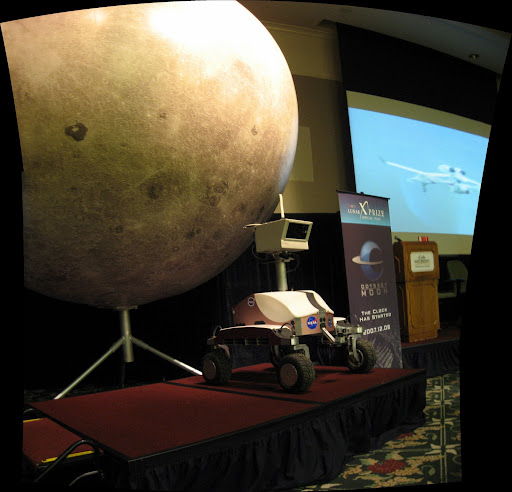
In a little toss to WALL-E's opening this past week, the Picture of the Week is a mock-up of what a Google Lunar X Prize rover might end up looking like (EDIT: See comments for the full skinny, but the good folks at Odyssey Moon Ltd. note this is an actual prototype, with the photo being from their media conference about being named the first Lunar X prize team. Thank you Mr. Richards for the comment and the further details :) ). Such a rover would have to be capable of completing a 'Mooncast', consisting of 360ยบ photos, both HD and near-real time video, and transmission of specific data in order for the competing group to earn the $20 million prize. Additional $5 million prizes can be earned by coming in second and/or completing additional challenges, such as roving certain distances and surviving a frigid lunar night.

I personally find the giant model of the moon there to left of it almost as exciting as anything else. Put me in the same room as that thing, and I'd be all over it.

Friday, May 2, 2008

Elevator to the Moon (and the Fountains of Paradise Along the Way)


"Elevator to the moon, whistling a favorite tune..."
-"Satellite" , by Guster

A concept supported/pioneered by the likes of Arthur C. Clarke (initially in his book The Fountains of Paradise, and that he considered to be the greatest part of his science legacy; he also described the idea of communications satellites....in 1945) and NASA itself as of late, the Space Elevator is a seemingly radical, and yet very real, alternative for transport into space.


It's pretty much as it sounds, functioning as an elevator that climbs upwards along a ribbon, a 22,000-mile-long cable or tether going straight up into a fixed position in orbit from an oceanic, equatorial location on the Earth's surface, allowing cheap and easy transport of all kinds of materials (or people) in a similar manner to a more typical elevator.


"What we're talking about is building the biggest thing...ever."
-Steven Steiner, MIT, in a
NOVA feature on the Space Elevator

Initially described as a concept in 1960 by a Russian engineer, Yuri Artsutanov, the recent (approx. 1991) discovery of carbon nanotubes (a material 10,000 times as thin as a human hair, but stronger than steel) provides a base for the actual design and construction of a space elevator. The concept is real enough for NASA to support an annual X prize-like contest to race prototypes, and for various companies to pop up that are taking the idea very seriously.

A space elevator would be far less expensive than space shuttles, despite the spectacular nature of it, even down to '100th or 1,000th' of the cost, particularly for the actual transport of goods per weight. The cost to build it would be around $10 billion, compared to $1.7 billion for one space shuttle, with a cost of $450 million to launch it each time. Not too bad, considering.

A space elevator would make population and transport of goods to Lunar and Martian colonies far easier, and could be constructed on the Moon itself for surface-orbit transport there.

Space elevators are an (as the amount of links here attests to) enormous concept/movement, with a lot of momentum behind it; almost as much as I've seen for lunar colonization itself. Any time private companies are investing themselves in an idea as large as this, that can be an indicator of the seriousness and imminent nature of a technology or concept. In other words, this could be something in the headlines before the end of the next President's administration.

Expect a lot of discussion here about the various aspects of the space elevator, and how they pertain to moon colonization and integration; perhaps, even, I'll manage to explore to topic personally at some point soon for you all.

Friday, April 11, 2008

Ashes to Ashes, Dust to Moondust

As many have heard through various news outlets lately, a company (Celestis) is now offering to send human remains to the Moon or the Moon's orbit. Celestis actually describes it universally as "Luna", e.g. the "Luna Service", which I guess sounds more romantic.

First thing I noticed with Celestis' Luna Service is it is through a partnership with Odyssey Moon, Ltd. and Astrobotic Technology, Inc., with the general lean being to go for the Google Lunar X Prize, worth a cool $30 million.

Commerical ventures to the Moon are, as you can tell, a reality, and in fact may very well be far more important in implications than any governmental effort. This ashes effort may go down as a large, early step down a historic and critical path.

For now, though, let's look at the practical matters of having our remains on and around Luna.

For an easy $10,000, you can have one gram of remains transported to the moon (or, as they note, attempted to be transported to; the remains get a free! re-flight if the mission fails). For two participants (e.g., husband/wife), or for more remains (7g instead of 1g), the cost is higher, up to $30,000 (well, $29,985).


As the Yahoo!/Reuters article linked above notes, Celestis projects 1,000 capsules will go on the first flight, with 5,000 on later flights. Half a dozen have already registered remains for the first flight. The service was inaugurated some time ago, in 1999, for the remains of Dr. Eugene Shoemaker. Celestis is itself a company of Space Services, Inc. which has already had other ventures, such as Name a Star.

The thing I wonder about personally with the remains is, where exactly are they headed? Looking at Earth's history with this kind of thing, and from my perspective of having recently finished my Bachelor's in Urban Studies and Planning...I respect the idea of putting remains on the Moon, but the track record for future respect to their location is not a pretty one (and so proper identification of their location becomes critical). And therein lies one of the first Lunar Environmental Planning issues: How, exactly, to prevent the resting place of these remains from being turned into a waste dump, or a base for a country or company unaware of the location's significance, or something else similarly inappropiate.

It seems like a no-brainer now that we'd be able to avoid something like that with such a high-profile and newsworthy venture, but mankind really is a race never to be underestimated, especially when we're building things.

Whenever we as a race get in a big rush to pioneer somewhere, the little things (like preserving the sanctity of people's remains) often get passed over in the excitement of the moment (just like Neil Armstrong's missing A). Let's see what we can do this time to make sure these little oversights remain a habit of mankind on just Earth, and not on other celestial bodies :)

For now, though, we have an exciting project to keep our eye on and to entertain our daydreams. And, really, who knows what they'll come up with next? :)