Showing posts with label Helium-3. Show all posts

Saturday, November 15, 2008

India's Chandrayaan Flags the Moon

I've been flagging "Chandrayaan" on a lot of my moon posts as of late, but now the Chandrayaan-1 has done me one better, flagging something itself: the Moon.

The craft's Moon Impact Probe, carrying the Indian Tricolour (pictured above) on its side, landed on the Moon on Friday, making India the fifth (or fourth; videos seems to state fourth, but that linked article from the India Times states fifth) world entity (after the U.S., Russia, Japan, and the 17-nation ESA) to reach the surface of the Moon.

That is a picture the Moon Impact Probe took before impact (from the India Times); the prode landed just 32km from the all-important Shackleton Crater near the South Pole, a very likely location for a future full-fledged colony or colonies (due to its rim being a Peak of Eternal Light, a.k.a. eternal solar power and other benefits). So its likely that future colonists (robotic or otherwise) will come across, or at least take field trips to, this Indian tricolor in the future :)

Below is a great video from CCTV on the Probe's landing, which rather interestingly, also confirms the active Indian interest in helium-3 (something not mentioned in the official ISRO Moon Impact Probe page):

Wednesday, November 12, 2008

Chandrayaan-1 Payload Feature #2: Sub KeV Atom Reflecting Analyser (SARA)

Today is the second in a series of features on each of India's recently-launched Chandrayaan-1's scientific payloads.

The Chandrayaan-1 lunar orbiter has 11 scientific instruments onboard to complete an array of measurements: five Indian instruments, and six from other nations and organizations (including the ESA and NASA). Today is the first look at one of the foriegn payloads: the Swedish Sub KeV Atom Reflecting Analyser (SARA).

Sub KeV Atom Reflecting Analyser (SARA)

SARA is a device mainly to study the magnetosphere (or in the case of the Moon, the lack thereof) and solar wind interactions with the lunar surface.

Developed through the ESA in collaboration with the Swedish Institute of Space Physics and the Indian ISRO's Vikram Sarabhai Space Centre, the payload itself is of Swedish development while the data processing unit is Indian.

Solar wind experiments were peformed on the lunar surface during many of the Apollo missions (11, 12, 14, 15, and 16); they analyzed the chemical components of lunar surface in relation to the solar wind, and found that the lunar surface had been enriched with atomic nuclei, including helium-3, a major motivator behind this current base race.

While details on the SARA's mission are vague, the impression that I get is that the SARA's additional solar wind analysis, going by the above connection between solar wind and the all-important helium-3, could yield interesting information regarding the chemical composition of the moon, possibly for mining purposes (helium and otherwise). So, perhaps, the result of this seemingly unassuming device could end up being commercially significant.

----

Check back within the next couple of days for the next feature, on another of the Indian payloads, as well as for any other updates on the moon mission's progress that may come along :). You can find the first payload feature (and all the features as they'll be posted) here.

Tuesday, October 28, 2008

Picture of the Week: Finally Got a Plasma

That is an image from the Korea Times (by way of Gizmodo) of the first plasma generated by South Korea 's KSTAR (Korea Superconducting Tokamak Advanced Reactor) fusion reactor.

The experiment back in June produced 2 1/2 times more plasma than anticipated, which was good news for the project and for other, similar projects, like the high-profile ~$7-14 billion ITER (International Thermonuclear Experimental Reactor) reactor being built in France.

Fusion power is considered a leading motivation for moon colonization, as a primary fuel for it (helium-3) is rare on Earth, but plentiful on the Moon. Seen as an ultimate power source, fusion power could be a solution to certain problems that may crop up in the next 50 years.

Last year, South Korea announced plans to launch a lunar orbiter in 2020 (similar to the craft just launched by India), so they could be getting ahead of the game with their early development of the fusion side of things.

Wednesday, October 22, 2008

India Launches Chandrayaan 1 Moon Mission (News)

Today, India's Indian Space Research Organisation (ISRO) successfully launched it's first lunar mission, the Chandrayaan 1.

An unmanned lunar explorer (a la Japan's Kaguya), the Chandrayaan-1 (which is "moon craft" in Sanskrit) is set to map lunar topography in 3D, creating (as the ISRO puts it) a "3D atlas" and notably, chemical mapping of the lunar surface.

While I haven't found any specific references to helium-3 in any Indian or other documentation of the Chandrayaan project, that prominent "chemical mapping" goal suggests that, like Russia, China, NASA, and others, India is seriously interested in the resource potential of the Moon.

The craft is carrying scientific payloads for six other organizations (check that link for specific pages for each one), including NASA, Europe's ESA, and Bulgaria's Space Research Institute.

This story got some big media play in the form of a huge front-page Drudge Report splash, with a huge picture of the Moon in the place usually reserved for the likes of Obama and McCain. Here's that spectacular image (which ran with an "INDIA TO THE MOON!" headline):


I'm a little surprised at the high-profile coverage, as this Indian mission isn't a whole lot different than JAXA's, which didn't appear to get quite the same sort of media push. I think this speaks to the sort of excitement the Base Race can generate, especially as the significant 2010-2020 decade pulls closer (and as things domestically get more and more grim in the meantime).

The Chandrayaan-1 mission is expected to last for two years, with Chandrayaan-2, a joint Indo-Russian moon rover venture, shooting for 2011.

Tuesday, October 7, 2008

NASA Chief Mike Griffin's Interesting 50th Anniversary Comments

Recently, Michael Griffin (Administrator, a.k.a the chief, of NASA) made some interesting comments to the Agency France-Presse (AFP) when discussing the 50th anniversary of NASA and NASA's current state:

"[Christopher Columbus] travelled for months and spent a few weeks in the Americas and returned home. He could hardly have said to have explored the New World. So we have just begun to touch other worlds."

-Mike Griffin, referring to Apollo 11's first walk on the Moon

Mr. Griffin went on to talk about how the explorers of the 15th century set out not knowing exactly what they'd find, and what value it would have. Griffin stated, "We can't prove today that we can exploit what we find to the benefit of humankind", though personally I beg to differ (and so do others more significant than me).

Griffin also expresses support for international cooperation, a subject that was a key contrast between the Obama and McCain space plans (with Obama's plan mentioning it often and McCain's plan never mentioning it).

"The space station is much bigger and better and more impressive and more productive as a result of the partnership with Canada, Russia, Europe, and Japan, than it would have been if we had done it ourselves."
-Mike Griffin

For some more interesting Mike Griffin interviews, check out this Popular Mechanics '10 tough questions' from 2007, and a Space.com grilling from about a month ago on the space shuttle program, changes to it, and the potential impact of that on Constellation. Seems like Mr. Griffin gets some tough gigs with these interviews, haha.

(Note: I think that 8.8mb portrait from NASA of Mr. Griffin is one of the largest images I have ever seen uploaded to the internet.)

Sunday, October 5, 2008

Eternal Flame? Phoenix Lander Lasting Longer Than Expected

NASA's robotic Mars lander, Phoenix, made news recently as it was snowed on. Let the Martian snowmen and snowball fights commence.

But, a subplot to this event and just as notable in the long run, is that the Phoenix lander has lasted much longer than anticipated.

Originally expected to last 90 Martian days (also known as "sols"; Martian hours, minutes, and seconds are 2.7% longer than Earth ones), the lander has operated for 120+. The Martian winter is settling in, and with the lander being at a pole, that means a long, cold dark and the probable end of the lander's lifespan.

Considering that everything from the $30 million Google Lunar X Prize up through Helium-3 mining and moon base surveying and construction will be completed by similar robotic rovers and other heroic robots, the fact that as high-profile a rover as the Phoenix has proven much more durable than anticipated is great news for any and all forthcoming efforts to integrate, and then colonize the Moon.

Rovers proving more durable means that everything on Luna will get explored, built on, and mined that much faster and more efficiently (and more efficiency itself speeds things up again by freeing up R+D, etc. cash). If rovers and other equipment prove to consistently outperform expectations like the Phoenix has, then the pace of the Moon's integration into our Earthbound society is going to get really wild.

The Phoenix lander's perserverance has shone a bright light of promise into the future of robotic Martian, Lunar, and other missions.

Saturday, October 4, 2008

Picture of the Week: Festival Coming Soon

That is that first Chinese photo of the Moon, taken by their Chang'e-1 (嫦娥一号) Lunar orbiter craft last year, as part of an imaging/exploration mission (including for concentrations of helium-3).

Check out this really interesting look from the China National Space Administration (CNSA) at the Chang'e-1 program and its goals, from the Chang'e project leader, Luan Enjie. He's exceptionally well-spoken-- here's a great interview where he talks about his take on the differences from this space race (that I refer to as the "Base Race") and the space rae of the 1950's and 60's.

The Chang'e program is named after the Chinese goddess of the moon, who (notably) only lives on the moon.

"The U.S. is the leader in deep space exploration."
-Luan Enjie, opening statement of his description of the Chang'e-1 program

The way the Chinese space program has been rolling along in the past year, I think we could be seeing a 'chang'e' to that fact in the very near future ;)

Tuesday, September 9, 2008

Picture of the Week: It's A Miner Thing, and They're a Miner King

From the University of Wisconsin-Madison's Fusion Technology Institute (by way of the European Space Agency) comes an artist's rendition of a Helium-3 miner.

Helium-3 is a resource that is rare on Earth, but plentiful on the moon. It's drawn a lot of interest, including officially from China and Russia, as the primary fuel for fusion power, which is something of the ultimate power source: clean and efficient, one shuttle's load of Helium-3 from the Moon would be roughly enough to power the United States for one year. And that's just one load!

While fusion probably won't turn up until around 2050, that's about the time we're expected to be running out of fossil fuels and potentially in need of a new energy source. So, the idea among Russia, China, the U.S., and potential commercial efforts would be to get a headstart on collecting the fuel by stockpiling it early, and developing some kind of dominance over the resource in order to gain leverage (and massive profits).

So, as a result, even though we might not be seeing fusion power itself for a while, we'll be seeing (and hearing about) miners like the one above much sooner.

Sunday, September 7, 2008

Google Lunar X Prize Shirt Contest Completed

The folks over at the X Prize Foundation just wrapped up a T-Shirt design contest for the Google Lunar X Prize.

I was never personally a fan of the old "Moon 2.0" shirts (with Moon 2.0 being the slogan of sorts for the Lunar X Prize), and I believe a strong brand could significantly amplify interest in the subject.

The new, winning design by Julian F. Bennett of Merritt Island, FL:


That meters diagram is awesome. And the second prize runner-up, by Claire A. Schaeffer of Clearwater, FL:


Expect me to me modeling that winning design on the streets of Portland (OR) in the near future... :)

If you're wondering more about Moon 2.0 and that brand, here's an informative (if mildly cheesy)video all about it (the bit about silicon and solar power is interesting...I was totally expecting that to be a helium-3 lead-up):


Thursday, September 4, 2008

"The Future of Urban Planning": The Moon?

I, your beloved blogger, am a recent graduate with my Bachelor's in Urban Planning, and part of why I started this blog (despite having a rather different background than your typical space enthusiast) is that I maintain that lunar colonization is, in fact, urban planning. My argument being, that the Moon's surface is now land for all intents and purposes, and therefore any colony/mine, infrastructure, or other utilization of its surface is land use; and land use planning is the core of urban planning. NASA, Roscosmos, the CNSA, etc. are all well into programs to complete substantial built environments on the Moon by 2030, and so this has become a timely subject.

Once in a while, I find that I am (in fact) not the only one who thinks about these things, and here's a case in point I came across today.

"In the future, these questions will likely be posed for cities that exist on the moon or Mars... You might think that such a city is unrealistic, but NASA has been planning a "city in the sky" for years."
-"HowStuffWorks" article on Urban Planning by William Harris

A Wired.com article chronicles NASA's 'recurring dream', with the first substantial and 'modern' looks (that included thoughts on industrialization of the moon, a key to current efforts) coming in 1972 and 1975.

Check out that HowStuffWorks article linked above, and keep an eye here for more and more content regarding just what the planning topics are for moon colonization in the next 10 years (the early phase) and beyond. :)

Monday, July 21, 2008

Magnetic Attraction

One concern that gets voiced about lunar colonization is the levels of radiation colonists could be exposed to, and how much of a threat that is (and whether there is sufficient methods of protection against it).

"We really need to know more about the radiation environment on the Moon, especially if people will be staying there for more than just a few days."
-Harlan Spence, astronomy professor at Boston University

Mapping out and investigating the levels of radiation is one the central goals of NASA's Lunar Reconnaissance Orbiter (LRO) mission, the first tentpole mission of the landmark Vision for Space Exploration/Constellation era.

Various remedies and shields have been suggested, including isolated magnetic fields (like Reiner Gamma, pictured above; these are speculated to be a result of crater- and other ejecta), spherical man-made shields (pictured below), and even the Earth itself.

I personally trust in human ingenuity to come up with something, and the lack of effects on the Apollo astronauts seems promising (though many seem to think that indicates the whole Apollo landing was actually a hoax). At the very least, the commercial motivation for a company to come up with something that could enable colonization (and therefore utilization of groundbreaking resources) could eventually (or very quickly) become too strong to be ignored.

To cap, here's a segment on the subject from a NASA video (Destination Tomorrow), courtesy of Youtube:

Saturday, July 12, 2008

MoonPop: "WALL-E" (News)

"Outlet Mall, coming soon!"
-A 'Buy N Large Corp'. billboard on the Moon, next to the American Flag at Mare Tranquillitatis, in the film "WALL-E"


I had a chance last week to finally catch Pixar's latest masterwork, "WALL-E". Much like with "Iron Man" earlier this summer, a movie that a whole heck of a lot of people ended up seeing happened to also be a movie with a look at the Moon; and in WALL-E's case, a look specifically at the Moon colonization and the potential outcomes of it.

It's a simple, and brief, moment in the film, but a memorable one: In a fly-by of the Moon, the site of the American flag in the Sea of Tranquility is seen as having a billboard adjacent to it advertising a future outlet mall (which, given the circumstances and setting of the film, the builders apparently never did get around to).

The placement of the sign directly next to the flag site could suggest that the fictional Buy N Large Corporation in the film was intending to plow right over the site for their new mall; or that they simply plopped that sign down there for attention.

The strange thing about all of this is that this isn't really that far from the truth, as things are developing now. The Sea of Tranquility is rich in Helium-3, a resource extremely rare on Earth but plentiful on the Moon that could be valuable for fusion power. So within 15-20 years, we could very well be seeing mining operations going up right next to the Apollo landing sites.

With the generation of kids seeing WALL-E today being the ones who will have the newscasts of their lives dominated by Moon colonization, it should be interesting to see how this one moment in an extremely visible film gets referenced and remembered, as commerical development of the Sea of Tranquility and the rest of the Moon becomes an imminent reality (and potentially, a major public debate).

Wednesday, May 14, 2008

We have "Land"-ing?

This budding era of Moon Colonization, like few eras in our history ever have before, brings up new frontiers not only in terms of land, but in ideas, concepts, and societal functions.

Now, wait-- "land"? A quick look at the Wikipedia entry for that lovable dry space we call home (mostly) brings up an interesting note:

"Land may refer to:
  • Land, the part of the Earth that is not covered by water "

That would lead one to believe that, since the surface of the Moon is in fact not part of Earth (or is it?), and therefore not a part of Earth that isn't covered with water, it doesn't technically have 'land'.

A quick field trip to Dictionary.com, though, reveals more:

"land /lænd/ –noun
1.
any part of the earth's surface not covered by a body of water; the part of the earth's surface occupied by continents and islands:
Land was sighted from the crow's nest.
2.
an area of ground with reference to its nature or composition:
arable land.
3.
an area of ground with specific boundaries:
to buy land on which to build a house.
4.
rural or farming areas, as contrasted with urban areas:
They left the land for the city.
5.
Law.
a.
any part of the earth's surface that can be owned as property, and everything annexed to it, whether by nature or by the human hand.
b.
any legal interest held in land. "

When talking about 'land' on the Moon, numbers 3 and 5 are the most relevant here: an area with specific boundaries, and the legal definition of...well, technically, that's defined there as Earth's surface. So we'll stick to number , and let the space law junkies duke it out over number 5.

So now that we've more or less established that land, as a concept, does exist on the Moon, what does that mean? So what?

Well, Mankind is about to gain an extra 3.793×10⁷ km² , or 0.074 Earths' worth of land. Mare Tranquillitatis alone is the size of the Phillipines (population: 92 million), never mind the entire surface of the Moon.

I got all excited to find a link in the Space Law article to a "Lunar Land Management Society", but came away with nothing but a broken link. But, Google provides victory!--A link that works. The site remains pretty barren, though (much like Luna herself). One valuable piece of information can be wrought from it, though: they're based out of the Mojave Space Port (or, were?).

The point here being, I'm not the only one who thinks lunar land management is not only a serious topic, but a timely and current one.

As a matter of fact, a little more digging reveals you can already be your very own Lunar land owner. That one surprised even me; even land in the Sea of Tranquility is supposedly available...which is rich in helium-3...which countries want. Their site has some amusing analysis of what happened with the 1967 UN Outer Space Treaty; that looks like a thick treaty, and something I'll have to cover in depth here another day.

For now, though, we can rest knowing that not only is the Moon 'land', it can already be bought. This, therefore, opens up the concept of Lunar land use and land use planning. Now, what end of the spectrum lunar land development ends up being on remains to be seen; and, in fact, could be decided by this very generation within the next decade. A little law and effort can go a long ways...

Saturday, April 26, 2008

The Resource of the 21st Century

"We will provide the most reliable report on helium-3 to mankind," Ouyang Ziyuan, the chief scientist of China's lunar program, told a Chinese newspaper. "Whoever first conquers the moon will benefit first."
--
Russian space geologist Erik Galimov told the Russian Izvestia newspaper that NASA's plan to colonize the moon will "enable the U.S. to establish its control of the global energy market 20 years from now and put the rest of the world on its knees as hydrocarbons run out."
--

Those quotes, from an article in Wired magazine by John Lasker, give you an idea of the seriousness of the race to mine helium-3 on the moon. As a matter of fact, helium-3 is a primary motivation for colonization of the moon in the first place.


Helium-3 is used in fusion power, seen as many (including Apollo 17 astronaut and former U.S. senator Jack Schmitt, the chairman of NASA's Advisory Council) as the ultimate fuel of the future. As the Artemis Project notes, once a fusion plant is up and running (France is hosting a test facility, and the technology is expected to be in use by 2050), one shuttle's worth of helium-3 would power the United States for an entire year. Mind you that this is without any greenhouse gases, or the risk of fission power. The perfect nuclear power (or energy resource of any kind), in other words.


Helium-3 is rare on earth, but plentiful on the Moon. Above is a map of Helium-3 on the Moon's surface, with a lot of it concentrated in Mare Tranquillitatis to the middle-right.

Both Russia and China have stated in various places that helium-3 is a motivation, and the quotes at the beginning here attest to their awareness of its importance.

Helium-3 is a critical element (excuse the pun) of mankind's efforts to colonize the moon this century, and could help solve a lot of problems. It's going to be a headline-maker and a focus of our energies for a long time, and you'll be hearing a lot more about it both here in the near future, and elsewhere over the long-term.

Friday, April 18, 2008

Atlas' Back: Mare Tranquillitatis


For the first edition of Atlas' Back, a semi-regular series of features touring selenographic features of the moon, we have ourselves a look at Mare Tranquillitatis: The Sea of Tranquility.

The name being the latin form of "Sea of Tranquility", Mare Tranquillitatis is the most famous of the Maria, the basaltic plains originally mistaken for actual seas by early astronomers (hence the name, which is latin for "seas"). The above map has the landing sites for Ranger 5, Apollo 11 (the first manned landing), Apollo 16, and Apollo 17 (the last manned landing up to this point) marked, illustrating the massive historical signifigance of this sea in the sky.

With the amount of attention and activity directed towards Mare Tranquillitatis, there's plenty of images to go around. A few visual highlights to give you a feel for the mare:


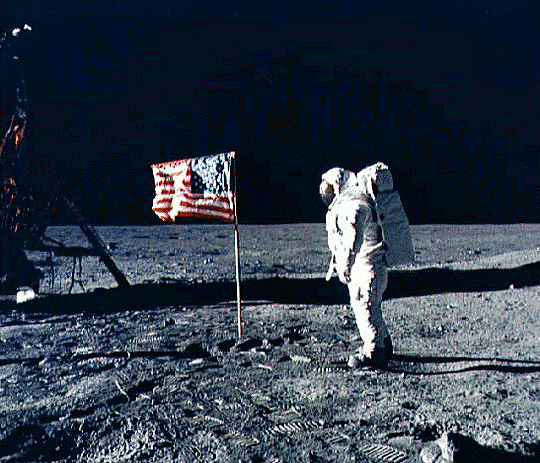
Buzz Aldrin on Mare Tranquillitatis.


A view of the mare from the window of the Apollo 11 lander, right after landing.


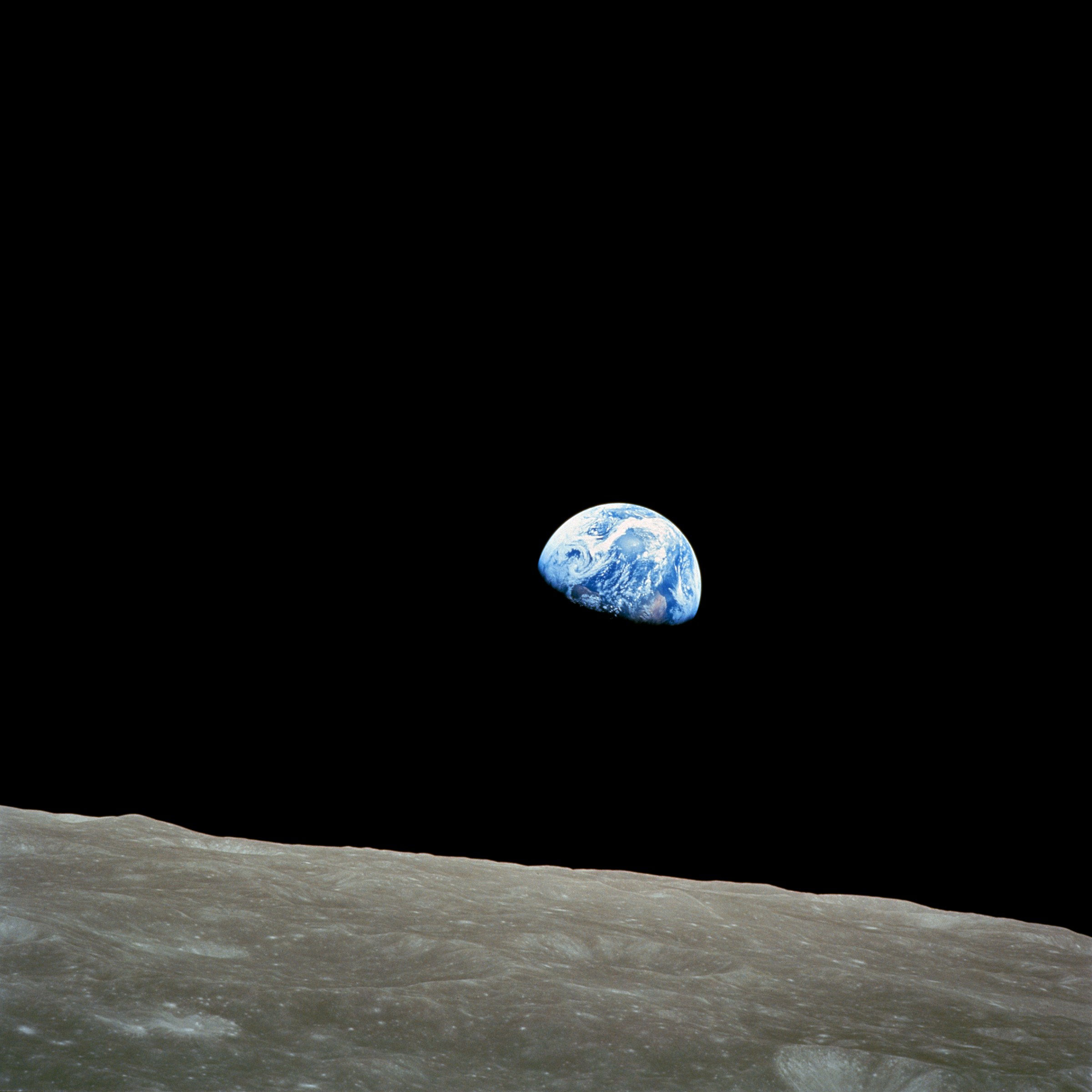
An Earthrise photo, taken from Apollo 11 prior to landing (different from the famous "Earthrise" photo, featured recently and significantly in the film "An Inconvenient Truth" and widely regarded as having helped found the environmentalism movement; that was taken from orbit during the earlier Apollo 8 mission).


From a distance; Mare Tranquillitatis is the expansive dark patch in the upper left there, with the Apollo 11 landing site being in the lower left corner, as can be seen clearly via the handy Google Moon (a Google Earth counterpart currently geared around the Apollo landings).

The mare is about 300,000 sq km (roughly the same size as the Phillipines), and as that bit of size research turned up, is apparently also a very good site for Helium-3, with (as that abstract notes) about 50% of the mare being minable. Though, my initial reaction here would be to think of Mare Tranquillitatis as a site for the moon's first protected historical park, and not, say, strip mining.

I hope you've enjoyed this brief tour of Mare Tranquillitatis; there's many more tours of this sort to come, both from me here, and from many others elsewhere, as this last photo below (of the mare) illustrates pretty well. Stay tuned for the next edition of Atlas' Back...

Thursday, April 17, 2008

The Roster Grows: Europe and India

In the midst of a little research, I discovered two more countries/efforts to add to the Base Race roster:

-Europe (European Space Agency)
-India (Indian Space Research Organization; check out that stylin' website!)

While both have projects underway for manned/unmanned missions, it is noted that I don't see a specific reference to lunar base plans. With all the other governments/governmental organizations making similar preliminary efforts (lunar orbiters, men on the moon around 2015-2016, etc.) also having an eventual base as part of their plans, though, it seems like bases for both the above organizations could be inevitable. Might as well build one while you're there, right? You've already made the effort to get there in the first place, so you can go ahead and mine yourself some nice souvenirs (for the folks back home) that can also happen to potentially power your country for an entire year.

So now we're up to the U.S. , China, Russia, India, Japan, Sweden, and Europe all joining in on the great big Lunar picnic that is the Base Race...and the party's just getting started.