Showing posts with label NASA. Show all posts

Friday, December 19, 2008

Bow?...Wow: NASA Lunar Pressurized Rover To Be Part of Obama Inaugural Parade (News)

An awesome (and rather adorable) news bit about the upcoming Jan 20th Obama Inaugural parade:


NASA's small pressurized rover concept is, according to a report from Keith Cowing at OnOrbit, going to participate in the parade, and will even crabwalk (pictured above doing so, via NASA's EDGE blog) and bow before the podium. A number of NASA folks will be there alongside the rover, and a suited astronaut will exit the vehicle and plant or carry a U.S. flag.

I cannot wait for video of this :D

For more information on the now-officially-awesome inaugural parade, check out the official site :)

Monday, December 15, 2008

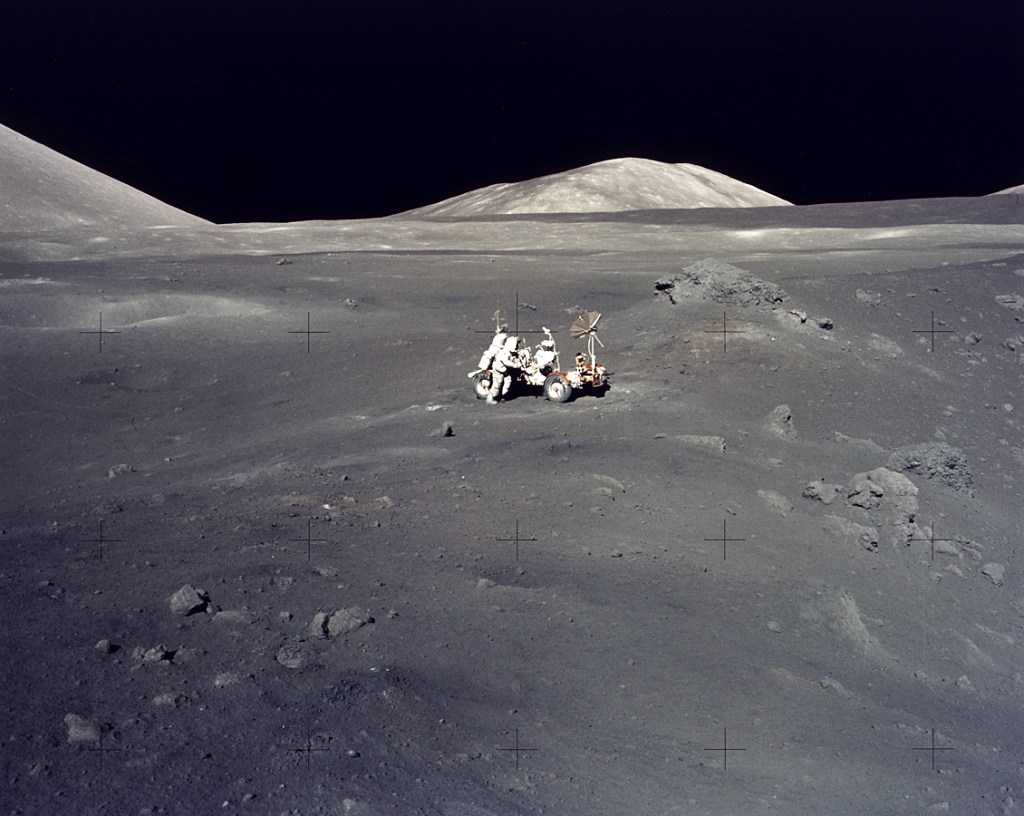
Picture of the Week: Sweet Seventeen

That is a NASA file image of astronaut Harrison "Jack" Schmitt (now an active supporter of helium-3 mining on the Moon) in Mare Serenitatis alongside he and Eugene Cernan's rover during the Apollo 17 mission, in which astronauts spent by far the most amount of time exploring the surface, roving for 21 miles instead of the hundreds of yards previous astronauts had been limited to.

Check out the selenographic landmarks of the mission on Google Moon (Luna's equivalent of Google Maps), and the great Discovery Channel documentary miniseries "When We Left Earth: The NASA Missions" includes a particularly neat (if brief) look at the mission.

The mission occured 27 years ago this week (December 7th-19th, 1972), and is the last time a man walked on the moon (until, of course, approximately 2020, when most likely a taikonaut will become the 13th man on the moon).

"As I take man's last step from the surface, back home for some time to come — but we believe not too long into the future — I'd like to just [say] what I believe history will record — that America's challenge of today has forged man's destiny of tomorrow. And, as we leave the Moon at Taurus-Littrow, we leave as we came and, God willing, as we shall return, with peace and hope for all mankind. Godspeed the crew of Apollo 17."
– Eugene A. Cernan, Apollo 17 Commander. Last man to walk on the moon, December 14, 1972.

Saturday, December 13, 2008

Griffin 'Strife' Report Update

An update on my last post about the OrlandoSentinel.com blog reporting strife between NASA's administrator Mike Griffin and the Obama space transition team, via Space.com:

"Today, Griffin replied, calling the charges "simply wrong."

"I am appalled by any accusations of intimidation, and encourage a free and open exchange of information with the contractor community," Griffin said. "I would like to reiterate what I have stated in a previous email to all NASA Officials: we must make every effort to 'lean forward,' to answer questions promptly, openly and accurately.""
-"NASA Chief 'Appalled' By Accusations He's Not Cooperating with Obama's Team ", Space.com Staff

For more info on Obama's space transition team, check out the official transition site, Change.gov.

Thursday, December 11, 2008

Strife Between NASA's Griffin and Obama Transition Over Constellation? (News)

A report from the Orlando Sentinel describes problems that are arising between the Obama space transition team (headed by a former associate administrator of NASA, Lori Garver) and the current NASA administrator, Mike Griffin:

"In a heated 40-minute conversation last week with Lori Garver, a former NASA associate administrator who heads the space transition team, a red-faced Griffin demanded to speak directly to Obama, according to witnesses.

In addition, Griffin is scripting NASA employees and civilian contractors on what they can tell the transition team and has warned aerospace executives not to criticize the agency’s moon program, sources said."
- "NASA has become a transition problem for Obama", by Robert Block, Orlando Sentinel

It's probably naive to assume that all government relations, especially in a transition where one's legacy could be at stake (Griffin's), are going to be peachy-keen and happy. High-level leaders are always going to have a certain amount of ego, and they're always going to clash (the films "Thirteen Days" and "W." demonstrate the White House Cabinet brand of this pretty well).

The article goes on to illustrate examples that suggest this strife is simply an example of that, and not indicative of actual problems with Constellation that the Obama team would have.

Obama has shown consistent support for Constellation, even getting involved with allowing the NASA purchase of Soyuz craft in the middle of the campaign (with help from Joe Biden), and the article from today mentions an idea from NASA that I think hits the nail on the head (and that I've talked about here before on my own): that the Obama administration “could take ownership of the [Constellation] program and ‘re-brand’ it as their own with minor tweaks.”"

With all the bad news about, the Obama administraion's going to need some good, inspirational PR, and the Constellation program could prove an excellent source for that.

And regardless, even if the Constellation program was (by some strange series of occurances) seriously delayed or cancelled, the probably more-relevant-anyways private sector will still be rolling along, and other countries are going to the Moon (and in my opinion, will win the 'Base Race' anyways; more motivation, with Apollo being 'old hat' here), so mankind's integration and colonization of the Moon will go on, with or without NASA.

Sunday, December 7, 2008

Chandrayaan-1 Payload Feature #4: Radiation Dose Monitor Experiment (RADOM)

Today is the fourth in a series of features on each of the Indian lunar orbiter Chandrayaan-1's scientific payloads. The Chandrayaan-1 has 11 scientific instruments onboard to complete an array of measurements: five Indian instruments, and six from other nations and organizations (including the ESA and NASA).

For this edition, we look at the Radiation Dose Monitor Experiment, or RADOM, which is from the Bulgarian Academy of Sciences.

Radiation Dose Monitor Experiment (RADOM)


The RADOM is essentially looking to get results (like those pictured above) on just how much radiation there is in lunar orbit and around the surface, so future moon missions have a clearer image if just how much radiation protection is needed.

Radiation is a serious problem for potential colonists, and as that article notes, NASA is including radiation experiments in its own lunar orbiter mission, the LRO (coming next year).

""We really need to know more about the radiation environment on the Moon, especially if people will be staying there for more than just a few days," says Harlan Spence, a professor of astronomy at Boston University."
-"Radioactive Moon", by Patrick L. Barry, NASA

The Apollo astronauts were never out in the radiation for long, so creative solutions are needed to shield long-term settlement. But, first, it needs to be known just how much radiation there is to shield from; and the RADOM is a big step towards that.

For all the full scientific details on the payload straight from the Bulgarians, check out this document. :)
----------
Keep checking back here for more payload features, Chandrayaan-1 news, and a complete wealth of updates and information about the base race, private space boom, and everything else with the true introduction of Man to Luna :)

Monday, November 24, 2008

Picture of the Week: A Mysterious Development...

This relatively unassuming rendering caught my eye when searching for something completely different (the International Lunar Network--features coming soon on that), and it was a small detail in the image that struck me, and sent me on a magical mystery tour of the web for more info:

Up on the carrier there, the label (in this NASA rendering) says:

Lunar Development Corporation.

As a 24-year-old with an Urban Planning degree, seeing such a particular phrase on a NASA rendering really got my attention. And what I've found has surprised me: this 'Lunar Development Corporation' could not only be a massive player in our colonization of the moon, but this reference on an official NASA image has proven to be highly mysterious.

A quick search on "lunar development corporation" dug up some gold (or helium-3, if you will):
  • A detailed paper on public-private partnerships (PPP), including the concept of a singular Lunar Development Corporation (I'll provide a full analysis of this paper as a marquee feature within the next two weeks);
  • A mildly dated (February 2007) article from Space.com on methods of solidifying public; investor; and other support for lunar plans, which it notes could (in part) be accomplished by instituting "a public-private lunar development corporation" (again, singular).

Among other things, mostly odds and ends.

This became extremely strange upon finding the original source of the image; I first encountered it via a mostly unrelated ThomasNet article. Then, after some digging based on the ThomasNet description, I found the image in the Wikipedia article on Moon Colonization.

Taking the hunt to NASA itself, a search for "lunar development corporation" on their main site turned up....nothing. Hmm. I then applied my method for finding that Wikipedia repeat of the image to NASA's new official images site, NASAImages.org, and found the image with a full (and revealing?) description.

The archived image's original source is this page, which has the same description alongside it.

That description is potentially very revealing, by just how unrevealing it is. Nowhere is the appearance of "Lunar Development Corporation" mentioned, as the brief text talks only about the rover and cargo lander.

A search on NASA's site for "lunar development corporation" turns up only a brief mention of "the new Houston-based Lunar Development Corporation" being listed as founded apparently by the Artemis Society's Gregory Bennett (a bio which does not mention this LDC in any form), and a Google or other search turns up no official site or mention of the entity in any form..

...yet it appears on the cargo lander on this official NASA image.

This may be explained by a small detail, from the end of the image's description:

"This image was produced for NASA by John Frassanito and Associates. Technical concepts from NASA's Planetary Projects Office (PPO), Johnson Space Center (JSC). "

Here's the website for John Frassanito and Associates, but a search for "Planetary Projects Office" and/or alongside "Johnson Space Center" turns up...nothing (except more concept images). NASA has a plethora of official sites for its various departments, but yet this Houston space center's "PPO" does, apparently, not.

A little more hunting at the Johnson Space Center site turns up a reference that the PPO became the "Planetary Missions and Materials Branch", a search for which, again, fails to turn up an official site. Searching the JSC's site brought up more odds and ends, including a newsletter (Lunar News issue number 62) from 1998, so it looks like "Planetary Mission and Materials Branch" may have been a name that was changed again, though to what, I'm not sure.

In fact, closer inspection of the original image's page confirms it is from 1994.

So after all that adventure, it may just be an old and outdated concept. Still, the prominence of the "Lunar Development Corporation" on the rendering (and others, it turns out), combined with the dual facts that the rendering is from "technical concepts, and the lack of mention of the Corporation in the image descriptions despite it being so readily apparent in them, suggest that "Lunar Development Corporation" was an element of the technical concepts not entirely intended to be released; e.g., an innocuous leak.

I'm going to do some further investigating, sending off some emails, and I'll post an update in the very near future about whether the Lunar Development Corporation could be something currently being worked on (as it is featured in concept images that are alongside much more current ones in the galleries). Stay tuned... :)

Thursday, November 20, 2008

New Orion Craft Test: Abort Motor

You know a test went well when it shot flames 100 feet into the air.


Especially when there was video of it:


That is the second (the first being back in April) test of the Orion craft's abort motor; the Orion being the successor to the Space Shuttle, and the craft that will get NASA astronauts back to the Moon (with the Altair serving as the lander).

Despite the spectacularly dangerous-looking results, the abort motor is actually a safety feature: it would direct the Orion craft away from the Ares rockets in the event of a launch malfunction.

Sunday, November 16, 2008

Picture of the Week: MoonOne, A Space Odyssey


That (by way of the Google Lunar X Prize site) is a new rendering of Odyssey Moon's competing lander, MoonOne.

Most details about MoonOne have been under wraps; recently, Odyssey Moon scored a partnership with NASA itself for technical support in the development of the craft.

Check out this neat MSNBC gallery for renderings of many of the other teams' crafts :)

Tuesday, November 11, 2008

Twilight Embers: Phoenix Mars Mission Ends

Months after it was originally anticipated to fall silent, and after discovering both ice and falling snow on Mars, the Phoenix lander has lost contact, and the mission has been declared completed.

Lasting five months, the lander was originally expected to last just 90 sols (martian days), until September 30th; the last communciation was on November 2nd.
A Martian sunrise in late August, marking the oncoming of the winter that eventually doomed the lander. [Photo from UniverseToday.com by way of NASA/JLP/UA)

The unexpected durability of the lander could be promising for the efforts of future landers and rovers, including lunar ones.

Check out the official NASA media page on Phoenix for videos recapping the mission.

A related note: The Mars explroation rovers, Spirit and Opportunity, are still kickin', after nearly five years (more than seventeen times longer than expected).

Considering how much longer 'than expected' both the Phoenix and the twin rovers have lasted, could it also happen that completion of lunar bases (being built by, of course, robots) will come much faster 'than expected' (with their construction workers potentially proving much hardier and productive workers than predicted)?

Saturday, November 8, 2008

Chandrayaan-1 Payload Spotlight #1: Terrain Mapping Camera (TMC)

Today is the first in a series of features on each of India's recently-launched Chandrayaan-1's scientific payloads.

The Chandrayaan-1 lunar orbiter (which just Saturday reached lunar orbit) has 11 scientific instruments onboard to complete an array of measurements: five Indian instruments, and six from other nations and organizations (including the ESA and NASA). Japan and China launched similar missions last year, but not with foreign instruments onboard.
This chart below, from the ISRO, shows what types of 'coverage' the payloads as a unit have:

As I cover each of the eleven payloads in individual posts over the next few weeks, I'm going to alternate between the Indian and foreign payloads.

Without further ado, here's your spotlight on the Terrain Mapping Camera (TMC).

Terrain Mapping Camera

An Indian instrument, the first payload being featured here was also the first one to be tested.

It's mostly as it sounds: a high-resolution camera that can take black and white photographs of the lunar surface (with a 5m spatial resolution--"the ability to distinguish between two closely spaced objects on an image"--in 20km swaths[PDF] ), with the intent to map the entire topography of the moon (including the dark side and the poles) at that 5m resolution; creating the most high-resolution, detailed map of the lunar surface to date. Such maps exist of Mars, but not of the Moon.

NASA's Lunar Reconaissance Orbiter (LRO) mission set for next year will have similar, if more powerful, camera and mapping systems. These kinds of maps will clearly be useful for the planning stages of the eventual lunar colonies and for other efforts.

The power of the TMC could well be enough to finally settle one thing for NASA ahead of time, though: it could photograph the Apollo and other NASA craft on the Moon's surface, hopefully putting all those conspiracy theories to rest. :)

Here's a picture from the ISRO of the TMC itself:


And, last but not least, one of the test images the camera took of Earth (high resolution here):


For every technical detail you ever wanted to know about the TMC, see this PDF.

Check back within the next couple of days for the next feature, on one of the Chandrayaan-1's foreign payloads, as well as for any other updates on the moon mission's progress that may come along :)

Wednesday, November 5, 2008

What President Obama Means for Moon Colonization and Private Space Policy (Immediate Action?)

A few months back I did an in-depth analysis of Barack Obama's detailed space plan, but now that he is officially the President-Elect of the United States (and therefore, given the timing of his term, one of the most important figures ever in mankind's integration and colonization of the moon; it is within his first four-year term that the Google Lunar X Prize should be won, and that Astrobotic alone has 6 lunar surface missions planned), it's time to take a look at what change he might bring on early on in his administration.

One thing Obama's space plan detailed that we could see forming perhaps even before he takes office, is the return of the National Aeronautics and Space Council (here's an obviously in-progress Wiki article on it's previous incarnations, which were from 1953-1973 and 1989-1993; beyond that, online background is lacking).

"There is currently no organizational authority in the Federal government with a sufficiently broad mandate to oversee a comprehensive and integrated strategy and policy dealing with all aspects of the government's space- related programs, including those being managed by NASA, the Department of Defense, the National Reconnaissance Office, the Commerce Department, the Transportation Department, and other federal agencies."
-Barack Obama's Space Plan

The Council was a White House entity to help coordinate these sorts of agenices, something that is arguably needed more now than it was in the Space Race era, with the booming private space sector (from Armadillo and Astrobotic to Odyssey Moon and Virgin Galactic, with numerous inbetween) being around, as Obama puts it, to "amplify NASA's reach":

"In achieving this vision, Obama will reach out to include international partners and to engage the private sector to amplify NASA's reach. Obama believes that a revitalized NASA can help America maintain its innovation edge and contribute to American economic growth."
-Paragraph 3 of the Obama Space Plan

As has been much discussed, economic growth is something America could use right about now, and so having a council that strengthens coordination of private and government space efforts (something already underway, an example being the agreement between Odyssey Moon and NASA announced just last week) could in turn, strengthen the role in a recovering American economy of a thriving space sector. The council would greatly amplify the 'amplification of NASA's reach'.

"And that's a major debate I'm going to want to convene when I'm president of the United States. What direction do we take the space program in?"
-Barack Obama, on a couple of occasions on the campaign trail

An interesting blog post from an Obama supporter on the official Obama site talked about the idea of a new National Space Council from a political and practical perspective:

"A National Space Council could be critical to advancing such interagency issues on climate change, space communications, technical innovation, and the commercial uses of space. ...We are missing opportunities because no agency is charged with helping space industries in the way that the Federal government helped the infant aviation industry before World War II."
-Blog post by Gary Oleson on the official Obama campaign site

His post also notes that historically, the National Space Council was chaired by the Vice President; Vice President-Elect Joe Biden was as recently as October involved directly in Obama's space policy, as the sponsor of a waiver to allow the U.S. to buy Soyuz craft from Russia until the Orion craft is ready, something Obama spoke in favor of and then became involved with. Biden also was outspoken as a space advocate in the last days of campaign (though I'm sure Florida had something do to with that).


With Obama already starting to put his Cabinet together, we could see movement on the new National Space Council's creation within the next few weeks and months. The space program certainly is something hopeful and inspiring that Obama could mix in with all the grim challenges, which would be politically invaluable, especially if there's a lot of emphasis on the possibilities of lunar policy (with the Moon, of course, visible to every American on a regular basis as an impromptu symbol of hope).

Keep an eye here for frequent updates as Obama's presidential space policy begins to take even further shape, and check out my original analysis of his space plan for more details on that.

Friday, October 31, 2008

Odyssey Moon Announces NASA Partnership (News)

Right on the heels of Astrobotic's big announcement of the details of their commerical missions, there's big news out of Odyssey Moon, Ltd., another Google Lunar X Prize competitor and major private lunar venture.

Odyssey Moon put forth a media release announcing a deal between them and NASA, with Odyssey Moon paying NASA for technical support on their MoonOne (M-1) Google Lunar X Prize mission. This agreement was reached through a Reimbursable Space Act Agreement, signed at the Ames Research Center in Silicon Valley. As that above link notes, the difference between a 'reimbursable' and a 'non-reimbursable' Space Act Agreement is whether or not there is a transfer of funds from the private entity (here, Odyssey Moon) to NASA, with NASA providing "data, facilities and services to the paying entity."

An important element of the agreement is that Odyssey Moon will then "share its technical data from its engineering tests and actual lunar missions with NASA", as the release puts it. So in exchange for getting initial support from NASA, Odyssey Moon's operational (and efficiency, a crutch of the value of the private space sector) knowledge will be utilized by NASA it it's own colonization efforts.

Leonard David over at LiveScience.com had the inside scoop on the agreement; check out his blog post for neat insider tidbits from his own experiences at Ames and from elsewhere.

Sunday, October 26, 2008

NASA Test Driving New Small Pressurized Rover in Arizona (News)

That is a NASA image (from their EDGE blog) of their Black Point, Arizona test driving yesterday of their lunar Small Pressurized Rover concept.

In a lava-field area with many geologic similarities to the lunar surface, the new rover roared into action at speeds up to 6 mph, designed with leather seats and bunks with the ability for astronauts to take the vehicle on two-week trips. The vehicle includes "suitports" (see at right, image also from NASA's EDGE blog), allowing the astronauts to enter and exit the rover without having to bring the suits (and the potentially dangerous dust clinging to them) in.

"Dust is the No. 1 environmental problem on the moon."
-Harrison "Jack" Schmitt, Apollo 17 astronaut (Wired.com dust article)

This is where the name "Small Pressurized Rover" comes in--the cabin being pressurized is what allows the astronauts to not have to wear the suits inside.

The testing has been going on for a week with day-long rides (sounds like fun), with the big test coming up in a three-day jaunt, largely to test the comfort of the vehicle (sorry, no wet bar).

Check out NASA's official page for their trademark really huge pictures and more details (including some great informational PDFs with even more images, and a short video, embedded below via Youtube:)

Sunday, October 19, 2008

Space Knights? Virgin Territory for the Pentagon

The Times Online has a story today about the Pentagon planning a "spaceplane" that could deliver troops (or supplies) to an emergency zone within four hours.

Codenamed "Hot Eagle", the craft is designed closely off of Virgin Galactic and Scaled Composites' WhiteKnight craft, which Burt Rutan carried to a collection of the $10 million Ansari X Prize in 2004.

A government picking up on a private spacefaring design is an interesting precedent. Barack Obama, in his space plan, talked of using the private sector to "amplify NASA's reach"; but this is a whole another level of interaction between government and private enterprise (and it's happening already!).

The Pentagon hopes to have these craft in use within 11 years (2019). Check out the article for a lot more of the details and background.

One interesting angle (excuse the pun): these same craft could fly someone commercially from London to Sydney in four hours. Now that's executive class.

Thursday, October 16, 2008

Bush Signs New NASA Authorization Act: One More Shuttle, Faster Orion (News)

Today, President Bush signed into law a new NASA Authorization Act with some interesting folds in regards to NASA's development, especially in regards to the Space Shuttle program.

The act authorizes $20.2 billion for NASA, including funding for an additional space shuttle flight , originally planned for retirement in 2010.

The gap between the shuttle's retirement and the first flights of the Orion craft in 2014-2015 has created some concern, with the Russian Soyuz being the main stopgap option; recently, a measure was passed in Congress to allow NASA to purchase Soyuz craft (instead of having to piggyback); an interesting side note is that the Soyuz purchase waiver was something that Barack Obama discussed and then became involved with, with his running mate Joe Biden being the sponsor of the waiver. NASA's future is clearly attracting some high-profile attention lately.

The new authorization act also calls for $1 billion in additional funding to accelerate the Orion program.

For the full text of the act, check out the always dependable SpaceRef.com's posting of it here.

Tuesday, October 7, 2008

NASA Chief Mike Griffin's Interesting 50th Anniversary Comments

Recently, Michael Griffin (Administrator, a.k.a the chief, of NASA) made some interesting comments to the Agency France-Presse (AFP) when discussing the 50th anniversary of NASA and NASA's current state:

"[Christopher Columbus] travelled for months and spent a few weeks in the Americas and returned home. He could hardly have said to have explored the New World. So we have just begun to touch other worlds."

-Mike Griffin, referring to Apollo 11's first walk on the Moon

Mr. Griffin went on to talk about how the explorers of the 15th century set out not knowing exactly what they'd find, and what value it would have. Griffin stated, "We can't prove today that we can exploit what we find to the benefit of humankind", though personally I beg to differ (and so do others more significant than me).

Griffin also expresses support for international cooperation, a subject that was a key contrast between the Obama and McCain space plans (with Obama's plan mentioning it often and McCain's plan never mentioning it).

"The space station is much bigger and better and more impressive and more productive as a result of the partnership with Canada, Russia, Europe, and Japan, than it would have been if we had done it ourselves."
-Mike Griffin

For some more interesting Mike Griffin interviews, check out this Popular Mechanics '10 tough questions' from 2007, and a Space.com grilling from about a month ago on the space shuttle program, changes to it, and the potential impact of that on Constellation. Seems like Mr. Griffin gets some tough gigs with these interviews, haha.

(Note: I think that 8.8mb portrait from NASA of Mr. Griffin is one of the largest images I have ever seen uploaded to the internet.)

Wednesday, September 24, 2008

Former Director of Kennedy Space Center Joins Odyssey Moon (News)

Odyssey Moon, Ltd. (a high-profile 'private commercial lunar enterprise', and the first official team that was announced for the Google Lunar X Prize) has announced through a media release that Jay Honeycutt, former Director of the Kennedy Space Center, has joined their team as their director of U.S. operations.

"I believe the private sector has an important role to play in a permanent lunar program and Odyssey Moon has put together some pretty impressive people and plans to help make this happen. We look forward to working with NASA and other space agencies as both partners and customers in this effort.”
-Jay Honeycutt

That quote from the media release reminds me of what Barack Obama suggested in his space plan-- 'amplifying NASA's reach' with the private sector. Mr. Honeycutt there is speaking along much the same lines.

Other lunar enterprise companies, such as Astrobotic (also a Google Lunar X Prize contestant), express serving as a partner for government (as opposed to, say, strictly commercial) as part of their goals and general gameplan. It should be interesting to watch as NASA and the private sector mix and mingle further, and to see to what extent NASA ends up partnering with the private sector (and what positive impacts that could have, especially in an era of a lagging economy and potentially squeezed government budgets).

Friday, September 19, 2008

Picture of the Week: Pinch Us

Yes, the Moon Colonization Picture of the Week is of Federal Reserve Chairman Ben Bernanke, President George W. Bush, Secretary of the Treasury Henry Paulson, and Securities and Exchange Commission (SEC) Chairman Christopher Cox. This might not seem on-topic at first, but unfortunately, it very much could be.

The event pictured is the announcement of the financial rescue package being put into place to stabilize the struggling American economy.

This package could potentially become extremely relevant (and rather ominous) to NASA, as this rescue could end up costing the government upwards of a trillion dollars, which in turn could then end up limiting government spending for some time. This crisis, as a result, could then become an eventual bane to NASA's rather large amount of funding (and the particularly pricey Constellation program).

Luckily, there's still other nations and plenty of private enterprise rolling along towards the Moon, so even if NASA takes a hit, the lunar surface should be plenty busy for some time to come. And as a matter of fact, Barack Obama's space plan suggests he may attempt to utilize the private space sector as a way to spur the economy back out of this slump, and so in the end, the American space focus may simply shift, rather than slump; as any slack lost by a NASA spending decline could be readily picked right back up by American private enterprise.

It will be interesting to see how the unfolding of this rescue package ends up shifting America's impact on the base race and the future of development on the Moon.

Thursday, September 4, 2008

"The Future of Urban Planning": The Moon?

I, your beloved blogger, am a recent graduate with my Bachelor's in Urban Planning, and part of why I started this blog (despite having a rather different background than your typical space enthusiast) is that I maintain that lunar colonization is, in fact, urban planning. My argument being, that the Moon's surface is now land for all intents and purposes, and therefore any colony/mine, infrastructure, or other utilization of its surface is land use; and land use planning is the core of urban planning. NASA, Roscosmos, the CNSA, etc. are all well into programs to complete substantial built environments on the Moon by 2030, and so this has become a timely subject.

Once in a while, I find that I am (in fact) not the only one who thinks about these things, and here's a case in point I came across today.

"In the future, these questions will likely be posed for cities that exist on the moon or Mars... You might think that such a city is unrealistic, but NASA has been planning a "city in the sky" for years."
-"HowStuffWorks" article on Urban Planning by William Harris

A Wired.com article chronicles NASA's 'recurring dream', with the first substantial and 'modern' looks (that included thoughts on industrialization of the moon, a key to current efforts) coming in 1972 and 1975.

Check out that HowStuffWorks article linked above, and keep an eye here for more and more content regarding just what the planning topics are for moon colonization in the next 10 years (the early phase) and beyond. :)

Monday, September 1, 2008

Picture of the Week: Oh, Chute!

That is the result of a recent NASA test of its Orion craft's (Orion being the replacement for the Space Shuttle) recovery-landing parachutes.

According to NASA's report on the failed test, the parachutes on the actual craft worked fine, but the parachutes used to set up the test (e.g., the simulation) failed, causing the craft to fall faster than desired and resulting in what I'm sure was a lovely and distinctive "thump".

Apparently this is a pretty common type of failure, and doesn't represent a serious setback (though it did succeed in producing entertaining photos and video...and not to mention a lot of coverage).

Yes, video: