The X PRIZE Foundation has done an excellent job with their media on the prize so far, and they're getting better all the time; keep an eye on that channel and their blog.
Personally, between a teleport and a jetpack, if that teleporter's safe, it's teleporter all the way for me :)
Today is the one-year anniversary of the announcement of the first Google Lunar X PRIZE team, Odyssey Moon (with the Google Lunar X PRIZE itself having been announced in August of last year).
It's also the 25th anniversary of my birth (haha), possibly a large part of why I remember the date ;)
Check out the Google Lunar X PRIZE's excellent and increasingly active Youtube channel here, as well as their excellent Launch Pad blog.
Most details about MoonOne have been under wraps; recently, Odyssey Moon scored a partnership with NASA itself for technical support in the development of the craft.
A few months back I did an in-depth analysis of Barack Obama's detailed space plan, but now that he is officially the President-Elect of the United States (and therefore, given the timing of his term, one of the most important figures ever in mankind's integration and colonization of the moon; it is within his first four-year term that the Google Lunar X Prize should be won, and that Astrobotic alone has 6 lunar surface missions planned), it's time to take a look at what change he might bring on early on in his administration.
One thing Obama's space plan detailed that we could see forming perhaps even before he takes office, is the return of the National Aeronautics and Space Council (here's an obviously in-progress Wiki article on it's previous incarnations, which were from 1953-1973 and 1989-1993; beyond that, online background is lacking).
"There is currently no organizational authority in the Federal government with a sufficiently broad mandate to oversee a comprehensive and integrated strategy and policy dealing with all aspects of the government's space- related programs, including those being managed by NASA, the Department of Defense, the National Reconnaissance Office, the Commerce Department, the Transportation Department, and other federal agencies." -Barack Obama's Space Plan
The Council was a White House entity to help coordinate these sorts of agenices, something that is arguably needed more now than it was in the Space Race era, with the booming private space sector (from Armadillo and Astrobotic to Odyssey Moon and Virgin Galactic, with numerous inbetween) being around, as Obama puts it, to "amplify NASA's reach":
"In achieving this vision, Obama will reach out to include international partners and to engage the private sector to amplify NASA's reach. Obama believes that a revitalized NASA can help America maintain its innovation edge and contribute to American economic growth." -Paragraph 3 of the Obama Space Plan
As has been much discussed, economic growth is something America could use right about now, and so having a council that strengthens coordination of private and government space efforts (something already underway, an example being the agreement between Odyssey Moon and NASA announced just last week) could in turn, strengthen the role in a recovering American economy of a thriving space sector. The council would greatly amplify the 'amplification of NASA's reach'.
"And that's a major debate I'm going to want to convene when I'm president of the United States. What direction do we take the space program in?" -Barack Obama, on a couple of occasions on the campaign trail
An interesting blog post from an Obama supporter on the official Obama site talked about the idea of a new National Space Council from a political and practical perspective:
"A National Space Council could be critical to advancing such interagency issues on climate change, space communications, technical innovation, and the commercial uses of space. ...We are missing opportunities because no agency is charged with helping space industries in the way that the Federal government helped the infant aviation industry before World War II." -Blog post by Gary Oleson on the official Obama campaign site
With Obama already starting to put his Cabinet together, we could see movement on the new National Space Council's creation within the next few weeks and months. The space program certainly is something hopeful and inspiring that Obama could mix in with all the grim challenges, which would be politically invaluable, especially if there's a lot of emphasis on the possibilities of lunar policy (with the Moon, of course, visible to every American on a regular basis as an impromptu symbol of hope).
Keep an eye here for frequent updates as Obama's presidential space policy begins to take even further shape, and check out my original analysis of his space plan for more details on that.
Odyssey Moon put forth a media release announcing a deal between them and NASA, with Odyssey Moon paying NASA for technical support on their MoonOne (M-1) Google Lunar X Prize mission. This agreement was reached through a Reimbursable Space Act Agreement, signed at the Ames Research Center in Silicon Valley. As that above link notes, the difference between a 'reimbursable' and a 'non-reimbursable' Space Act Agreement is whether or not there is a transfer of funds from the private entity (here, Odyssey Moon) to NASA, with NASA providing "data, facilities and services to the paying entity."
An important element of the agreement is that Odyssey Moon will then "share its technical data from its engineering tests and actual lunar missions with NASA", as the release puts it. So in exchange for getting initial support from NASA, Odyssey Moon's operational (and efficiency, a crutch of the value of the private space sector) knowledge will be utilized by NASA it it's own colonization efforts.
"Astrobotic will robotically explore the Moon’s high-interest areas on a commercial basis, collecting information required to design future outposts and to answer scientific questions about the Moon and Earth." -David Gump, President of Astrobotic, from their announcement
As part of the announcement, Astrobotic released a White Paper (a 'white paper' being an a report or guide that addresses problems and how to solve them, typically seen in business and politics) detailing their program and goals.
In addition to their initial effort for the $20 million Lunar X Prize, TranquilityTrek (which, as David Gump told Space.com for their article today, was "very clear" that it was "going to cost more to win the prize than the prize itself"), Astrobotic will follow with five more missions:
Rovers and landers are pretty commonplace ideas, but the 'dozer' was a new one to me. With some digging (excuse the pun), I found an example: NASA's Lunar Chariot prototype, which could build roads, dig trenches, or even mine minerals. There's even some video of it in action, kicking ass and taking names on Earth:
The White Paper has oodles of details on their exact mission plans, particularly the diagram on page 3.
With the X Prize TranquilityTrek slated for Q2 2010, they've got their South pole scout (headed for the rim of Shackleton Crater, long considered a prime location for a moon colony) shooting for Q3 2011, with two more missions (a North Pole scout and a 'Moon Quake 1" seismic and weather collection mission at Shackleton) set for 2012 and an Ice Surveyor mission going deep into Shackleton itself, followed by the Lunar Dozer mission also at Shackleton Rim, both being conducted in 2013.
So, for Astrobotic alone, that's 6 total lunar missions in the next four years. Exciting times. And this, of course (and as the White Paper notes), is just the initial slate. Most or all of the rovers will include HD video broadcasting, it sounds like, so we'll all have a front row seat, to boot.
The general goal of the missions is to build a data library to facilitate other organizations' (e.g., NASA; Barack Obama, in his space plan, talked of "amplifying NASA's reach" with the private space sector) and companies' missions with information for sale, such as detailed terrain maps, allowing future colonial efforts to simply buy the information from Astrobotic at a lower cost that it would take for the efforts to collect the data themselves.
Check out that 4-page White Paper and Astrobotic's site for the full skinny on their efforts, and keep an eye here for frequent updates and analysis as they (and other similar companies, such as fellow Google Lunar X Prize competitor Odyssey Moon, Ltd.) progress rapidly towards their mission slate :)
Still, it was an exciting event and a great first day, with Armadillo Aerospace taking home the $350,000 prize with a successful flight and TrueZer0 getting a launch off (which, as you'll see in the video below from the actual craft, didn't end as well as it started:)
Keep an eye here at Luna C/I for future event coverage as the private space boom and Base Race continue to take shape :)
Of the nine teams to enter the contest, two managed to make it to the point of actually getting flights in at the Challenge: Armadillo Aerospace and TrueZer0 (check out my previous post for short profiles on each).
A congrats to Armadillo Aerospace as, third time being the charm this year (after competing the last two years), they won the $350,000 prize with a successful flight (check out that Space.com/MSNBC article for a full skinny on their frustrations, including a lot of clock problems, many due to the aforementioned venue change to Las Cruces airport).
"Color me quite frustrated on several counts." -John Carmack, Armadillo Aerospace founder/lead engineer, and co-founder of iD software (makers of Doom, Quake), to Space.com
TrueZer0 gets something of an underdog prize, though, despite not qualifying for a prize with their Level One flight: they were already only the fourth competitor ever to get their craft off the ground (and that's ever, including in test flights), and they had entered the competition very late. Bad news, though, in that their craft (while making it into the air) crashed and burned after 18 seconds, being lost completely.
There's a completely awesome recap from the X Prize Foundation of Day 1 up on Youtube today, embedded below for your enjoyment:
For Day 2 coverage, there's a live blog by Leonard David at LiveScience chronicling the events as they happen, and of course there's the live webcast with chat and much narration by Dr. Peter Diamandis, Chairman and CEO of the X Prize Foundation (which as you see with the video above, is itself really interesting, to see such a wealth of dialogue from an important figure in the private space boom). As TrueZer0 was only entering Level One competition, it's all the Armadillo show today as they go for the big one, the Level Two prize (landing on difficult lunar surface-like terrain).
Check back for more link-a-riffic coverage here as the weekend rolls on... :)
The competition, taking place at Holloman Air Force Base in Alamogordo, New Mexico, challenges competing teams to successfully simulate an lunar orbit-to-surface trip, launching into the air and landing at a specified location and then making a return trip. The prize at stake is $2.5 million, making this the first of NASA's Centennial Challenges to have a multi-million dollar purse.
There are nine teams set to compete, and the entire event will be webcast live, which should be a blast to watch. The X Prize Foundation's got a fun little Matchups feature up to compare the teams and their offerings, and I'll post a closer-profile look at all the teams later this week as things ramp up for the event.
In another Google Lunar X Prize related note, Astrobotic Technology (one of the teams competing) recently did a significant revamp of their site, including nifty features. Hate to sound almost like an ad, but there's tons of info there now.
They do a good job of talking about their technological development, including their new blog with pics and descriptions of various elements of their craft, and their Lunar X Prize team page has this neat video on their camera testing:
As the Lunar X Prize's requirements state the grand prize goals must be met by 2012 (with the final, any-prize-at-all date being the end of 2014), the Lunar X Prize is going to be a central topic here at Luna C/I over the short-term. Expect to see a lot more features and updates on all the teams in the coming weeks, months, and years here :)
Independence-X Aerospace, a Malaysia-based team with a goal to "Transform Malaysia into a developed space country by the year 2020", and
Omega Envoy, the effort of the Florida-based not-for-profit Earthrise Space, Inc., founded by a group of students and professionals to help reestablish Florida's status as a space hub.
Both teams expresssimplicity as a key of their efforts to get a Mooncast and the other objectives completed.
It'll be fun to watch this X Prize ramp up in the next couple of years, as it could be remembered as something of a 'Shot Heard 'Round the World' for Lunar integration (perhaps that panoramic view in the requirements could be 'The Shot Seen 'Round the World'? :) ).
But, a subplot to this event and just as notable in the long run, is that the Phoenix lander has lasted much longer than anticipated.
Originally expected to last 90 Martian days (also known as "sols"; Martian hours, minutes, and seconds are 2.7% longer than Earth ones), the lander has operated for 120+. The Martian winter is settling in, and with the lander being at a pole, that means a long, cold dark and the probable end of the lander's lifespan.
Considering that everything from the $30 million Google Lunar X Prize up through Helium-3 mining and moon base surveying and construction will be completed by similar robotic rovers and other heroic robots, the fact that as high-profile a rover as the Phoenix has proven much more durable than anticipated is great news for any and all forthcoming efforts to integrate, and then colonize the Moon.
Rovers proving more durable means that everything on Luna will get explored, built on, and mined that much faster and more efficiently (and more efficiency itself speeds things up again by freeing up R+D, etc. cash). If rovers and other equipment prove to consistently outperform expectations like the Phoenix has, then the pace of the Moon's integration into our Earthbound society is going to get really wild.
The Phoenix lander's perserverance has shone a bright light of promise into the future of robotic Martian, Lunar, and other missions.
Their Falcon 1 craft successfully made it into orbit on what is actually the fourth attempt by SpaceX (kudos to their perserverance and pioneering spirit). Here's a video (with raw sound, but incredible visuals) of the launch, including images from the Falcon 1 itself:
With SpaceX's goal to "reduce the cost and increase the reliability of space access by a factor of ten", this (combined with other recent efforts) is a huge sign that a private space boom really is coming, and coming fast. This is a historic step, amazingly coming right on the heels of events like the Chinese spacewalk. It's been an incredible couple of weeks.
Of course, orbit is just the beginning. Once we've got a private space boom in full swing (or even before), there'll be more than just a few private efforts with their eyes fixed on the Moon.
"I believe the private sector has an important role to play in a permanent lunar program and Odyssey Moon has put together some pretty impressive people and plans to help make this happen. We look forward to working with NASA and other space agencies as both partners and customers in this effort.” -Jay Honeycutt
That quote from the media release reminds me of what Barack Obamasuggested in his space plan-- 'amplifying NASA's reach' with the private sector. Mr. Honeycutt there is speaking along much the same lines.
Other lunar enterprise companies, such as Astrobotic (also a Google Lunar X Prize contestant), express serving as a partner for government (as opposed to, say, strictly commercial) as part of their goals and general gameplan. It should be interesting to watch as NASA and the private sector mix and mingle further, and to see to what extent NASA ends up partnering with the private sector (and what positive impacts that could have, especially in an era of a lagging economy and potentially squeezed government budgets).
I was never personally a fan of the old "Moon 2.0" shirts (with Moon 2.0 being the slogan of sorts for the Lunar X Prize), and I believe a strongbrand could significantly amplify interest in the subject.
The new, winning design by Julian F. Bennett of Merritt Island, FL:
That meters diagram is awesome. And the second prize runner-up, by Claire A. Schaeffer of Clearwater, FL:
Expect me to me modeling that winning design on the streets of Portland (OR) in the near future... :)
If you're wondering more about Moon 2.0 and that brand, here's an informative (if mildly cheesy)video all about it (the bit about silicon and solar power is interesting...I was totally expecting that to be a helium-3 lead-up):
While McCain's plan is only about a third of the length of Obama's (989 words to 3,486), there's still enough information and context that can be discerned from it to give an idea of what a McCain administration's space policy could shape up to be like.
Batting leadoff is this first-sentence statement : "For the past 50 years, space activities have contributed greatly to US scientific discovery, national security, economic development, and national innovation, pride and power." The placement of "national security" second on that list is notable, and not a surprise given McCain's military background.
The plan goes on to briefly discuss Sputnik, the reaction to it, and how that led to a dominance in American science and technology, noting: "The end of the Cold War and the space race has greatly reduced the profile of space exploration as a point of national pride...", creating a "degree of 'mission-rut'" for NASA.
After noting "Much of our communications infrastructure is dependent upon space based assets that are essential to the quality of our everyday lives and the economy", the report goes on to detail how China, Russia, India, Japan and Europe are all "active players" in space exploration.
McCain then writes briefly about the increasing activity in the commerical sector and mentions the Google Lunar X Prize and space tourism, specifically noting the "importance of investments in key industries such as space to the future of our national security, environmental sustainability, economic competitiveness, and national pride as a technological leader"; again, a distinct foreign policy lean with national security being first on the list and "competitiveness" and "pride" being in there also.
An entire paragraph is devoted to discussion of the following quote regarding the Nixon administration's mulling of the cancellation of Apollo and non-approval of the Space Shuttle:
"[That policy] ...would be confirming in some respects a belief that I fear is gaining credence at home and abroad: That our best years are behind us, that we are turning inward, reducing our defense commitments, and voluntarily starting to give up our super-power status and our desire to maintain world superiority."
McCain then states, rather significantly, that "Three and a half decades later this seems equally valid, if not more so given the increased number of countries that are making significant investments in space."
The report then concludes with a little on McCain's contributions to the space program as a Senator and on NASA's current policies and projects.
McCain's last statement about Weinberger's quote, combined with the foreign policy leaning of the plan, clearly illustrates that McCain sees Constellation and the rest of NASA's programs as key to American international standing, prestige, and competitiveness.
This is somewhat of a contrast to Obama's plan, which has a focus that is notably more domestic, primarily discussing the private sector. A perhaps even more notable contrast is that while Obama's plan discusses international cooperation quite a bit, it is something that is not mentioned a single time in McCain's plan.
The differences in the two plans are fascinating, and more than I would have expected, illustrating that this is definitely a subject that both candidates take very seriously, and that they both have their own distinctive styles towards handling.
That is an official JAXA (Japan Aerospace Exploration Agency) rendering of their lunar orbiter Kaguya (formerly SELENE; the new name is derived from the name of a lunar princess in the oldest surviving piece of Japanese fiction, The Tale of the Bamboo Cutter), which completed much of its operations (namely visual documentation, including amazing HD video of Luna's surface, which can be viewed here) in 2007.
A main facet of the Google Lunar X Prize's award conditions is the completion of a 'Mooncast', including HD video, from the surface of the moon, representing something of a next step forward from what JAXA's Kaguya carried forward from Apollo.
For a remarkably thorough and neat examination of the Kaguya craft itself, see this Discovery Channel profile on it.
All three pieces give an interesting (and more intimate than is typical) view into the commercial venture aspect of colonization, which falls under what one could call the integration of the moon into our societies. The private sector reaching the moon may well become more significant that the actual governmental colonization efforts, as far as the Moon's presence and influence in our daily lives; and it's happening a lot sooner.
"In 2020 the moon is going to be part of our human society, of our economic sphere. Human beings will be there. I think the private sector will outpace governments for a while, but the governments will be working in concert and we will be establishing a moon base, prospecting for resources, we'll be trying to understand how we can utilize the moon for the benefit of life on Earth." -Bob Richards, from a CNN interview
Check out all three pieces as linked above, especially the three-and-a-half minute "The Reality of Space" feature. It's some of the highest-quality material I've come across, and is a great preview of what I'm sure will be a flood of constant coverage over the next twenty years and beyond, as well as an interesting (albieit brief) portrait of an important figure in the integration process.
I have now, as you see, emerged out of the blogging stone age and have figured out how to embed videos in here. (It wasn't hard.)
The gentleman speaking in the video is Sergey Brin, co-founder of Google, talking about the Google Lunar X Prize and sort of the inspirations and motivations for the sponsorship/prize.
Talking to people I know and always getting blanks on Moon Colonization/Integration, I sometimes forget that important people are out there that take this seriously, and it's not as fringe as my other interestssometimes are, despite the seemingly 'radical' nature of the subject. So, it's always a cool and interesting reminder to see someone like a Sergey Brin, a Stephen Hawking, or a John McCain actually out there talking about this.
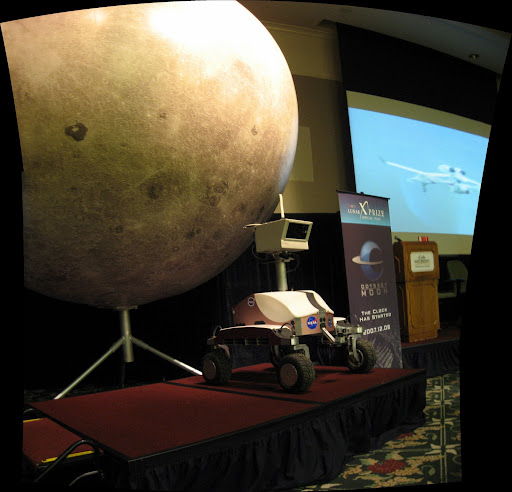
In a little toss to WALL-E's opening this past week, the Picture of the Week is a mock-up of what a Google Lunar X Prize rover might end up looking like (EDIT: See comments for the full skinny, but the good folks at Odyssey Moon Ltd. note this is an actual prototype, with the photo being from their media conference about being named the first Lunar X prize team. Thank you Mr. Richards for the comment and the further details :) ). Such a rover would have to be capable of completing a 'Mooncast', consisting of 360º photos, both HD and near-real time video, and transmission of specific data in order for the competing group to earn the $20 million prize. Additional $5 million prizes can be earned by coming in second and/or completing additional challenges, such as roving certain distances and surviving a frigid lunar night.
I personally find the giant model of the moon there to left of it almost as exciting as anything else. Put me in the same room as that thing, and I'd be all over it.


 Expect me to me modeling that winning design on the streets of Portland (OR) in the near future... :)

 Posts
Posts