Showing posts with label Orion (craft). Show all posts

Thursday, November 20, 2008

New Orion Craft Test: Abort Motor

You know a test went well when it shot flames 100 feet into the air.


Especially when there was video of it:


That is the second (the first being back in April) test of the Orion craft's abort motor; the Orion being the successor to the Space Shuttle, and the craft that will get NASA astronauts back to the Moon (with the Altair serving as the lander).

Despite the spectacularly dangerous-looking results, the abort motor is actually a safety feature: it would direct the Orion craft away from the Ares rockets in the event of a launch malfunction.

Wednesday, November 5, 2008

What President Obama Means for Moon Colonization and Private Space Policy (Immediate Action?)

A few months back I did an in-depth analysis of Barack Obama's detailed space plan, but now that he is officially the President-Elect of the United States (and therefore, given the timing of his term, one of the most important figures ever in mankind's integration and colonization of the moon; it is within his first four-year term that the Google Lunar X Prize should be won, and that Astrobotic alone has 6 lunar surface missions planned), it's time to take a look at what change he might bring on early on in his administration.

One thing Obama's space plan detailed that we could see forming perhaps even before he takes office, is the return of the National Aeronautics and Space Council (here's an obviously in-progress Wiki article on it's previous incarnations, which were from 1953-1973 and 1989-1993; beyond that, online background is lacking).

"There is currently no organizational authority in the Federal government with a sufficiently broad mandate to oversee a comprehensive and integrated strategy and policy dealing with all aspects of the government's space- related programs, including those being managed by NASA, the Department of Defense, the National Reconnaissance Office, the Commerce Department, the Transportation Department, and other federal agencies."
-Barack Obama's Space Plan

The Council was a White House entity to help coordinate these sorts of agenices, something that is arguably needed more now than it was in the Space Race era, with the booming private space sector (from Armadillo and Astrobotic to Odyssey Moon and Virgin Galactic, with numerous inbetween) being around, as Obama puts it, to "amplify NASA's reach":

"In achieving this vision, Obama will reach out to include international partners and to engage the private sector to amplify NASA's reach. Obama believes that a revitalized NASA can help America maintain its innovation edge and contribute to American economic growth."
-Paragraph 3 of the Obama Space Plan

As has been much discussed, economic growth is something America could use right about now, and so having a council that strengthens coordination of private and government space efforts (something already underway, an example being the agreement between Odyssey Moon and NASA announced just last week) could in turn, strengthen the role in a recovering American economy of a thriving space sector. The council would greatly amplify the 'amplification of NASA's reach'.

"And that's a major debate I'm going to want to convene when I'm president of the United States. What direction do we take the space program in?"
-Barack Obama, on a couple of occasions on the campaign trail

An interesting blog post from an Obama supporter on the official Obama site talked about the idea of a new National Space Council from a political and practical perspective:

"A National Space Council could be critical to advancing such interagency issues on climate change, space communications, technical innovation, and the commercial uses of space. ...We are missing opportunities because no agency is charged with helping space industries in the way that the Federal government helped the infant aviation industry before World War II."
-Blog post by Gary Oleson on the official Obama campaign site

His post also notes that historically, the National Space Council was chaired by the Vice President; Vice President-Elect Joe Biden was as recently as October involved directly in Obama's space policy, as the sponsor of a waiver to allow the U.S. to buy Soyuz craft from Russia until the Orion craft is ready, something Obama spoke in favor of and then became involved with. Biden also was outspoken as a space advocate in the last days of campaign (though I'm sure Florida had something do to with that).


With Obama already starting to put his Cabinet together, we could see movement on the new National Space Council's creation within the next few weeks and months. The space program certainly is something hopeful and inspiring that Obama could mix in with all the grim challenges, which would be politically invaluable, especially if there's a lot of emphasis on the possibilities of lunar policy (with the Moon, of course, visible to every American on a regular basis as an impromptu symbol of hope).

Keep an eye here for frequent updates as Obama's presidential space policy begins to take even further shape, and check out my original analysis of his space plan for more details on that.

Thursday, October 16, 2008

Bush Signs New NASA Authorization Act: One More Shuttle, Faster Orion (News)

Today, President Bush signed into law a new NASA Authorization Act with some interesting folds in regards to NASA's development, especially in regards to the Space Shuttle program.

The act authorizes $20.2 billion for NASA, including funding for an additional space shuttle flight , originally planned for retirement in 2010.

The gap between the shuttle's retirement and the first flights of the Orion craft in 2014-2015 has created some concern, with the Russian Soyuz being the main stopgap option; recently, a measure was passed in Congress to allow NASA to purchase Soyuz craft (instead of having to piggyback); an interesting side note is that the Soyuz purchase waiver was something that Barack Obama discussed and then became involved with, with his running mate Joe Biden being the sponsor of the waiver. NASA's future is clearly attracting some high-profile attention lately.

The new authorization act also calls for $1 billion in additional funding to accelerate the Orion program.

For the full text of the act, check out the always dependable SpaceRef.com's posting of it here.

Monday, October 13, 2008

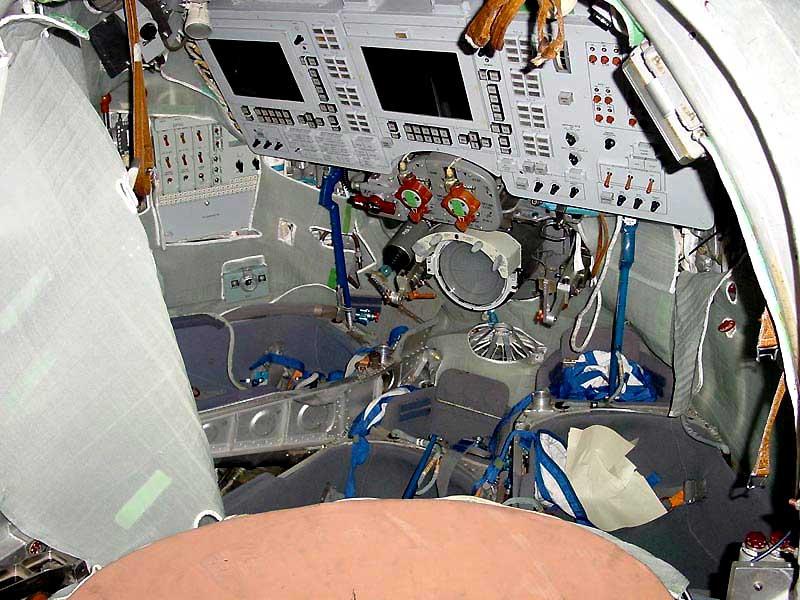
Picture of the Week: So You's Comfortable In There?


That is the interior of the Russian Soyuz craft, that is currently in the news for carrying the 6th space tourist, video game developer (and son of an astronaut) Richard Garriott, to the International Space Station for a few weeks (a trip that has it's own web site).

The Soyuz, once the space shuttle is retired in 2010, will actually be the vehicle American astronauts will have to hitch a ride on (or, as appears to be the case now, the craft NASA will be buying from he Russians for our use) to get to the ISS and into space in general until the development of the Orion craft is completed.

For more on space tourism, check out Space.com's whole section on it.

Monday, September 1, 2008

Picture of the Week: Oh, Chute!

That is the result of a recent NASA test of its Orion craft's (Orion being the replacement for the Space Shuttle) recovery-landing parachutes.

According to NASA's report on the failed test, the parachutes on the actual craft worked fine, but the parachutes used to set up the test (e.g., the simulation) failed, causing the craft to fall faster than desired and resulting in what I'm sure was a lovely and distinctive "thump".

Apparently this is a pretty common type of failure, and doesn't represent a serious setback (though it did succeed in producing entertaining photos and video...and not to mention a lot of coverage).

Yes, video:

Tuesday, August 12, 2008

NASA abandons accelerated Orion 2013 plan (News)

Yesterday, it was announced that NASA was abandoning its idea for an ambitious, accelerated launch of its next-gen Orion spacecraft, pushing back the date a year. While the announced launch date is March of 2015, they were hoping to get the craft up and launched as soon as 2013; now they are looking an an internal date of 2014 (with the 'announced' launch date still sitting pretty on 2015).

The Orion craft seats 4-6 astronauts (with the current Space Shuttle typically carrying 7), and is the craft planned to carry NASA's astronauts to the Moon (with Orion being launched by the Ares rockets, subsequent to a seperate launch of the lunar lander, Altair; both craft have been spotlighted here recently). Meanwhile, other nations have their own equivalents brewing...

Wednesday, July 23, 2008

Russian/European Joint, Manned Spacecraft Design Unveiled (News)

The replacement for the oft-used Russian Soyuz craft was unveiled today, and it is a joint project by the European Space Agency and the Russian Federal Space Agency(Roscosmos):


Designed by Russian space firm RKK Energia, this is a craft planned to be used for lunar missions, effectively being the counterpart to NASA's Ares/Orion lunar-mission tag team (which I profiled briefly here at Luna C/I back in May). In NASA's case, the Ares is the launch module and the Orion the manned portion; this new craft is a manned craft, with the launch vehicle undetermined and (as noted in the linked BBC news article) possibly being either an entirely new vehicle or a modified existing Russian rocket.

The Russian-European plans to collaborate are not a set-in-stone agreement, and so the ESA does have a backup plan to continue should the partnership with Roscosmos fall through. Still, it's promising to see signs of this sort of high-level collaboration working, as opposed to, say, tense and outright competition that could lead to cynical (perhaps silly?) 'war in space' scenarios. In my view, if there's a time for humanity to start moving on from the more petty social-geopolitical problems of Earth, this is it. Do we really need to go start churning out terms like "lunapolitical conflict"?

But, for the time being, we have developments like this tentative Euro-Russian agreement (and other cooperation efforts) to nudge things towards what I see, at least for now, as a positive direction.

Friday, May 23, 2008

Picture of the Week: What's in a Name?

That is the vessel with which NASA's Constellation astronauts will launching efforts towards the Moon, and eventually, Mars. The Ares rocket, with Ares I carrying the crew and Ares V carrying the cargo, is the first replacement for the Space Shuttle (which launched both cargo and crew at once). The Ares is the launch vehicle, with the spacecraft per se being the Orion.

Ares, the god, interestingly is (as Wikipedia puts it): "...more accurately the god of savage warfare, or bloodlust, or slaughter personified". Lovely. I perhaps might have chosen a, ah...more diplomatic name for the vehicle launching our space efforts, though the choice technically comes from Ares' Roman alter ego/incarnation: Mars, the warrior god, a form in which he was more honored in society (second only to Jupiter, in fact). Fun fact: the month of March is named after Mars.

Hopefully our efforts on the Moon and Mars have a lot more truth and introspection than bloodlust and slaughter personifed ("That's no moon...").