Saturday, May 31, 2008

Picture of the Week: Who Needs Video

The above is an animated GIF from NASA'a Phoenix Lander, brought to you from the lovely locale of Mars. A robotic arm deploying may not always the most exciting thing in the world--or, err, solar system?--, but coming straight from another planet, it's pretty neat. (For a bunch more images from the lander, see here).

Part of the Google Lunar X Prize requirements for a qualifying victory are to send back images and data (including HD video) from the Moon; what they call a "Mooncast".

"MOONCAST: The Mooncast consists of digital data that must be collected and transmitted to the Earth composed of the following:
• High resolution 360º panoramic photographs taken on the surface of the Moon;
• Self portraits of the rover taken on the surface of the Moon;
• Near-real time videos showing the craft’s journey along the lunar surface;
• High Definition (HD) video;
• Transmission of a cached set of data, loaded on the craft before launch (e.g. first email from the Moon).
Teams will be required to send a Mooncast detailing their arrival on the lunar surface, and a second Mooncast that provides imagery and video of their journey roaming the lunar surface. All told, the Mooncasts will represent approximately a Gigabyte of stunning content returned to the Earth."

I note that they actually require a self-portrait of the rover in all of that. So, little things like that GIF above are going to be big things for many folks in the coming years :)

Thursday, May 29, 2008

A 'World Wind' Tour

I discovered the other day, and installed last night, a stellar program for anyone interested in off-Earth colonization, selenology/selenography (and their Martian equivalent, areology), and coolness in general: NASA's World Wind. (Note: it's unfortunately Windows-only at the moment...*Nick's bad childhood memories of limited Mac software recur*...).

Very similar to Google Earth, but with that NASA touch and focus, the program lets you look at Earth, the Moon, Mars, Jupiter, Venus, and the Sloan Digital Sky Survey (SDSS) in that familiar Google Earth-esque interactive globe fashion. You can spin Mars around like an intergalactic DJ or, as is most relevant here, peer down at all kinds of features our beloved Luna, labeled and all.

The Lunar globe as it appears in the program.

A look at Mare Tranquillitatis and its color-coded features; yellow being craters, etc.

I'll admit the Lunar globe is actually the iffy-est of the globes, despite the abundance of labeled features; it's a little hole-ridden, especially on the Dark Side (understandably), and also rather noticably around the poles (and thus including some of the most important colonial features, like Shackleton and Malapert).

Still, it's an awesome and easy-to-use program (screenshots are a breeze, as you see above), and it's got its own giant Wiki to support it (the official site seems severely out-of-date beyond the download, and I believe the Wiki is why). The Mars globe is a blast, and all in all it's a fascinating adventure of a program you could spend a lot of time enveloped in.

Wednesday, May 28, 2008

A Phoenix + Ice = ?

Three days ago (May 25th), NASA's Phoenix lander made it safely to the surface of Mars; specifically, the north polar region (where water ice was discovered to be chillin' back in 2005).

Like the features of the Moon, the north polar region of Mars has a Latin name: Planeum Borem (insert "Bore 'em" joke/pun here), which means simply 'The Northern Plain". Below is a mosaic of this northern region from, appropiately enough, the Viking spacecraft:


You're probably thinking "Yeah, NASA and all, but what's this got to do with colonization of the Moon?"

Well, as far as having water at the poles, Mars may have company. The key word, though, seems to be "may": efforts such as NASA's Lunar Prospector and Europe's SMART-1 have not turned up any clear evidence. Third time may be the charm, though (or at least that's NASA's idea): the Lunar Reconaissance Orbiter (LRO; launching November 24th, 2008) has a primary goal of finding water, along with even more critical research regarding lunar landing sites and radiation study.

As that Space.com AP article above notes, though:

"...the only way to know for sure is to send a human or robot. 'You've got to go down and stick your finger in it, so to speak,' he [Alan Binder, the director of the Lunar Research Institute] said."

With Mars, that obviously seems to be their plan. While Mars has the possibility of past life tied to its water, the main motivation to discover water on the Moon is to plan for the possibility of future life (though water could simply be imported, especially if a space elevator is around to reduce the cost of getting it off Earth).

As the 6-month Phoenix surface mission unfolds, it should be interesting to see what lessons can be gleaned from it for similar poking around on the Moon.

Friday, May 23, 2008

Picture of the Week: What's in a Name?

That is the vessel with which NASA's Constellation astronauts will launching efforts towards the Moon, and eventually, Mars. The Ares rocket, with Ares I carrying the crew and Ares V carrying the cargo, is the first replacement for the Space Shuttle (which launched both cargo and crew at once). The Ares is the launch vehicle, with the spacecraft per se being the Orion.

Ares, the god, interestingly is (as Wikipedia puts it): "...more accurately the god of savage warfare, or bloodlust, or slaughter personified". Lovely. I perhaps might have chosen a, ah...more diplomatic name for the vehicle launching our space efforts, though the choice technically comes from Ares' Roman alter ego/incarnation: Mars, the warrior god, a form in which he was more honored in society (second only to Jupiter, in fact). Fun fact: the month of March is named after Mars.

Hopefully our efforts on the Moon and Mars have a lot more truth and introspection than bloodlust and slaughter personifed ("That's no moon...").

Wednesday, May 21, 2008

Mare Tranquilitatis Fact Sheet: Zuh?

In a past bout of research on the Sea of Tranquility, I came across this fact sheet.

It starts off easy enough: "Mare Tranquillitatis sits within the Tranqillitatis basin." Simple, and eponymous.

Then you happily trudge along to the next line and... "The mare material within the basin consists of basalt in the intermediate to young age group of the Upper Imbrian epoch." Whoa!
What did they just say?

A point-by-point analysis:

"Mare" is a basaltic lunar plain; basalt being a type of volcanic rock that gives the maria a bluish tint. "Upper Imbrian" refers to the Lunar geologic timescale, and a period of it that occured ~3500 million years ago; Upper Imbrian is the fourth period, with Pre-Nectarian, brief Nectarian, and Lower Imbrian periods preceding and the Eratosthenian and Copernican ages following.

Those are some crazy paragraphs even within the Wikipedia articles; I see a "Lunar geologic timsescale: Cliffs Notes edition" post in this blog's future.

But, for now, the next section of this fact sheet:

"The surrounding mountains are thought to be of the Lower Imbrian epoch, but the actual basin is probably Pre-Nectarian."

So the basin is older than the mountains around it. Interesting.

"The basin has irregular margins and lacks a defined multiple-ringed structure."

...What? A search and dictionary/encyclopedia search turns up nothing definitive on the meaning of "irregular margins"; "multiple-ring structure", though, comes up with this upon a search: "In the largest craters, the centre may rise and fall more than once leading to mulitple ring structure." So they are saying Tranquilitatis does not have this multiple-ring structure, which by the mere mention of this fact suggests that is unusual (as it 'lacks' it).

"The irregualr (sic) topography in and near this basin results from the intersection of the Tranquillitatis, Nectaris, Crisium, Fecunditatis, and Serenitatis basins with two throughgoing rings of the Procellarum basin."

So this basin is apparently kind of screwy due to a bunch of basins coming together, within the rings of Procellarum, also known as Oceanus Procellarum. Procellarum is the mother of lunar maria, covering 4 million square kilometers and (as we've seen here) encompassing, at least partially, smaller maria like Tranquilitatis.

The fact sheet goes on to talk about a "Palus Somn" , which is both a crazy-cool name and apparently a typo, as it is supposed to be "Palus Somni" (which translates to 'Marsh of Sleep' from Latin, which is an even more crazy-cool name for a place). A picture, below:


This Marsh of Sleep is 143 km (~88-90 miles or so) wide, with the whole mare Tranquilitatis being about the size of The Phillipines or New Zealand.

I'll start wrapping my head around that geologic timetable, and I'll get back to you all in the future with that in plain English...but, for now, you have a better understanding on some level of that rather blunt fact sheet :)

Sunday, May 18, 2008

MoonPop: Finders Keepers

A different hallway of pop culture for ya today...

This week's feature is one way to wear your Lunar-American patriotism on your sleeve. Literally.


In a bizarre twist, in saving that "Finders Keepers" image above to my images folder for this blog, it happened to be saved in such a way that in gallery view, it's right next to the very picture it happens to be based off of (which I had saved as 'flag_pose'). I've only got about 20 pictures in there, what are the odds it'd end up next to the exact pose? Or even having that particular photo in there from a different post in the first place? Talk about a freak of alphabetizing.

Friday, May 16, 2008

Picture of the Week: Rock Bottom


The above is a small crater near the Apollo 11 landing site on Mare Tranquilitatis. I find this picture to be, I guess ironically, Earth-y in an interesting way: more than many moon surface pictures I've seen, I can almost feel like what it'd be to scramble around on that incline. That sky is beautiful; I'm wondering what that little faded streak of blue at the top is...

You can find more pictures from Apollo 11 here, straight from NASA.

Thursday, May 15, 2008

Land Follow Up: Purchasing Bologna

At the end of the previous post, I came across Moon land for sale at, in theory, the only 'legitmate' seller of Moon real estate among many, many competitors.

A little investigation suggests the whole concept may be moot due to the vagueness of the relevant space law in the first place, and the potential for that to basically change suddenly and render any deeds (even the 'legitimate' ones that weren't ridiculous in the first place) meaningless.

So, with apologies to Ellen Degeneres, purchasing moon land at the moment may not be the greatest idea, at least until the related laws get settled more definitively (it would probably suck to buy up moon land, only to have it taken through eminent domain or, say, Chinese/Russian/Japanese/Indian/European invasion or occupation).

At the very least, though, the Martians are still selling.

Wednesday, May 14, 2008

We have "Land"-ing?

This budding era of Moon Colonization, like few eras in our history ever have before, brings up new frontiers not only in terms of land, but in ideas, concepts, and societal functions.

Now, wait-- "land"? A quick look at the Wikipedia entry for that lovable dry space we call home (mostly) brings up an interesting note:

"Land may refer to:
  • Land, the part of the Earth that is not covered by water "

That would lead one to believe that, since the surface of the Moon is in fact not part of Earth (or is it?), and therefore not a part of Earth that isn't covered with water, it doesn't technically have 'land'.

A quick field trip to Dictionary.com, though, reveals more:

"land /lænd/ –noun
1.
any part of the earth's surface not covered by a body of water; the part of the earth's surface occupied by continents and islands:
Land was sighted from the crow's nest.
2.
an area of ground with reference to its nature or composition:
arable land.
3.
an area of ground with specific boundaries:
to buy land on which to build a house.
4.
rural or farming areas, as contrasted with urban areas:
They left the land for the city.
5.
Law.
a.
any part of the earth's surface that can be owned as property, and everything annexed to it, whether by nature or by the human hand.
b.
any legal interest held in land. "

When talking about 'land' on the Moon, numbers 3 and 5 are the most relevant here: an area with specific boundaries, and the legal definition of...well, technically, that's defined there as Earth's surface. So we'll stick to number , and let the space law junkies duke it out over number 5.

So now that we've more or less established that land, as a concept, does exist on the Moon, what does that mean? So what?

Well, Mankind is about to gain an extra 3.793×10⁷ km² , or 0.074 Earths' worth of land. Mare Tranquillitatis alone is the size of the Phillipines (population: 92 million), never mind the entire surface of the Moon.

I got all excited to find a link in the Space Law article to a "Lunar Land Management Society", but came away with nothing but a broken link. But, Google provides victory!--A link that works. The site remains pretty barren, though (much like Luna herself). One valuable piece of information can be wrought from it, though: they're based out of the Mojave Space Port (or, were?).

The point here being, I'm not the only one who thinks lunar land management is not only a serious topic, but a timely and current one.

As a matter of fact, a little more digging reveals you can already be your very own Lunar land owner. That one surprised even me; even land in the Sea of Tranquility is supposedly available...which is rich in helium-3...which countries want. Their site has some amusing analysis of what happened with the 1967 UN Outer Space Treaty; that looks like a thick treaty, and something I'll have to cover in depth here another day.

For now, though, we can rest knowing that not only is the Moon 'land', it can already be bought. This, therefore, opens up the concept of Lunar land use and land use planning. Now, what end of the spectrum lunar land development ends up being on remains to be seen; and, in fact, could be decided by this very generation within the next decade. A little law and effort can go a long ways...

Saturday, May 10, 2008

Jumpstart a Moon Colony from your Bedroom? (i09.com)

I recently stumbled across a neat little article from io9.com about how to jumpstart a Moon Colony from your own bedroom, complete with a 5-point checklist.

While their article ranges from space elevators to LEDs, here's some more random ones for ya from the terrifying abyss that is my mind:

1) Write a letter to a member of congress (or even the Emperor of the Moon)
2) Miraculously schedule an appearance on a Late Night TV Staple
3) Convince a skeptic to take the subject seriously
4) Constantly bring up the subject in Barrens Chat
5) Start a blog ;)

If you've got ideas of your own, post 'em in the comments :)

Thursday, May 8, 2008

Picture of the Week: луна основа

'луна основа' (or is it основа луна? My current knowledge of Russian grammar and diction is nonexistent, despite my ethnic roots) translates roughly to "moon base", and not so roughly to a goal of modern Russia.

The above is a picture of the Moon above St. Petersburg (Санкт-Петербург). Yesterday, Russia (in theory) swore a new President into office, Dmitry Medvedev ( Дмитрий Медведев; that's straight off Wikipedia, so that's gotta be correct, right? :) ); a quick search turned up nothing on his record in relation to Russia's moon base aspirations, but considering his relationship with Putin and the relatively recent announcement (August 31st, 2007) of the country's official plans for a base by ~2032, things probably won't change much. Though, dramatic moon missions always make for good PR, so it wouldn't be surprising to see Medvedev follow in Bush's footsteps and have a large step forward in Russia's moon efforts as an early kickstart to his term.

Tuesday, May 6, 2008

Conan O'Brien: Space Elevator Interview (News)

This past Friday (May 2nd), Brian Turner of the Kansas City Space Pirates was a guest on Late Night with Conan O'Brien, to be interviewed about the Space Elevator concept (a concept covered here just the other day).

Here's the interview via Youtube, and the full episode is actually also available from the official site.

The interview's very funny, as you might expect from Conan, and there's some great stuff in there about the plan for space elevator(s), e.g. how many and when. A great, short layman's-terms rundown of what's up in the world of the space elevator.

I think this makes Brian Turner/the Space Pirates something of geek heroes, as well :)

Sunday, May 4, 2008

MoonPop Bonus: "Iron Man" (News)

Just got back from seeing "Iron Man" on one of the most beautiful days I have ever seen (hey, after winter lasted until like ~April 20th here, nature owes us Oregonians one), and in a film making a cool $100 million+ after three days (good for second-best for a nonsequel ever), there's a little MoonPop in there for us Lunatics' enjoyment.

The film (possibly the most intelligent/genuinely thoughtful blockbuster I've ever seen, and the first real successful pop look at the meanings of the post-9/11 era; and I always say, a pop look is the most important kind, as that's what most people actually see) includes Mr. Tony Stark in the film's eponymous suit several times making high, test launches to see what altitude his flying suit can manage.

All the attempts are at night, and the one object he focuses on as he soars to the limits of technology's capabilities? The Moon, of course. Beautifully so, too. 'Shooting for the moon', you could say.

An allegory for mankind's current push to, once again, stretch our technologies to the limit in pursuit of the Moon (and finding inspiration in the process)? I would say so, especially considering the other deep material in the film regarding current events. For entertainment, this film makes a surprising number of serious choices in its means of (very effective) engagement.

For a film that has an astounding 94% on Rotten Tomatoes and yet also is making $100 million in one weekend (that's a lot of spectators!), a little thought on the meaning of the Moon both says a lot (about the profile of this type of thinking), and will go a long way.

Saturday, May 3, 2008

MoonPop: "2001: A Space Odyssey"-The Trip to the Moon

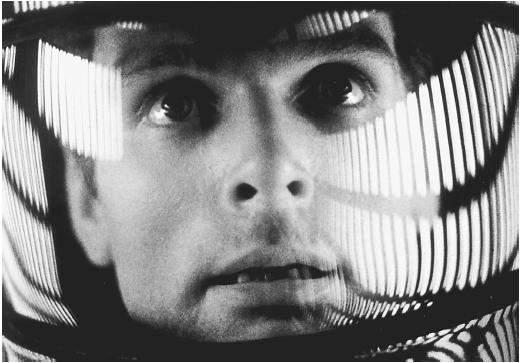
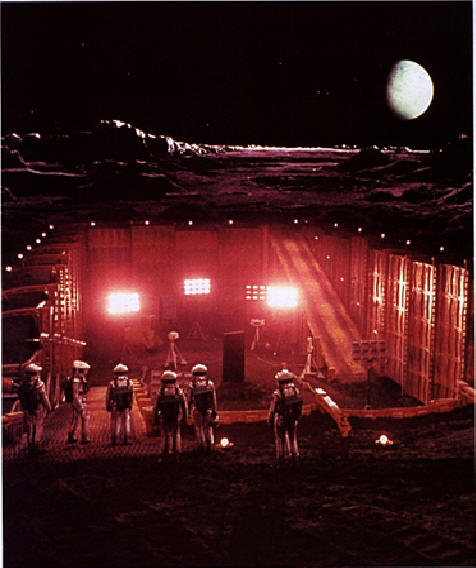
For your Youtube viewing pleasure today is this week's moon colonization in pop culture highlight: the sequence from Stanley Kubrick's legendary 1968 film "2001: A Space Odyssey" involving a trip from Earth to the Moon, with one of the most unique choices in film history as far as sound design, and the level this design is taken to:


An interesting thing I noticed upon watching this again is the lander the astronauts use, which has strong similarity to a current NASA design and previous Picture of the Week feature here at Luna C/I. Which came first, the chicken or the egg? :)

Friday, May 2, 2008

Elevator to the Moon (and the Fountains of Paradise Along the Way)


"Elevator to the moon, whistling a favorite tune..."
-"Satellite" , by Guster

A concept supported/pioneered by the likes of Arthur C. Clarke (initially in his book The Fountains of Paradise, and that he considered to be the greatest part of his science legacy; he also described the idea of communications satellites....in 1945) and NASA itself as of late, the Space Elevator is a seemingly radical, and yet very real, alternative for transport into space.


It's pretty much as it sounds, functioning as an elevator that climbs upwards along a ribbon, a 22,000-mile-long cable or tether going straight up into a fixed position in orbit from an oceanic, equatorial location on the Earth's surface, allowing cheap and easy transport of all kinds of materials (or people) in a similar manner to a more typical elevator.


"What we're talking about is building the biggest thing...ever."
-Steven Steiner, MIT, in a
NOVA feature on the Space Elevator

Initially described as a concept in 1960 by a Russian engineer, Yuri Artsutanov, the recent (approx. 1991) discovery of carbon nanotubes (a material 10,000 times as thin as a human hair, but stronger than steel) provides a base for the actual design and construction of a space elevator. The concept is real enough for NASA to support an annual X prize-like contest to race prototypes, and for various companies to pop up that are taking the idea very seriously.

A space elevator would be far less expensive than space shuttles, despite the spectacular nature of it, even down to '100th or 1,000th' of the cost, particularly for the actual transport of goods per weight. The cost to build it would be around $10 billion, compared to $1.7 billion for one space shuttle, with a cost of $450 million to launch it each time. Not too bad, considering.

A space elevator would make population and transport of goods to Lunar and Martian colonies far easier, and could be constructed on the Moon itself for surface-orbit transport there.

Space elevators are an (as the amount of links here attests to) enormous concept/movement, with a lot of momentum behind it; almost as much as I've seen for lunar colonization itself. Any time private companies are investing themselves in an idea as large as this, that can be an indicator of the seriousness and imminent nature of a technology or concept. In other words, this could be something in the headlines before the end of the next President's administration.

Expect a lot of discussion here about the various aspects of the space elevator, and how they pertain to moon colonization and integration; perhaps, even, I'll manage to explore to topic personally at some point soon for you all.

Thursday, May 1, 2008

Picture of the Week: Earthnauts


This week's Picture of the Week comes from Mars. Well, sort of.

That is several 'astronauts' exploring around at the Mars Desert Research Station, the second of four such stations to be built in order to test habitats and lifestyles, somewhat ahead of what NASA is up to. These sort of stations will provide invaluable for figuring out the details of Lunar and Martian colony life, and the lessons from one could be applied to another.

It'll be interesting to see, in particular, the psychological kinds of studies one can get from these...