"Outlet Mall, coming soon!"
-A 'Buy N Large Corp'. billboard on the Moon, next to the American Flag at Mare Tranquillitatis, in the film "WALL-E"
I had a chance last week to finally catch Pixar's latest masterwork, "WALL-E". Much like with "Iron Man" earlier this summer, a movie that a whole heck of a lot of people ended up seeing happened to also be a movie with a look at the Moon; and in WALL-E's case, a look specifically at the Moon colonization and the potential outcomes of it.
It's a simple, and brief, moment in the film, but a memorable one: In a fly-by of the Moon, the site of the American flag in the Sea of Tranquility is seen as having a billboard adjacent to it advertising a future outlet mall (which, given the circumstances and setting of the film, the builders apparently never did get around to).
The placement of the sign directly next to the flag site could suggest that the fictional Buy N Large Corporation in the film was intending to plow right over the site for their new mall; or that they simply plopped that sign down there for attention.
The strange thing about all of this is that this isn't really that far from the truth, as things are developing now. The Sea of Tranquility is rich in Helium-3, a resource extremely rare on Earth but plentiful on the Moon that could be valuable for fusion power. So within 15-20 years, we could very well be seeing mining operations going up right next to the Apollo landing sites.
With the generation of kids seeing WALL-E today being the ones who will have the newscasts of their lives dominated by Moon colonization, it should be interesting to see how this one moment in an extremely visible film gets referenced and remembered, as commerical development of the Sea of Tranquility and the rest of the Moon becomes an imminent reality (and potentially, a major public debate).
Showing posts with label Mare Tranquillitatis. Show all posts
Showing posts with label Mare Tranquillitatis. Show all posts
Saturday, July 12, 2008

Wednesday, May 21, 2008
Mare Tranquilitatis Fact Sheet: Zuh?
In a past bout of research on the Sea of Tranquility, I came across this fact sheet.
It starts off easy enough: "Mare Tranquillitatis sits within the Tranqillitatis basin." Simple, and eponymous.
Then you happily trudge along to the next line and... "The mare material within the basin consists of basalt in the intermediate to young age group of the Upper Imbrian epoch." Whoa!
What did they just say?
A point-by-point analysis:
"Mare" is a basaltic lunar plain; basalt being a type of volcanic rock that gives the maria a bluish tint. "Upper Imbrian" refers to the Lunar geologic timescale, and a period of it that occured ~3500 million years ago; Upper Imbrian is the fourth period, with Pre-Nectarian, brief Nectarian, and Lower Imbrian periods preceding and the Eratosthenian and Copernican ages following.
Those are some crazy paragraphs even within the Wikipedia articles; I see a "Lunar geologic timsescale: Cliffs Notes edition" post in this blog's future.
But, for now, the next section of this fact sheet:
"The surrounding mountains are thought to be of the Lower Imbrian epoch, but the actual basin is probably Pre-Nectarian."
So the basin is older than the mountains around it. Interesting.
"The basin has irregular margins and lacks a defined multiple-ringed structure."
...What? A search and dictionary/encyclopedia search turns up nothing definitive on the meaning of "irregular margins"; "multiple-ring structure", though, comes up with this upon a search: "In the largest craters, the centre may rise and fall more than once leading to mulitple ring structure." So they are saying Tranquilitatis does not have this multiple-ring structure, which by the mere mention of this fact suggests that is unusual (as it 'lacks' it).
"The irregualr (sic) topography in and near this basin results from the intersection of the Tranquillitatis, Nectaris, Crisium, Fecunditatis, and Serenitatis basins with two throughgoing rings of the Procellarum basin."
So this basin is apparently kind of screwy due to a bunch of basins coming together, within the rings of Procellarum, also known as Oceanus Procellarum. Procellarum is the mother of lunar maria, covering 4 million square kilometers and (as we've seen here) encompassing, at least partially, smaller maria like Tranquilitatis.
The fact sheet goes on to talk about a "Palus Somn" , which is both a crazy-cool name and apparently a typo, as it is supposed to be "Palus Somni" (which translates to 'Marsh of Sleep' from Latin, which is an even more crazy-cool name for a place). A picture, below:
This Marsh of Sleep is 143 km (~88-90 miles or so) wide, with the whole mare Tranquilitatis being about the size of The Phillipines or New Zealand.
I'll start wrapping my head around that geologic timetable, and I'll get back to you all in the future with that in plain English...but, for now, you have a better understanding on some level of that rather blunt fact sheet :)
Friday, May 16, 2008
Picture of the Week: Rock Bottom

The above is a small crater near the Apollo 11 landing site on Mare Tranquilitatis. I find this picture to be, I guess ironically, Earth-y in an interesting way: more than many moon surface pictures I've seen, I can almost feel like what it'd be to scramble around on that incline. That sky is beautiful; I'm wondering what that little faded streak of blue at the top is...
You can find more pictures from Apollo 11 here, straight from NASA.
Wednesday, May 14, 2008
We have "Land"-ing?
This budding era of Moon Colonization, like few eras in our history ever have before, brings up new frontiers not only in terms of land, but in ideas, concepts, and societal functions.
Now, wait-- "land"? A quick look at the Wikipedia entry for that lovable dry space we call home (mostly) brings up an interesting note:
"Land may refer to:
Now, wait-- "land"? A quick look at the Wikipedia entry for that lovable dry space we call home (mostly) brings up an interesting note:
"Land may refer to:
- Land, the part of the
That would lead one to believe that, since the surface of the Moon is in fact not part of Earth (or is it?), and therefore not a part of Earth that isn't covered with water, it doesn't technically have 'land'.
A quick field trip to Dictionary.com, though, reveals more:
"land /lænd/ –noun
1.
any part of the earth's surface not covered by a body of water; the part of the earth's surface occupied by continents and islands: Land was sighted from the crow's nest.
2.
an area of ground with reference to its nature or composition: arable land.
3.
an area of ground with specific boundaries: to buy land on which to build a house.
4.
rural or farming areas, as contrasted with urban areas: They left the land for the city.
5.
Law.
a.
any part of the earth's surface that can be owned as property, and everything annexed to it, whether by nature or by the human hand.
b.
any legal interest held in land. "
When talking about 'land' on the Moon, numbers 3 and 5 are the most relevant here: an area with specific boundaries, and the legal definition of...well, technically, that's defined there as Earth's surface. So we'll stick to number , and let the space law junkies duke it out over number 5.
So now that we've more or less established that land, as a concept, does exist on the Moon, what does that mean? So what?
Well, Mankind is about to gain an extra 3.793×10⁷ km² , or 0.074 Earths' worth of land. Mare Tranquillitatis alone is the size of the Phillipines (population: 92 million), never mind the entire surface of the Moon.
I got all excited to find a link in the Space Law article to a "Lunar Land Management Society", but came away with nothing but a broken link. But, Google provides victory!--A link that works. The site remains pretty barren, though (much like Luna herself). One valuable piece of information can be wrought from it, though: they're based out of the Mojave Space Port (or, were?).
The point here being, I'm not the only one who thinks lunar land management is not only a serious topic, but a timely and current one.
As a matter of fact, a little more digging reveals you can already be your very own Lunar land owner. That one surprised even me; even land in the Sea of Tranquility is supposedly available...which is rich in helium-3...which countries want. Their site has some amusing analysis of what happened with the 1967 UN Outer Space Treaty; that looks like a thick treaty, and something I'll have to cover in depth here another day.
For now, though, we can rest knowing that not only is the Moon 'land', it can already be bought. This, therefore, opens up the concept of Lunar land use and land use planning. Now, what end of the spectrum lunar land development ends up being on remains to be seen; and, in fact, could be decided by this very generation within the next decade. A little law and effort can go a long ways...
Saturday, April 26, 2008
The Resource of the 21st Century
"We will provide the most reliable report on helium-3 to mankind," Ouyang Ziyuan, the chief scientist of China's lunar program, told a Chinese newspaper. "Whoever first conquers the moon will benefit first."
--
Russian space geologist Erik Galimov told the Russian Izvestia newspaper that NASA's plan to colonize the moon will "enable the U.S. to establish its control of the global energy market 20 years from now and put the rest of the world on its knees as hydrocarbons run out."
--
Those quotes, from an article in Wired magazine by John Lasker, give you an idea of the seriousness of the race to mine helium-3 on the moon. As a matter of fact, helium-3 is a primary motivation for colonization of the moon in the first place.

Helium-3 is used in fusion power, seen as many (including Apollo 17 astronaut and former U.S. senator Jack Schmitt, the chairman of NASA's Advisory Council) as the ultimate fuel of the future. As the Artemis Project notes, once a fusion plant is up and running (France is hosting a test facility, and the technology is expected to be in use by 2050), one shuttle's worth of helium-3 would power the United States for an entire year. Mind you that this is without any greenhouse gases, or the risk of fission power. The perfect nuclear power (or energy resource of any kind), in other words.
--
Russian space geologist Erik Galimov told the Russian Izvestia newspaper that NASA's plan to colonize the moon will "enable the U.S. to establish its control of the global energy market 20 years from now and put the rest of the world on its knees as hydrocarbons run out."
--
Those quotes, from an article in Wired magazine by John Lasker, give you an idea of the seriousness of the race to mine helium-3 on the moon. As a matter of fact, helium-3 is a primary motivation for colonization of the moon in the first place.
Helium-3 is used in fusion power, seen as many (including Apollo 17 astronaut and former U.S. senator Jack Schmitt, the chairman of NASA's Advisory Council) as the ultimate fuel of the future. As the Artemis Project notes, once a fusion plant is up and running (France is hosting a test facility, and the technology is expected to be in use by 2050), one shuttle's worth of helium-3 would power the United States for an entire year. Mind you that this is without any greenhouse gases, or the risk of fission power. The perfect nuclear power (or energy resource of any kind), in other words.

Helium-3 is rare on earth, but plentiful on the Moon. Above is a map of Helium-3 on the Moon's surface, with a lot of it concentrated in Mare Tranquillitatis to the middle-right.
Both Russia and China have stated in various places that helium-3 is a motivation, and the quotes at the beginning here attest to their awareness of its importance.
Helium-3 is a critical element (excuse the pun) of mankind's efforts to colonize the moon this century, and could help solve a lot of problems. It's going to be a headline-maker and a focus of our energies for a long time, and you'll be hearing a lot more about it both here in the near future, and elsewhere over the long-term.
Friday, April 18, 2008
Atlas' Back: Mare Tranquillitatis

For the first edition of Atlas' Back, a semi-regular series of features touring selenographic features of the moon, we have ourselves a look at Mare Tranquillitatis: The Sea of Tranquility.
The name being the latin form of "Sea of Tranquility", Mare Tranquillitatis is the most famous of the Maria, the basaltic plains originally mistaken for actual seas by early astronomers (hence the name, which is latin for "seas"). The above map has the landing sites for Ranger 5, Apollo 11 (the first manned landing), Apollo 16, and Apollo 17 (the last manned landing up to this point) marked, illustrating the massive historical signifigance of this sea in the sky.
With the amount of attention and activity directed towards Mare Tranquillitatis, there's plenty of images to go around. A few visual highlights to give you a feel for the mare:

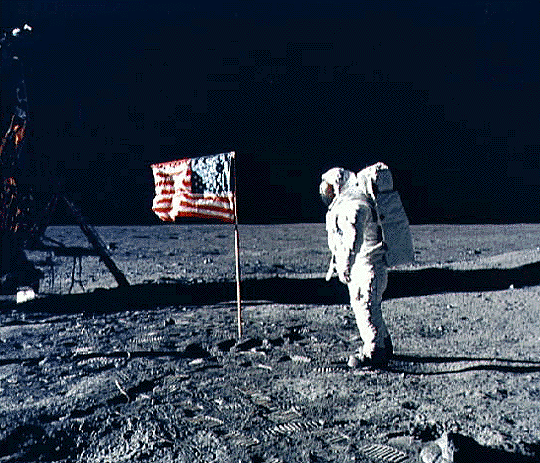
Buzz Aldrin on Mare Tranquillitatis.

A view of the mare from the window of the Apollo 11 lander, right after landing.

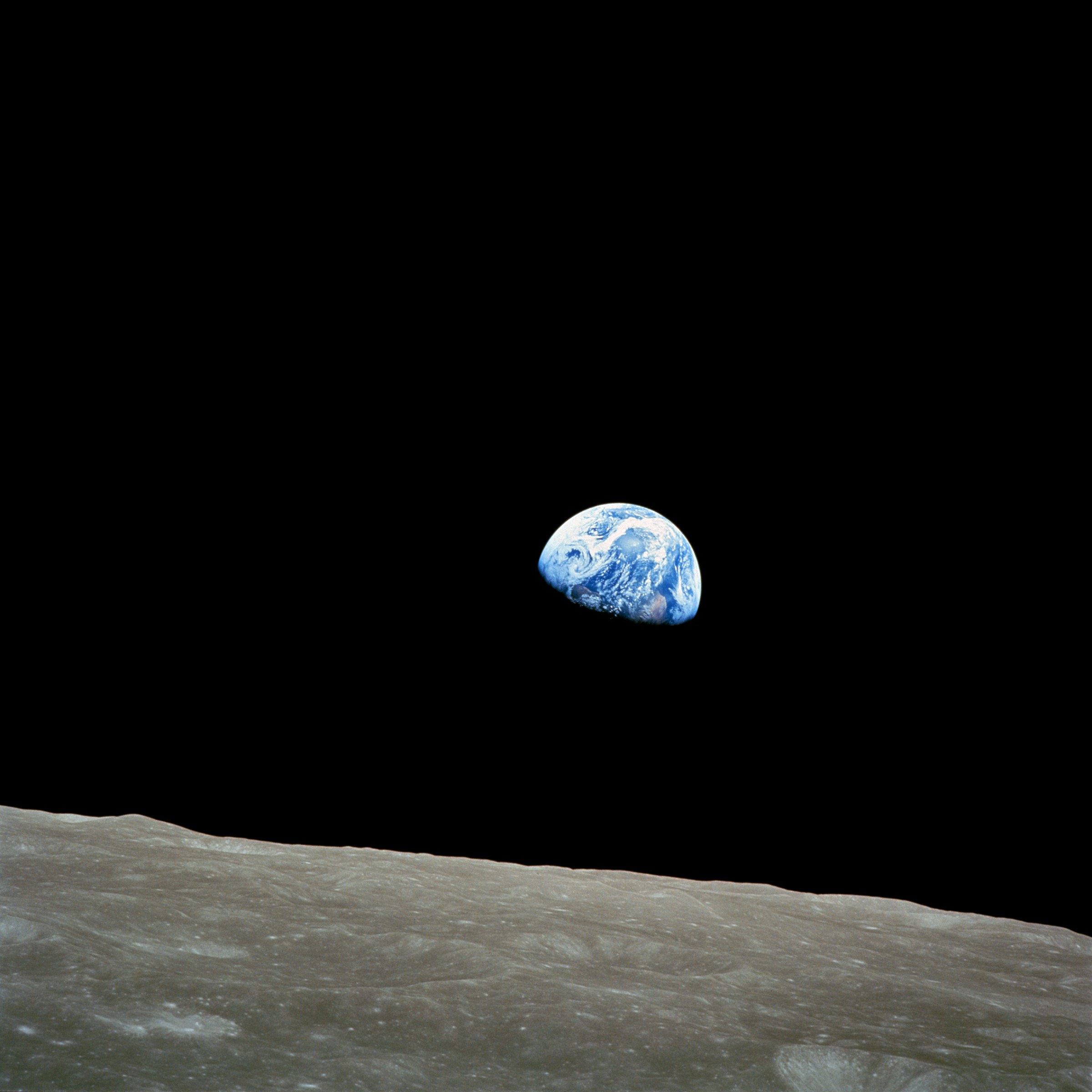
An Earthrise photo, taken from Apollo 11 prior to landing (different from the famous "Earthrise" photo, featured recently and significantly in the film "An Inconvenient Truth" and widely regarded as having helped found the environmentalism movement; that was taken from orbit during the earlier Apollo 8 mission).

From a distance; Mare Tranquillitatis is the expansive dark patch in the upper left there, with the Apollo 11 landing site being in the lower left corner, as can be seen clearly via the handy Google Moon (a Google Earth counterpart currently geared around the Apollo landings).
The mare is about 300,000 sq km (roughly the same size as the Phillipines), and as that bit of size research turned up, is apparently also a very good site for Helium-3, with (as that abstract notes) about 50% of the mare being minable. Though, my initial reaction here would be to think of Mare Tranquillitatis as a site for the moon's first protected historical park, and not, say, strip mining.
I hope you've enjoyed this brief tour of Mare Tranquillitatis; there's many more tours of this sort to come, both from me here, and from many others elsewhere, as this last photo below (of the mare) illustrates pretty well. Stay tuned for the next edition of Atlas' Back...

Subscribe to:
Posts (Atom)

 Posts