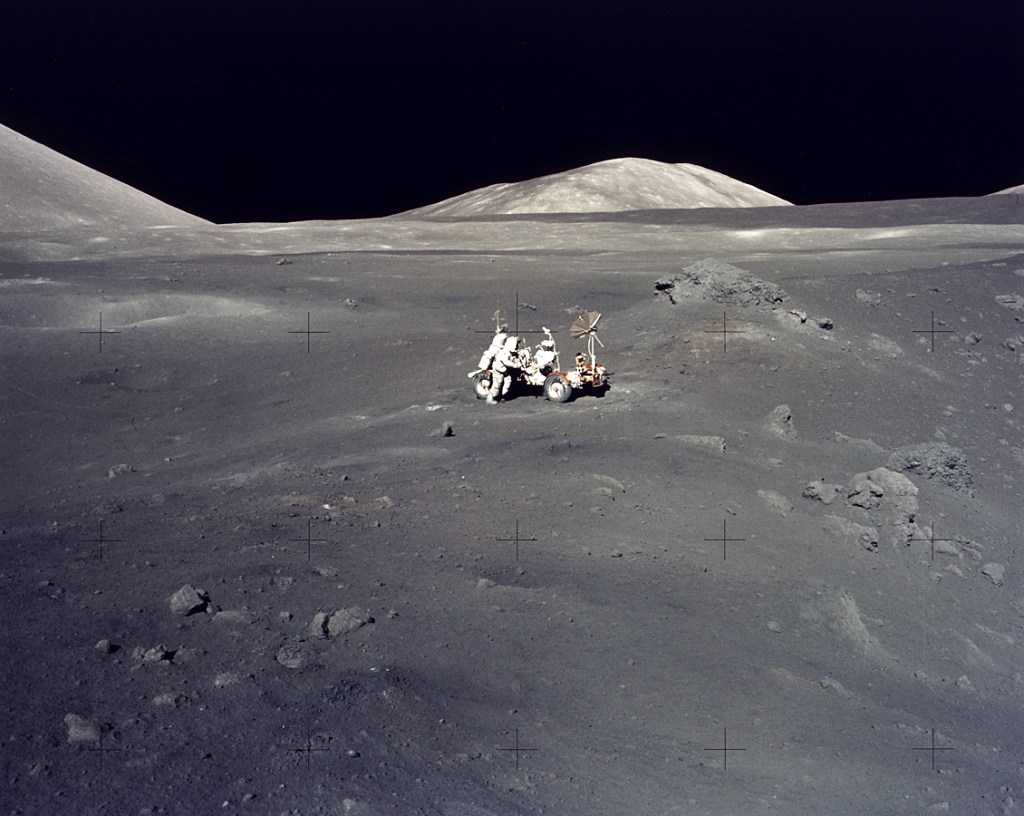
– Eugene A. Cernan, Apollo 17 Commander. Last man to walk on the moon, December 14, 1972.
Monday, December 15, 2008
Picture of the Week: Sweet Seventeen
– Eugene A. Cernan, Apollo 17 Commander. Last man to walk on the moon, December 14, 1972.
Monday, November 24, 2008
Picture of the Week: A Mysterious Development...
Up on the carrier there, the label (in this NASA rendering) says:
Lunar Development Corporation.
As a 24-year-old with an Urban Planning degree, seeing such a particular phrase on a NASA rendering really got my attention. And what I've found has surprised me: this 'Lunar Development Corporation' could not only be a massive player in our colonization of the moon, but this reference on an official NASA image has proven to be highly mysterious.
A quick search on "lunar development corporation" dug up some gold (or helium-3, if you will):- A detailed paper on public-private partnerships (PPP), including the concept of a singular Lunar Development Corporation (I'll provide a full analysis of this paper as a marquee feature within the next two weeks);
- A mildly dated (February 2007) article from Space.com on methods of solidifying public; investor; and other support for lunar plans, which it notes could (in part) be accomplished by instituting "a public-private lunar development corporation" (again, singular).
Among other things, mostly odds and ends.
This became extremely strange upon finding the original source of the image; I first encountered it via a mostly unrelated ThomasNet article. Then, after some digging based on the ThomasNet description, I found the image in the Wikipedia article on Moon Colonization.
Taking the hunt to NASA itself, a search for "lunar development corporation" on their main site turned up....nothing. Hmm. I then applied my method for finding that Wikipedia repeat of the image to NASA's new official images site, NASAImages.org, and found the image with a full (and revealing?) description.
The archived image's original source is this page, which has the same description alongside it.
That description is potentially very revealing, by just how unrevealing it is. Nowhere is the appearance of "Lunar Development Corporation" mentioned, as the brief text talks only about the rover and cargo lander.
A search on NASA's site for "lunar development corporation" turns up only a brief mention of "the new Houston-based Lunar Development Corporation" being listed as founded apparently by the Artemis Society's Gregory Bennett (a bio which does not mention this LDC in any form), and a Google or other search turns up no official site or mention of the entity in any form..
...yet it appears on the cargo lander on this official NASA image.
This may be explained by a small detail, from the end of the image's description:
"This image was produced for NASA by John Frassanito and Associates. Technical concepts from NASA's Planetary Projects Office (PPO), Johnson Space Center (JSC). "
Here's the website for John Frassanito and Associates, but a search for "Planetary Projects Office" and/or alongside "Johnson Space Center" turns up...nothing (except more concept images). NASA has a plethora of official sites for its various departments, but yet this Houston space center's "PPO" does, apparently, not.
A little more hunting at the Johnson Space Center site turns up a reference that the PPO became the "Planetary Missions and Materials Branch", a search for which, again, fails to turn up an official site. Searching the JSC's site brought up more odds and ends, including a newsletter (Lunar News issue number 62) from 1998, so it looks like "Planetary Mission and Materials Branch" may have been a name that was changed again, though to what, I'm not sure.
In fact, closer inspection of the original image's page confirms it is from 1994.
So after all that adventure, it may just be an old and outdated concept. Still, the prominence of the "Lunar Development Corporation" on the rendering (and others, it turns out), combined with the dual facts that the rendering is from "technical concepts, and the lack of mention of the Corporation in the image descriptions despite it being so readily apparent in them, suggest that "Lunar Development Corporation" was an element of the technical concepts not entirely intended to be released; e.g., an innocuous leak.
I'm going to do some further investigating, sending off some emails, and I'll post an update in the very near future about whether the Lunar Development Corporation could be something currently being worked on (as it is featured in concept images that are alongside much more current ones in the galleries). Stay tuned... :)
Sunday, November 16, 2008
Picture of the Week: MoonOne, A Space Odyssey
Sunday, November 9, 2008
Picture of the Week: Hail CESAR
That is a picture of the CESAR rover, which won last week's ESA Lunar Robotics Challenge. Built by a student team from the Bremen University, the rover completed the task of descending down the steep slopes of a 15-meter deep crater, grab a soil sample, and return it (all in darkness).Check out the CESAR site for details from the team on their rover (and their experience), and below is a Youtube clip of the victorious little guy conquering a hill in practice:
The lunar surface is a challenging environment, and it'll be a lot of fun to see the variety of designs for rovers that come along, and to see them in action there within the next few years :)
Tuesday, October 28, 2008
Picture of the Week: Finally Got a Plasma
The experiment back in June produced 2 1/2 times more plasma than anticipated, which was good news for the project and for other, similar projects, like the high-profile ~$7-14 billion ITER (International Thermonuclear Experimental Reactor) reactor being built in France.
Fusion power is considered a leading motivation for moon colonization, as a primary fuel for it (helium-3) is rare on Earth, but plentiful on the Moon. Seen as an ultimate power source, fusion power could be a solution to certain problems that may crop up in the next 50 years.
Last year, South Korea announced plans to launch a lunar orbiter in 2020 (similar to the craft just launched by India), so they could be getting ahead of the game with their early development of the fusion side of things.
Monday, October 13, 2008
Picture of the Week: So You's Comfortable In There?
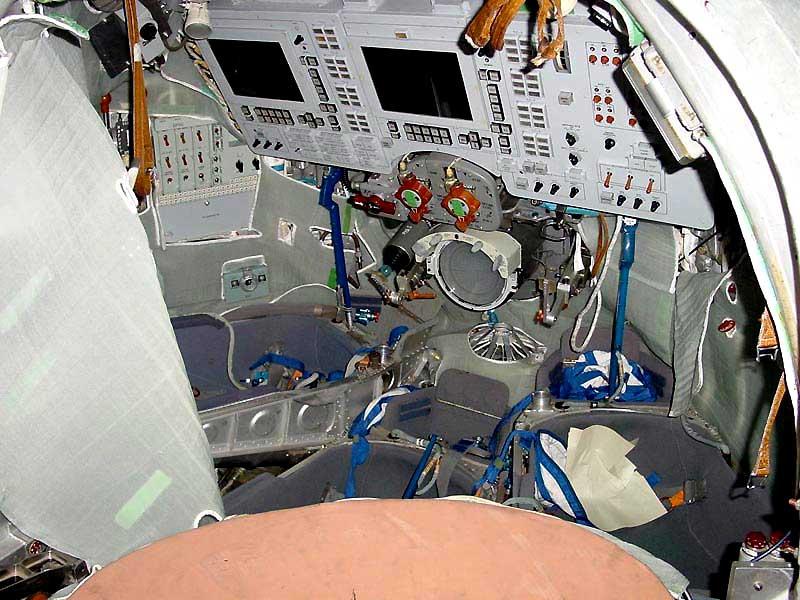
That is the interior of the Russian Soyuz craft, that is currently in the news for carrying the 6th space tourist, video game developer (and son of an astronaut) Richard Garriott, to the International Space Station for a few weeks (a trip that has it's own web site).
The Soyuz, once the space shuttle is retired in 2010, will actually be the vehicle American astronauts will have to hitch a ride on (or, as appears to be the case now, the craft NASA will be buying from he Russians for our use) to get to the ISS and into space in general until the development of the Orion craft is completed.
For more on space tourism, check out Space.com's whole section on it.
Saturday, October 4, 2008
Picture of the Week: Festival Coming Soon
That is that first Chinese photo of the Moon, taken by their Chang'e-1 (嫦娥一号) Lunar orbiter craft last year, as part of an imaging/exploration mission (including for concentrations of helium-3).Check out this really interesting look from the China National Space Administration (CNSA) at the Chang'e-1 program and its goals, from the Chang'e project leader, Luan Enjie. He's exceptionally well-spoken-- here's a great interview where he talks about his take on the differences from this space race (that I refer to as the "Base Race") and the space rae of the 1950's and 60's.
The Chang'e program is named after the Chinese goddess of the moon, who (notably) only lives on the moon.
"The U.S. is the leader in deep space exploration."
-Luan Enjie, opening statement of his description of the Chang'e-1 program
The way the Chinese space program has been rolling along in the past year, I think we could be seeing a 'chang'e' to that fact in the very near future ;)
Friday, September 19, 2008
Picture of the Week: Pinch Us
The event pictured is the announcement of the financial rescue package being put into place to stabilize the struggling American economy.
This package could potentially become extremely relevant (and rather ominous) to NASA, as this rescue could end up costing the government upwards of a trillion dollars, which in turn could then end up limiting government spending for some time. This crisis, as a result, could then become an eventual bane to NASA's rather large amount of funding (and the particularly pricey Constellation program).
Luckily, there's still other nations and plenty of private enterprise rolling along towards the Moon, so even if NASA takes a hit, the lunar surface should be plenty busy for some time to come. And as a matter of fact, Barack Obama's space plan suggests he may attempt to utilize the private space sector as a way to spur the economy back out of this slump, and so in the end, the American space focus may simply shift, rather than slump; as any slack lost by a NASA spending decline could be readily picked right back up by American private enterprise.
It will be interesting to see how the unfolding of this rescue package ends up shifting America's impact on the base race and the future of development on the Moon.
Tuesday, September 9, 2008
Picture of the Week: It's A Miner Thing, and They're a Miner King
From the University of Wisconsin-Madison's Fusion Technology Institute (by way of the European Space Agency) comes an artist's rendition of a Helium-3 miner.Helium-3 is a resource that is rare on Earth, but plentiful on the moon. It's drawn a lot of interest, including officially from China and Russia, as the primary fuel for fusion power, which is something of the ultimate power source: clean and efficient, one shuttle's load of Helium-3 from the Moon would be roughly enough to power the United States for one year. And that's just one load!
While fusion probably won't turn up until around 2050, that's about the time we're expected to be running out of fossil fuels and potentially in need of a new energy source. So, the idea among Russia, China, the U.S., and potential commercial efforts would be to get a headstart on collecting the fuel by stockpiling it early, and developing some kind of dominance over the resource in order to gain leverage (and massive profits).
So, as a result, even though we might not be seeing fusion power itself for a while, we'll be seeing (and hearing about) miners like the one above much sooner.
Monday, September 1, 2008
Picture of the Week: Oh, Chute!
According to NASA's report on the failed test, the parachutes on the actual craft worked fine, but the parachutes used to set up the test (e.g., the simulation) failed, causing the craft to fall faster than desired and resulting in what I'm sure was a lovely and distinctive "thump".
Apparently this is a pretty common type of failure, and doesn't represent a serious setback (though it did succeed in producing entertaining photos and video...and not to mention a lot of coverage).
Yes, video:
Monday, August 25, 2008
Picture of the Week: Moon Princess
A main facet of the Google Lunar X Prize's award conditions is the completion of a 'Mooncast', including HD video, from the surface of the moon, representing something of a next step forward from what JAXA's Kaguya carried forward from Apollo.
For a remarkably thorough and neat examination of the Kaguya craft itself, see this Discovery Channel profile on it.
Thursday, August 7, 2008
Picture of the Week: Peek-A-Boo
The LRO is the first major mission of the Vision for Space Exploration era of NASA, with an expected launch of February 27, 2009. It's mission is largely one of documentation, with a more in-depth look at the selenology and selenodesy of the moon in preparation for the set-up of colonies there before 2030 or so. In addition to what will assuredly be lots of neat, pretty pictures, the LRO will send back valuable information about radiation, water, and other key environmental elements that may or may not be present on the moon.
Wednesday, July 30, 2008
Picture of the Week: A Titanic Discovery (News)
That is a picture of a place the Moon could one day be seen as an important stepping stone to: Titan, the largest of the many moons of Saturn. Long suspected to have water, today it was announced that Titan is officially the second celestial body ever found to have stable liquid on its surface (the first being the one you're sitting on, of course).The lake, also officially the first non-Earthen lake ever found, is called Ontario Lacus and is comprised of liquid ethane. It shares a similar shape and size to Lake Ontario here on Earth; hence the name.
Someday, the many Titan colonists will harken back to the old days when the lunar pioneers set the stage for them. Moon colonization may seem like a blip at a point when we've began settling bodies with the potential of Titan and Europa.
Thursday, July 10, 2008
Picture of the Week: That's No Space Station...
Wednesday, July 2, 2008
Picture of the Week: Fetch, Rover
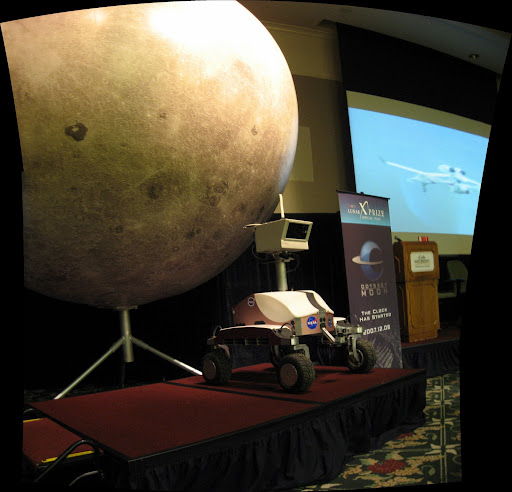
In a little toss to WALL-E's opening this past week, the Picture of the Week is a mock-up of what a Google Lunar X Prize rover might end up looking like (EDIT: See comments for the full skinny, but the good folks at Odyssey Moon Ltd. note this is an actual prototype, with the photo being from their media conference about being named the first Lunar X prize team. Thank you Mr. Richards for the comment and the further details :) ). Such a rover would have to be capable of completing a 'Mooncast', consisting of 360º photos, both HD and near-real time video, and transmission of specific data in order for the competing group to earn the $20 million prize. Additional $5 million prizes can be earned by coming in second and/or completing additional challenges, such as roving certain distances and surviving a frigid lunar night.I personally find the giant model of the moon there to left of it almost as exciting as anything else. Put me in the same room as that thing, and I'd be all over it.
Wednesday, June 25, 2008
Picture of the Week: A Model Example
Monday, June 16, 2008
Picture of the Week: Antarctiluna
Saturday, May 31, 2008
Picture of the Week: Who Needs Video
Part of the Google Lunar X Prize requirements for a qualifying victory are to send back images and data (including HD video) from the Moon; what they call a "Mooncast".
"MOONCAST: The Mooncast consists of digital data that must be collected and transmitted to the Earth composed of the following:
• High resolution 360º panoramic photographs taken on the surface of the Moon;
• Self portraits of the rover taken on the surface of the Moon;
• Near-real time videos showing the craft’s journey along the lunar surface;
• High Definition (HD) video;
• Transmission of a cached set of data, loaded on the craft before launch (e.g. first email from the Moon).
Teams will be required to send a Mooncast detailing their arrival on the lunar surface, and a second Mooncast that provides imagery and video of their journey roaming the lunar surface. All told, the Mooncasts will represent approximately a Gigabyte of stunning content returned to the Earth."
I note that they actually require a self-portrait of the rover in all of that. So, little things like that GIF above are going to be big things for many folks in the coming years :)
Friday, May 16, 2008
Picture of the Week: Rock Bottom
The above is a small crater near the Apollo 11 landing site on Mare Tranquilitatis. I find this picture to be, I guess ironically, Earth-y in an interesting way: more than many moon surface pictures I've seen, I can almost feel like what it'd be to scramble around on that incline. That sky is beautiful; I'm wondering what that little faded streak of blue at the top is...
You can find more pictures from Apollo 11 here, straight from NASA.
Thursday, May 8, 2008
Picture of the Week: луна основа
The above is a picture of the Moon above St. Petersburg (Санкт-Петербург). Yesterday, Russia (in theory) swore a new President into office, Dmitry Medvedev ( Дмитрий Медведев; that's straight off Wikipedia, so that's gotta be correct, right? :) ); a quick search turned up nothing on his record in relation to Russia's moon base aspirations, but considering his relationship with Putin and the relatively recent announcement (August 31st, 2007) of the country's official plans for a base by ~2032, things probably won't change much. Though, dramatic moon missions always make for good PR, so it wouldn't be surprising to see Medvedev follow in Bush's footsteps and have a large step forward in Russia's moon efforts as an early kickstart to his term.