An awesome (and rather adorable) news bit about the upcoming Jan 20th Obama Inaugural parade:
NASA's small pressurized rover concept is, according to a report from Keith Cowing at OnOrbit, going to participate in the parade, and will even crabwalk (pictured above doing so, via NASA's EDGE blog) and bow before the podium. A number of NASA folks will be there alongside the rover, and a suited astronaut will exit the vehicle and plant or carry a U.S. flag.
I cannot wait for video of this :D
For more information on the now-officially-awesome inaugural parade, check out the official site :)
Check out the selenographic landmarks of the mission on Google Moon (Luna's equivalent of Google Maps), and the great Discovery Channel documentary miniseries "When We Left Earth: The NASA Missions" includes a particularly neat (if brief) look at the mission.
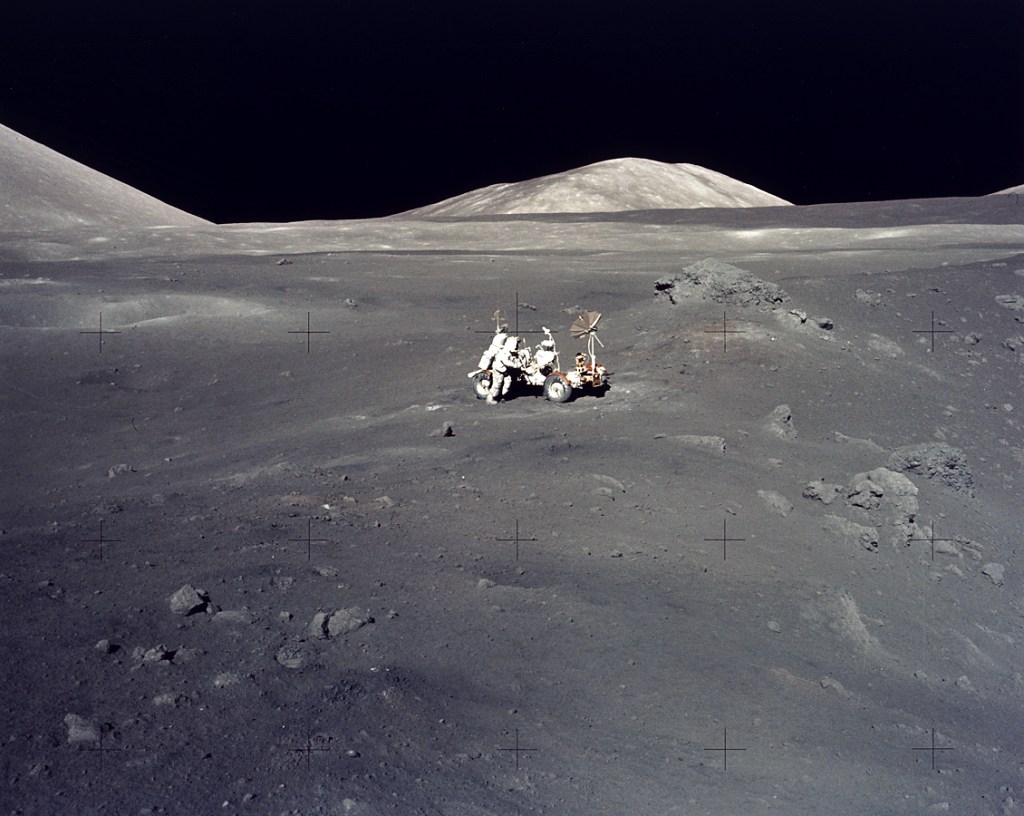
The mission occured 27 years ago this week (December 7th-19th, 1972), and is the last time a man walked on the moon (until, of course, approximately 2020, when most likely a taikonaut will become the 13th man on the moon).
"As I take man's last step from the surface, back home for some time to come — but we believe not too long into the future — I'd like to just [say] what I believe history will record — that America's challenge of today has forged man's destiny of tomorrow. And, as we leave the Moon at Taurus-Littrow, we leave as we came and, God willing, as we shall return, with peace and hope for all mankind. Godspeed the crew of Apollo 17." – Eugene A. Cernan, Apollo 17 Commander. Last man to walk on the moon, December 14, 1972.
Lasting five months, the lander was originally expected to last just 90 sols (martian days), until September 30th; the last communciation was on November 2nd.
A Martian sunrise in late August, marking the oncoming of the winter that eventually doomed the lander. [Photo from UniverseToday.com by way of NASA/JLP/UA)
The unexpected durability of the lander could be promising for the efforts of future landers and rovers, including lunar ones.
Check out the official NASA media page on Phoenix for videos recapping the mission.
Considering how much longer 'than expected' both the Phoenix and the twin rovers have lasted, could it also happen that completion of lunar bases (being built by, of course, robots) will come much faster 'than expected' (with their construction workers potentially proving much hardier and productive workers than predicted)?
That is a picture of the CESAR rover, which won last week's ESA Lunar Robotics Challenge. Built by a student team from the Bremen University, the rover completed the task of descending down the steep slopes of a 15-meter deep crater, grab a soil sample, and return it (all in darkness).
Check out the CESAR site for details from the team on their rover (and their experience), and below is a Youtube clip of the victorious little guy conquering a hill in practice:
The lunar surface is a challenging environment, and it'll be a lot of fun to see the variety of designsfor rovers that come along, and to see them in action there within the next few years :)
"Astrobotic will robotically explore the Moon’s high-interest areas on a commercial basis, collecting information required to design future outposts and to answer scientific questions about the Moon and Earth." -David Gump, President of Astrobotic, from their announcement
As part of the announcement, Astrobotic released a White Paper (a 'white paper' being an a report or guide that addresses problems and how to solve them, typically seen in business and politics) detailing their program and goals.
In addition to their initial effort for the $20 million Lunar X Prize, TranquilityTrek (which, as David Gump told Space.com for their article today, was "very clear" that it was "going to cost more to win the prize than the prize itself"), Astrobotic will follow with five more missions:
Rovers and landers are pretty commonplace ideas, but the 'dozer' was a new one to me. With some digging (excuse the pun), I found an example: NASA's Lunar Chariot prototype, which could build roads, dig trenches, or even mine minerals. There's even some video of it in action, kicking ass and taking names on Earth:
The White Paper has oodles of details on their exact mission plans, particularly the diagram on page 3.
With the X Prize TranquilityTrek slated for Q2 2010, they've got their South pole scout (headed for the rim of Shackleton Crater, long considered a prime location for a moon colony) shooting for Q3 2011, with two more missions (a North Pole scout and a 'Moon Quake 1" seismic and weather collection mission at Shackleton) set for 2012 and an Ice Surveyor mission going deep into Shackleton itself, followed by the Lunar Dozer mission also at Shackleton Rim, both being conducted in 2013.
So, for Astrobotic alone, that's 6 total lunar missions in the next four years. Exciting times. And this, of course (and as the White Paper notes), is just the initial slate. Most or all of the rovers will include HD video broadcasting, it sounds like, so we'll all have a front row seat, to boot.
The general goal of the missions is to build a data library to facilitate other organizations' (e.g., NASA; Barack Obama, in his space plan, talked of "amplifying NASA's reach" with the private space sector) and companies' missions with information for sale, such as detailed terrain maps, allowing future colonial efforts to simply buy the information from Astrobotic at a lower cost that it would take for the efforts to collect the data themselves.
Check out that 4-page White Paper and Astrobotic's site for the full skinny on their efforts, and keep an eye here for frequent updates and analysis as they (and other similar companies, such as fellow Google Lunar X Prize competitor Odyssey Moon, Ltd.) progress rapidly towards their mission slate :)
That is a NASA image (from their EDGE blog) of their Black Point, Arizona test driving yesterday of their lunar Small Pressurized Rover concept.
In a lava-field area with many geologic similarities to the lunar surface, the new rover roared into action at speeds up to 6 mph, designed with leather seats and bunks with the ability for astronauts to take the vehicle on two-week trips. The vehicle includes "suitports" (see at right, image also from NASA's EDGE blog), allowing the astronauts to enter and exit the rover without having to bring the suits (and the potentially dangerous dust clinging to them) in.
This is where the name "Small Pressurized Rover" comes in--the cabin being pressurized is what allows the astronauts to not have to wear the suits inside.
The testing has been going on for a week with day-long rides (sounds like fun), with the big test coming up in a three-day jaunt, largely to test the comfort of the vehicle (sorry, no wet bar).
An unmanned lunar explorer (a la Japan's Kaguya), the Chandrayaan-1 (which is "moon craft" in Sanskrit) is set to map lunar topography in 3D, creating (as the ISRO puts it) a "3D atlas" and notably, chemical mapping of the lunar surface.
While I haven't found any specific references to helium-3 in any Indian or other documentation of the Chandrayaan project, that prominent "chemical mapping" goal suggests that, like Russia, China, NASA, and others, India is seriously interested in the resource potential of the Moon.
This story got some big media play in the form of a huge front-page Drudge Report splash, with a huge picture of the Moon in the place usually reserved for the likes of Obama and McCain. Here's that spectacular image (which ran with an "INDIA TO THE MOON!" headline):
I'm a little surprised at the high-profile coverage, as this Indian mission isn't a whole lot different than JAXA's, which didn't appear to get quite the same sort of media push. I think this speaks to the sort of excitement the Base Race can generate, especially as the significant 2010-2020 decade pulls closer (and as things domestically get more and more grim in the meantime).
In another Google Lunar X Prize related note, Astrobotic Technology (one of the teams competing) recently did a significant revamp of their site, including nifty features. Hate to sound almost like an ad, but there's tons of info there now.
They do a good job of talking about their technological development, including their new blog with pics and descriptions of various elements of their craft, and their Lunar X Prize team page has this neat video on their camera testing:
As the Lunar X Prize's requirements state the grand prize goals must be met by 2012 (with the final, any-prize-at-all date being the end of 2014), the Lunar X Prize is going to be a central topic here at Luna C/I over the short-term. Expect to see a lot more features and updates on all the teams in the coming weeks, months, and years here :)
But, a subplot to this event and just as notable in the long run, is that the Phoenix lander has lasted much longer than anticipated.
Originally expected to last 90 Martian days (also known as "sols"; Martian hours, minutes, and seconds are 2.7% longer than Earth ones), the lander has operated for 120+. The Martian winter is settling in, and with the lander being at a pole, that means a long, cold dark and the probable end of the lander's lifespan.
Considering that everything from the $30 million Google Lunar X Prize up through Helium-3 mining and moon base surveying and construction will be completed by similar robotic rovers and other heroic robots, the fact that as high-profile a rover as the Phoenix has proven much more durable than anticipated is great news for any and all forthcoming efforts to integrate, and then colonize the Moon.
Rovers proving more durable means that everything on Luna will get explored, built on, and mined that much faster and more efficiently (and more efficiency itself speeds things up again by freeing up R+D, etc. cash). If rovers and other equipment prove to consistently outperform expectations like the Phoenix has, then the pace of the Moon's integration into our Earthbound society is going to get really wild.
The Phoenix lander's perserverance has shone a bright light of promise into the future of robotic Martian, Lunar, and other missions.
Like the plot of Batman Returns going out and having a wild affair with a Harsh Mistress, rocket-powered Penguins may soon be bounding across the moon.
The lunar penguin is a robotic explorer, developed by defense contractor Raytheon, with the ability to jump as high as a kilometer (and over great distances) as it completes missions (searching for frozen water, etc.).
With the moon's landscape being unusually harsh, hopping may very well be a prime mode of robotic lunar travel. One thing is for sure: we're going to be seeing a wide variety of proposals (and actual rovers/robots) over the next 10 to 20 years.


 A Martian sunrise in late August, marking the oncoming of the winter that eventually doomed the lander. [Photo from


 Posts


