Saturday, November 8, 2008

Chandrayaan-1 Payload Spotlight #1: Terrain Mapping Camera (TMC)

Today is the first in a series of features on each of India's recently-launched Chandrayaan-1's scientific payloads.

The Chandrayaan-1 lunar orbiter (which just Saturday reached lunar orbit) has 11 scientific instruments onboard to complete an array of measurements: five Indian instruments, and six from other nations and organizations (including the ESA and NASA). Japan and China launched similar missions last year, but not with foreign instruments onboard.
This chart below, from the ISRO, shows what types of 'coverage' the payloads as a unit have:

As I cover each of the eleven payloads in individual posts over the next few weeks, I'm going to alternate between the Indian and foreign payloads.

Without further ado, here's your spotlight on the Terrain Mapping Camera (TMC).

Terrain Mapping Camera

An Indian instrument, the first payload being featured here was also the first one to be tested.

It's mostly as it sounds: a high-resolution camera that can take black and white photographs of the lunar surface (with a 5m spatial resolution--"the ability to distinguish between two closely spaced objects on an image"--in 20km swaths[PDF] ), with the intent to map the entire topography of the moon (including the dark side and the poles) at that 5m resolution; creating the most high-resolution, detailed map of the lunar surface to date. Such maps exist of Mars, but not of the Moon.

NASA's Lunar Reconaissance Orbiter (LRO) mission set for next year will have similar, if more powerful, camera and mapping systems. These kinds of maps will clearly be useful for the planning stages of the eventual lunar colonies and for other efforts.

The power of the TMC could well be enough to finally settle one thing for NASA ahead of time, though: it could photograph the Apollo and other NASA craft on the Moon's surface, hopefully putting all those conspiracy theories to rest. :)

Here's a picture from the ISRO of the TMC itself:


And, last but not least, one of the test images the camera took of Earth (high resolution here):


For every technical detail you ever wanted to know about the TMC, see this PDF.

Check back within the next couple of days for the next feature, on one of the Chandrayaan-1's foreign payloads, as well as for any other updates on the moon mission's progress that may come along :)

Wednesday, November 5, 2008

What President Obama Means for Moon Colonization and Private Space Policy (Immediate Action?)

A few months back I did an in-depth analysis of Barack Obama's detailed space plan, but now that he is officially the President-Elect of the United States (and therefore, given the timing of his term, one of the most important figures ever in mankind's integration and colonization of the moon; it is within his first four-year term that the Google Lunar X Prize should be won, and that Astrobotic alone has 6 lunar surface missions planned), it's time to take a look at what change he might bring on early on in his administration.

One thing Obama's space plan detailed that we could see forming perhaps even before he takes office, is the return of the National Aeronautics and Space Council (here's an obviously in-progress Wiki article on it's previous incarnations, which were from 1953-1973 and 1989-1993; beyond that, online background is lacking).

"There is currently no organizational authority in the Federal government with a sufficiently broad mandate to oversee a comprehensive and integrated strategy and policy dealing with all aspects of the government's space- related programs, including those being managed by NASA, the Department of Defense, the National Reconnaissance Office, the Commerce Department, the Transportation Department, and other federal agencies."
-Barack Obama's Space Plan

The Council was a White House entity to help coordinate these sorts of agenices, something that is arguably needed more now than it was in the Space Race era, with the booming private space sector (from Armadillo and Astrobotic to Odyssey Moon and Virgin Galactic, with numerous inbetween) being around, as Obama puts it, to "amplify NASA's reach":

"In achieving this vision, Obama will reach out to include international partners and to engage the private sector to amplify NASA's reach. Obama believes that a revitalized NASA can help America maintain its innovation edge and contribute to American economic growth."
-Paragraph 3 of the Obama Space Plan

As has been much discussed, economic growth is something America could use right about now, and so having a council that strengthens coordination of private and government space efforts (something already underway, an example being the agreement between Odyssey Moon and NASA announced just last week) could in turn, strengthen the role in a recovering American economy of a thriving space sector. The council would greatly amplify the 'amplification of NASA's reach'.

"And that's a major debate I'm going to want to convene when I'm president of the United States. What direction do we take the space program in?"
-Barack Obama, on a couple of occasions on the campaign trail

An interesting blog post from an Obama supporter on the official Obama site talked about the idea of a new National Space Council from a political and practical perspective:

"A National Space Council could be critical to advancing such interagency issues on climate change, space communications, technical innovation, and the commercial uses of space. ...We are missing opportunities because no agency is charged with helping space industries in the way that the Federal government helped the infant aviation industry before World War II."
-Blog post by Gary Oleson on the official Obama campaign site

His post also notes that historically, the National Space Council was chaired by the Vice President; Vice President-Elect Joe Biden was as recently as October involved directly in Obama's space policy, as the sponsor of a waiver to allow the U.S. to buy Soyuz craft from Russia until the Orion craft is ready, something Obama spoke in favor of and then became involved with. Biden also was outspoken as a space advocate in the last days of campaign (though I'm sure Florida had something do to with that).


With Obama already starting to put his Cabinet together, we could see movement on the new National Space Council's creation within the next few weeks and months. The space program certainly is something hopeful and inspiring that Obama could mix in with all the grim challenges, which would be politically invaluable, especially if there's a lot of emphasis on the possibilities of lunar policy (with the Moon, of course, visible to every American on a regular basis as an impromptu symbol of hope).

Keep an eye here for frequent updates as Obama's presidential space policy begins to take even further shape, and check out my original analysis of his space plan for more details on that.

Sunday, November 2, 2008

Video: India's Chandrayaan-1 Moon Orbiter

Below is a neat video from the ESA (European Space Agency) on India's recently launched moon mission, the Chandrayaan-1 lunar orbiter.

The ISRO (Indian Space Research Organization) itself has a 30-minute video online about the Chandrayaan-1, as well, so there's plenty of video to go around to get caught up on India's hip moon mission :)

Saturday, November 1, 2008

Chandrayaan-1 Update: Terrain Mapping Tested

Click that image above for the whopping full-size image of Earth that the recently launched Indian lunar orbiter Chandrayaan-1 took with one of its 11 payloads, the Terrain Mapping Camera (TMC).

Check out the press release for the official take, as well as these neat articles. This was a test of the TMC, which is one of five Indian payloads on the Chandrayaan-1 (the other six being international, including two through NASA).

I'm going to be doing a series of individual spotlights on all eleven payloads as the Chandrayaan-1 makes its way out of its current Earth orbit and towards the Moon, so keep an eye here for the first installment of that very soon :)

Friday, October 31, 2008

Odyssey Moon Announces NASA Partnership (News)

Right on the heels of Astrobotic's big announcement of the details of their commerical missions, there's big news out of Odyssey Moon, Ltd., another Google Lunar X Prize competitor and major private lunar venture.

Odyssey Moon put forth a media release announcing a deal between them and NASA, with Odyssey Moon paying NASA for technical support on their MoonOne (M-1) Google Lunar X Prize mission. This agreement was reached through a Reimbursable Space Act Agreement, signed at the Ames Research Center in Silicon Valley. As that above link notes, the difference between a 'reimbursable' and a 'non-reimbursable' Space Act Agreement is whether or not there is a transfer of funds from the private entity (here, Odyssey Moon) to NASA, with NASA providing "data, facilities and services to the paying entity."

An important element of the agreement is that Odyssey Moon will then "share its technical data from its engineering tests and actual lunar missions with NASA", as the release puts it. So in exchange for getting initial support from NASA, Odyssey Moon's operational (and efficiency, a crutch of the value of the private space sector) knowledge will be utilized by NASA it it's own colonization efforts.

Leonard David over at LiveScience.com had the inside scoop on the agreement; check out his blog post for neat insider tidbits from his own experiences at Ames and from elsewhere.

Thursday, October 30, 2008

Astrobotic Technology Announces Details Galore on Series of Commercial Moon Missions (News)

Today, Astrobotic Technology (a leading contender for the Google Lunar X Prize) announced a new series of missions as part of their commercial efforts.

"Astrobotic will robotically explore the Moon’s high-interest areas on a commercial basis, collecting information required to design future outposts and to answer scientific questions about the Moon and Earth."
-David Gump, President of Astrobotic, from their announcement

As part of the announcement, Astrobotic released a White Paper (a 'white paper' being an a report or guide that addresses problems and how to solve them, typically seen in business and politics) detailing their program and goals.

In addition to their initial effort for the $20 million Lunar X Prize, TranquilityTrek (which, as David Gump told Space.com for their article today, was "very clear" that it was "going to cost more to win the prize than the prize itself"), Astrobotic will follow with five more missions:
  • Three polar rovers;
  • A lunar lander; and
  • A lunar dozer (see below).

Rovers and landers are pretty commonplace ideas, but the 'dozer' was a new one to me. With some digging (excuse the pun), I found an example: NASA's Lunar Chariot prototype, which could build roads, dig trenches, or even mine minerals. There's even some video of it in action, kicking ass and taking names on Earth:


The White Paper has oodles of details on their exact mission plans, particularly the diagram on page 3.

With the X Prize TranquilityTrek slated for Q2 2010, they've got their South pole scout (headed for the rim of Shackleton Crater, long considered a prime location for a moon colony) shooting for Q3 2011, with two more missions (a North Pole scout and a 'Moon Quake 1" seismic and weather collection mission at Shackleton) set for 2012 and an Ice Surveyor mission going deep into Shackleton itself, followed by the Lunar Dozer mission also at Shackleton Rim, both being conducted in 2013.

So, for Astrobotic alone, that's 6 total lunar missions in the next four years. Exciting times. And this, of course (and as the White Paper notes), is just the initial slate. Most or all of the rovers will include HD video broadcasting, it sounds like, so we'll all have a front row seat, to boot.

The general goal of the missions is to build a data library to facilitate other organizations' (e.g., NASA; Barack Obama, in his space plan, talked of "amplifying NASA's reach" with the private space sector) and companies' missions with information for sale, such as detailed terrain maps, allowing future colonial efforts to simply buy the information from Astrobotic at a lower cost that it would take for the efforts to collect the data themselves.

Check out that 4-page White Paper and Astrobotic's site for the full skinny on their efforts, and keep an eye here for frequent updates and analysis as they (and other similar companies, such as fellow Google Lunar X Prize competitor Odyssey Moon, Ltd.) progress rapidly towards their mission slate :)

Tuesday, October 28, 2008

Picture of the Week: Finally Got a Plasma

That is an image from the Korea Times (by way of Gizmodo) of the first plasma generated by South Korea 's KSTAR (Korea Superconducting Tokamak Advanced Reactor) fusion reactor.

The experiment back in June produced 2 1/2 times more plasma than anticipated, which was good news for the project and for other, similar projects, like the high-profile ~$7-14 billion ITER (International Thermonuclear Experimental Reactor) reactor being built in France.

Fusion power is considered a leading motivation for moon colonization, as a primary fuel for it (helium-3) is rare on Earth, but plentiful on the Moon. Seen as an ultimate power source, fusion power could be a solution to certain problems that may crop up in the next 50 years.

Last year, South Korea announced plans to launch a lunar orbiter in 2020 (similar to the craft just launched by India), so they could be getting ahead of the game with their early development of the fusion side of things.

Monday, October 27, 2008

Lunar Lander Challenge Wrap-Up

Day 2 of the 2008 Northrop Grumman Lunar Lander Challenge turned out to be uneventful. The official X Prize Foundation video recap explains what happened on the only attempt of the day:


Still, it was an exciting event and a great first day, with Armadillo Aerospace taking home the $350,000 prize with a successful flight and TrueZer0 getting a launch off (which, as you'll see in the video below from the actual craft, didn't end as well as it started:)


Keep an eye here at Luna C/I for future event coverage as the private space boom and Base Race continue to take shape :)

Sunday, October 26, 2008

NASA Test Driving New Small Pressurized Rover in Arizona (News)

That is a NASA image (from their EDGE blog) of their Black Point, Arizona test driving yesterday of their lunar Small Pressurized Rover concept.

In a lava-field area with many geologic similarities to the lunar surface, the new rover roared into action at speeds up to 6 mph, designed with leather seats and bunks with the ability for astronauts to take the vehicle on two-week trips. The vehicle includes "suitports" (see at right, image also from NASA's EDGE blog), allowing the astronauts to enter and exit the rover without having to bring the suits (and the potentially dangerous dust clinging to them) in.

"Dust is the No. 1 environmental problem on the moon."
-Harrison "Jack" Schmitt, Apollo 17 astronaut (Wired.com dust article)

This is where the name "Small Pressurized Rover" comes in--the cabin being pressurized is what allows the astronauts to not have to wear the suits inside.

The testing has been going on for a week with day-long rides (sounds like fun), with the big test coming up in a three-day jaunt, largely to test the comfort of the vehicle (sorry, no wet bar).

Check out NASA's official page for their trademark really huge pictures and more details (including some great informational PDFs with even more images, and a short video, embedded below via Youtube:)

Saturday, October 25, 2008

Lunar Lander Challenge: Day 1 Recap

Day 1 of the 2008 Northrop Grumman Lunar Lander Challenge is complete, and there's some great success out of it to recap for ya. (A location note: the event, orginally scheduled to be at Holloman Air Force Base, was recently moved to a different venue, the Las Cruces Airport).

Of the nine teams to enter the contest, two managed to make it to the point of actually getting flights in at the Challenge: Armadillo Aerospace and TrueZer0 (check out my previous post for short profiles on each).

A congrats to Armadillo Aerospace as, third time being the charm this year (after competing the last two years), they won the $350,000 prize with a successful flight (check out that Space.com/MSNBC article for a full skinny on their frustrations, including a lot of clock problems, many due to the aforementioned venue change to Las Cruces airport).

"Color me quite frustrated on several counts."
-John Carmack, Armadillo Aerospace founder/lead engineer, and co-founder of iD software (makers of Doom, Quake), to Space.com

TrueZer0 gets something of an underdog prize, though, despite not qualifying for a prize with their Level One flight: they were already only the fourth competitor ever to get their craft off the ground (and that's ever, including in test flights), and they had entered the competition very late. Bad news, though, in that their craft (while making it into the air) crashed and burned after 18 seconds, being lost completely.

There's a completely awesome recap from the X Prize Foundation of Day 1 up on Youtube today, embedded below for your enjoyment:


For Day 2 coverage, there's a live blog by Leonard David at LiveScience chronicling the events as they happen, and of course there's the live webcast with chat and much narration by Dr. Peter Diamandis, Chairman and CEO of the X Prize Foundation (which as you see with the video above, is itself really interesting, to see such a wealth of dialogue from an important figure in the private space boom). As TrueZer0 was only entering Level One competition, it's all the Armadillo show today as they go for the big one, the Level Two prize (landing on difficult lunar surface-like terrain).

Check back for more link-a-riffic coverage here as the weekend rolls on... :)

Thursday, October 23, 2008

Lunar Lander Challenge: The Teams

As promised earlier this week, here's a look at the teams competing in the Lunar Lander Challenge event coming up tomorrow (starting at ~630am, looks like) and Saturday (via live webcast, from a new and really cool site I hadn't heard about previously: Spacevidcast.com).

There are a total of nine teams; today, here's a look at (for now, four of them; I'll update this post with the others as the night comes along)


  • Acuity Technologies: Coming from Menlo Park, California (just north of Palo Alto--home of Stanford--and the rest of Silicon Valley where I happened to grow up), Acuity is one of the teams returning from last year's event. Started in 1992, Acuity develops specialized unmanned aerial systems. Their Level One (of two; there are two difficulty levels teams can compete for, one with smooth landing pad, one with a more lunar-surface-like landing area) "Hop & Hover" offering is a Hydrogen Peroxide and Methanol-fueled craft, coming in at 210 lbs.
  • Armadillo Aerospace: The only team from last year's event to get into the air, and only narrowly missing a victory in Level One competition (7 seconds short of the required time), Armadillo is a developer of resuable rocket-powered vehicles. Their site has a lot of goodies, including everything from a blog (of sorts) to a message board. They probably also have the logo and graphic design contests in the bag ;). Their craft, MOD, is a moose, weighing 1340 pounds with ~1800 pounds of thrust.
  • BonNova: An engineering design firm, they've developed designs for extreme conditions ranging from racecars to oil wells (and, with their specially-formed rocket team, this Lunar Challenge). Also a returning team, their leader (Allen Newcomb) has experience from the winning craft (SpaceShipOne) of the Ansari X Prize. Their craft ("Lauyad I") is similar in size to Acuity's (small-ish, at 200 lbs), but is using a Propane and N2O propulsion system.
  • High Expectations Rocketry: With no pressure from their name, High Expectations' team comes from Moscow, Idaho as a first-time participant in the challenge. Composed of four guys (the first three teams coming in at four, seven, and five, respectively), they look to succeed where last year's teams came up short. They are using more medium-sized craft, with their Level One offering "ISP 1" coming in at 350 pounds on a Nitrous oxide, nylon and propane propulsion system.

The most interesting contrast, clearly, is that none of them use the same type of fuel (and the Armadillo's craft weighing a good 1000 pounds more than the others'; note that Armadillo were the ones to get into the air last year, and so perhaps bigger will prove better?).

Tune into that webcast over the next two days to see just how the craft do, and check out the official matchup page.

Edit: Here's the rest of the teams, I'll edit/update as I go along.

  • Paragon Labs: This Denver-based team developed their effort in what they describe as a "skunk-works" environment, fielding a weightier 650-pound (1800-pound gross) craft ("Volkon") with a Liquid Oxygen/Ethanol fuel (check out this article for details on that combination). Chekc our their great gallery of works-in-progress and other images.
  • Team Phoenicia: With their eyes also set on the Google Lunar X Prize, probably the more poetic of the teams (and a competitor with Armadillo in the graphic design department) comes in with "The Wind At Dawn", a 660-pound RP-1(Rocket Propellant-1)-fueled craft with 550 pounds thrust. They've got an oddly familiar blog (I'm workin on it, I'm workin on it...;) ) and some sweet Youtubeage to go along with their interesting literary style.
  • TrueZer0: This Chicagoland 4-man team comes with with a 475-pound craft called "Ignignokt" (a name that is gloriously and amazingly not invented by the team, unlike some of the other teams' craft that ironically sound more like real-world influences; go figure) and plenty of dry humor (and as Ignignokt shows, humor of all kinds). Poetry, humor, armadillos; this competition has it all. Their site, while minimal, has a cool narrative to it, including some more great Youtube material. Ignignokt (and I presume his fellow "Mooninites") are fueled by Hydrogen Peroxide and Nitrogen gas.
  • Unreasonable Rocket: Fellow Blogspot-dwellers, their entry to the competition was the Hydrogen Peroxide-fueled Burning Speed 80 ( for the Level One), a 300 pound craft. As that link attest to though, they were not able to get operational in time. Shooting for next year (or the constant stream of opportunity we'll be seeing for efforts like theirs over the next decade), though, would not be unreasonable ;)
  • Seraphim Works is listed as a team on the official site, but their Landr Challenge page is a "coming soon" and a quick google turned up not even a whisper, so their status is unclear (and with so little presence at this late point, they are likely not a final competing team).

I watched Armadillo's first attempt while finishing this up (8:30 am on the 24th), and it was entertaining, as they got into the air but didn't fit within the required time frame. Tune back in at the end of the day for a full recap of that flight and the rest of Friday's Lunar Lander Challenge events :)

Wednesday, October 22, 2008

India Launches Chandrayaan 1 Moon Mission (News)

Today, India's Indian Space Research Organisation (ISRO) successfully launched it's first lunar mission, the Chandrayaan 1.

An unmanned lunar explorer (a la Japan's Kaguya), the Chandrayaan-1 (which is "moon craft" in Sanskrit) is set to map lunar topography in 3D, creating (as the ISRO puts it) a "3D atlas" and notably, chemical mapping of the lunar surface.

While I haven't found any specific references to helium-3 in any Indian or other documentation of the Chandrayaan project, that prominent "chemical mapping" goal suggests that, like Russia, China, NASA, and others, India is seriously interested in the resource potential of the Moon.

The craft is carrying scientific payloads for six other organizations (check that link for specific pages for each one), including NASA, Europe's ESA, and Bulgaria's Space Research Institute.

This story got some big media play in the form of a huge front-page Drudge Report splash, with a huge picture of the Moon in the place usually reserved for the likes of Obama and McCain. Here's that spectacular image (which ran with an "INDIA TO THE MOON!" headline):


I'm a little surprised at the high-profile coverage, as this Indian mission isn't a whole lot different than JAXA's, which didn't appear to get quite the same sort of media push. I think this speaks to the sort of excitement the Base Race can generate, especially as the significant 2010-2020 decade pulls closer (and as things domestically get more and more grim in the meantime).

The Chandrayaan-1 mission is expected to last for two years, with Chandrayaan-2, a joint Indo-Russian moon rover venture, shooting for 2011.

Monday, October 20, 2008

Preview: X Prize Foundation's Lunar Lander Challenge


Coming up this week (Friday the 24th and Saturday the 25th) is an event the X Prize Foundation announced back in June: the 2008 Northrop Grumman Lunar Lander Challenge.

The competition, taking place at Holloman Air Force Base in Alamogordo, New Mexico, challenges competing teams to successfully simulate an lunar orbit-to-surface trip, launching into the air and landing at a specified location and then making a return trip. The prize at stake is $2.5 million, making this the first of NASA's Centennial Challenges to have a multi-million dollar purse.

There are nine teams set to compete, and the entire event will be webcast live, which should be a blast to watch. The X Prize Foundation's got a fun little Matchups feature up to compare the teams and their offerings, and I'll post a closer-profile look at all the teams later this week as things ramp up for the event.

Sunday, October 19, 2008

Space Knights? Virgin Territory for the Pentagon

The Times Online has a story today about the Pentagon planning a "spaceplane" that could deliver troops (or supplies) to an emergency zone within four hours.

Codenamed "Hot Eagle", the craft is designed closely off of Virgin Galactic and Scaled Composites' WhiteKnight craft, which Burt Rutan carried to a collection of the $10 million Ansari X Prize in 2004.

A government picking up on a private spacefaring design is an interesting precedent. Barack Obama, in his space plan, talked of using the private sector to "amplify NASA's reach"; but this is a whole another level of interaction between government and private enterprise (and it's happening already!).

The Pentagon hopes to have these craft in use within 11 years (2019). Check out the article for a lot more of the details and background.

One interesting angle (excuse the pun): these same craft could fly someone commercially from London to Sydney in four hours. Now that's executive class.

Thursday, October 16, 2008

Bush Signs New NASA Authorization Act: One More Shuttle, Faster Orion (News)

Today, President Bush signed into law a new NASA Authorization Act with some interesting folds in regards to NASA's development, especially in regards to the Space Shuttle program.

The act authorizes $20.2 billion for NASA, including funding for an additional space shuttle flight , originally planned for retirement in 2010.

The gap between the shuttle's retirement and the first flights of the Orion craft in 2014-2015 has created some concern, with the Russian Soyuz being the main stopgap option; recently, a measure was passed in Congress to allow NASA to purchase Soyuz craft (instead of having to piggyback); an interesting side note is that the Soyuz purchase waiver was something that Barack Obama discussed and then became involved with, with his running mate Joe Biden being the sponsor of the waiver. NASA's future is clearly attracting some high-profile attention lately.

The new authorization act also calls for $1 billion in additional funding to accelerate the Orion program.

For the full text of the act, check out the always dependable SpaceRef.com's posting of it here.

Monday, October 13, 2008

Picture of the Week: So You's Comfortable In There?


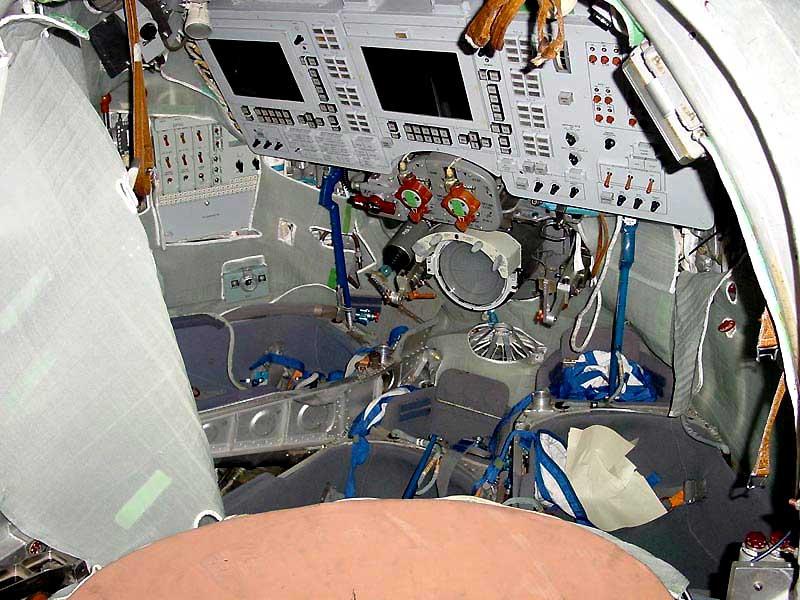
That is the interior of the Russian Soyuz craft, that is currently in the news for carrying the 6th space tourist, video game developer (and son of an astronaut) Richard Garriott, to the International Space Station for a few weeks (a trip that has it's own web site).

The Soyuz, once the space shuttle is retired in 2010, will actually be the vehicle American astronauts will have to hitch a ride on (or, as appears to be the case now, the craft NASA will be buying from he Russians for our use) to get to the ISS and into space in general until the development of the Orion craft is completed.

For more on space tourism, check out Space.com's whole section on it.

Friday, October 10, 2008

Astrobotic Site Revamp

In another Google Lunar X Prize related note, Astrobotic Technology (one of the teams competing) recently did a significant revamp of their site, including nifty features. Hate to sound almost like an ad, but there's tons of info there now.

They do a good job of talking about their technological development, including their new blog with pics and descriptions of various elements of their craft, and their Lunar X Prize team page has this neat video on their camera testing:


As the Lunar X Prize's requirements state the grand prize goals must be met by 2012 (with the final, any-prize-at-all date being the end of 2014), the Lunar X Prize is going to be a central topic here at Luna C/I over the short-term. Expect to see a lot more features and updates on all the teams in the coming weeks, months, and years here :)

Wednesday, October 8, 2008

Two New Teams Join Google Lunar X Prize (News)

The X Prize Foundation has announced that two additional teams have joined the quest for the Google Lunar X Prize:
  • Independence-X Aerospace, a Malaysia-based team with a goal to "Transform Malaysia into a developed space country by the year 2020", and
  • Omega Envoy, the effort of the Florida-based not-for-profit Earthrise Space, Inc., founded by a group of students and professionals to help reestablish Florida's status as a space hub.

Both teams express simplicity as a key of their efforts to get a Mooncast and the other objectives completed.

It'll be fun to watch this X Prize ramp up in the next couple of years, as it could be remembered as something of a 'Shot Heard 'Round the World' for Lunar integration (perhaps that panoramic view in the requirements could be 'The Shot Seen 'Round the World'? :) ).

Tuesday, October 7, 2008

NASA Chief Mike Griffin's Interesting 50th Anniversary Comments

Recently, Michael Griffin (Administrator, a.k.a the chief, of NASA) made some interesting comments to the Agency France-Presse (AFP) when discussing the 50th anniversary of NASA and NASA's current state:

"[Christopher Columbus] travelled for months and spent a few weeks in the Americas and returned home. He could hardly have said to have explored the New World. So we have just begun to touch other worlds."

-Mike Griffin, referring to Apollo 11's first walk on the Moon

Mr. Griffin went on to talk about how the explorers of the 15th century set out not knowing exactly what they'd find, and what value it would have. Griffin stated, "We can't prove today that we can exploit what we find to the benefit of humankind", though personally I beg to differ (and so do others more significant than me).

Griffin also expresses support for international cooperation, a subject that was a key contrast between the Obama and McCain space plans (with Obama's plan mentioning it often and McCain's plan never mentioning it).

"The space station is much bigger and better and more impressive and more productive as a result of the partnership with Canada, Russia, Europe, and Japan, than it would have been if we had done it ourselves."
-Mike Griffin

For some more interesting Mike Griffin interviews, check out this Popular Mechanics '10 tough questions' from 2007, and a Space.com grilling from about a month ago on the space shuttle program, changes to it, and the potential impact of that on Constellation. Seems like Mr. Griffin gets some tough gigs with these interviews, haha.

(Note: I think that 8.8mb portrait from NASA of Mr. Griffin is one of the largest images I have ever seen uploaded to the internet.)

Sunday, October 5, 2008

Eternal Flame? Phoenix Lander Lasting Longer Than Expected

NASA's robotic Mars lander, Phoenix, made news recently as it was snowed on. Let the Martian snowmen and snowball fights commence.

But, a subplot to this event and just as notable in the long run, is that the Phoenix lander has lasted much longer than anticipated.

Originally expected to last 90 Martian days (also known as "sols"; Martian hours, minutes, and seconds are 2.7% longer than Earth ones), the lander has operated for 120+. The Martian winter is settling in, and with the lander being at a pole, that means a long, cold dark and the probable end of the lander's lifespan.

Considering that everything from the $30 million Google Lunar X Prize up through Helium-3 mining and moon base surveying and construction will be completed by similar robotic rovers and other heroic robots, the fact that as high-profile a rover as the Phoenix has proven much more durable than anticipated is great news for any and all forthcoming efforts to integrate, and then colonize the Moon.

Rovers proving more durable means that everything on Luna will get explored, built on, and mined that much faster and more efficiently (and more efficiency itself speeds things up again by freeing up R+D, etc. cash). If rovers and other equipment prove to consistently outperform expectations like the Phoenix has, then the pace of the Moon's integration into our Earthbound society is going to get really wild.

The Phoenix lander's perserverance has shone a bright light of promise into the future of robotic Martian, Lunar, and other missions.