Wednesday, December 24, 2008

Luna C/I is Moving to Wordpress!

Big news as far as Luna C/I-- I'm moving the blog over to Wordpress!

The new site:


Should soon have its own domain name, as well.

Features of the new site:
  • A more suave look and design :)
  • A search box for the blog's content (immensely useful--want to know more about Harrison Schmitt on Helium-3 ? Just do a search for both and you're there)
  • Sub-pages (coming soon), expanding the site's function beyond a blog to a full-on information source
  • Easier integration (through a sub-page) of the upcoming Luna C/I Films--the first film, "One Small Step: An Introduction to Moon Colonization", should be hitting Youtube within a couple of weeks :)
Luna C/I's getting bigger and better, and the more advanced platform that is Wordpress will expedite this significantly.

So head on over and enjoy the spiffier design, and greatly expanding content :)

Friday, December 19, 2008

Bow?...Wow: NASA Lunar Pressurized Rover To Be Part of Obama Inaugural Parade (News)

An awesome (and rather adorable) news bit about the upcoming Jan 20th Obama Inaugural parade:


NASA's small pressurized rover concept is, according to a report from Keith Cowing at OnOrbit, going to participate in the parade, and will even crabwalk (pictured above doing so, via NASA's EDGE blog) and bow before the podium. A number of NASA folks will be there alongside the rover, and a suited astronaut will exit the vehicle and plant or carry a U.S. flag.

I cannot wait for video of this :D

For more information on the now-officially-awesome inaugural parade, check out the official site :)

Monday, December 15, 2008

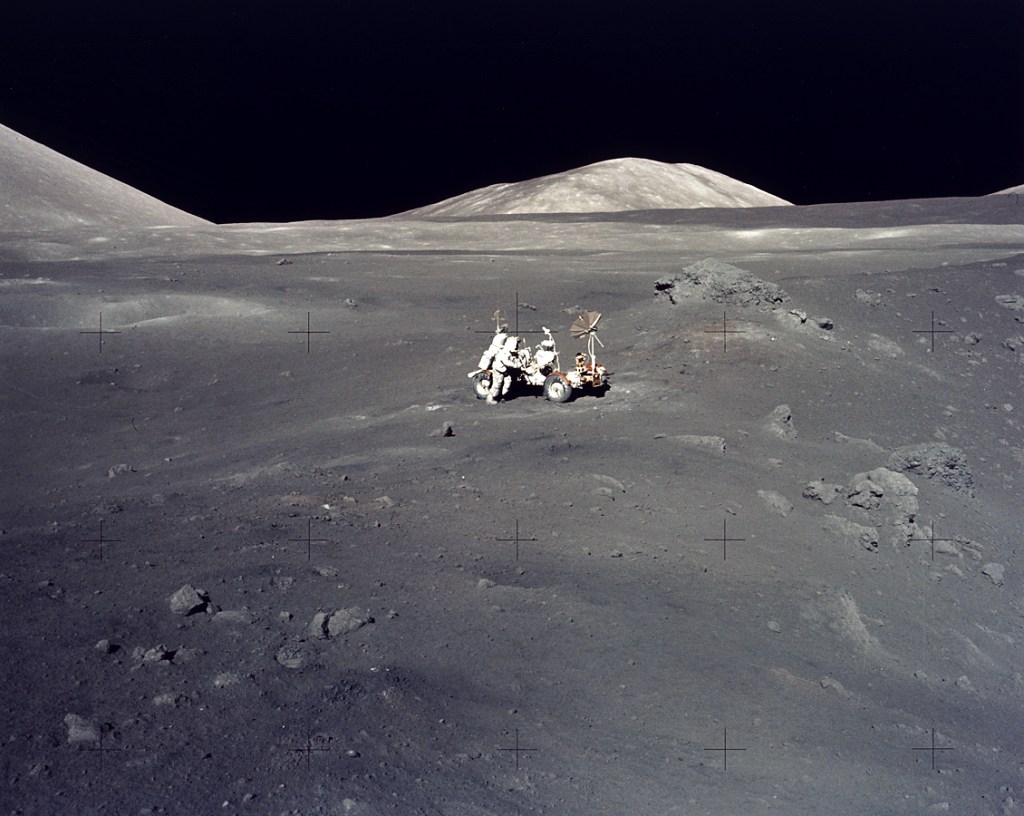
Picture of the Week: Sweet Seventeen

That is a NASA file image of astronaut Harrison "Jack" Schmitt (now an active supporter of helium-3 mining on the Moon) in Mare Serenitatis alongside he and Eugene Cernan's rover during the Apollo 17 mission, in which astronauts spent by far the most amount of time exploring the surface, roving for 21 miles instead of the hundreds of yards previous astronauts had been limited to.

Check out the selenographic landmarks of the mission on Google Moon (Luna's equivalent of Google Maps), and the great Discovery Channel documentary miniseries "When We Left Earth: The NASA Missions" includes a particularly neat (if brief) look at the mission.

The mission occured 27 years ago this week (December 7th-19th, 1972), and is the last time a man walked on the moon (until, of course, approximately 2020, when most likely a taikonaut will become the 13th man on the moon).

"As I take man's last step from the surface, back home for some time to come — but we believe not too long into the future — I'd like to just [say] what I believe history will record — that America's challenge of today has forged man's destiny of tomorrow. And, as we leave the Moon at Taurus-Littrow, we leave as we came and, God willing, as we shall return, with peace and hope for all mankind. Godspeed the crew of Apollo 17."
– Eugene A. Cernan, Apollo 17 Commander. Last man to walk on the moon, December 14, 1972.

Saturday, December 13, 2008

Griffin 'Strife' Report Update

An update on my last post about the OrlandoSentinel.com blog reporting strife between NASA's administrator Mike Griffin and the Obama space transition team, via Space.com:

"Today, Griffin replied, calling the charges "simply wrong."

"I am appalled by any accusations of intimidation, and encourage a free and open exchange of information with the contractor community," Griffin said. "I would like to reiterate what I have stated in a previous email to all NASA Officials: we must make every effort to 'lean forward,' to answer questions promptly, openly and accurately.""
-"NASA Chief 'Appalled' By Accusations He's Not Cooperating with Obama's Team ", Space.com Staff

For more info on Obama's space transition team, check out the official transition site, Change.gov.

Thursday, December 11, 2008

Strife Between NASA's Griffin and Obama Transition Over Constellation? (News)

A report from the Orlando Sentinel describes problems that are arising between the Obama space transition team (headed by a former associate administrator of NASA, Lori Garver) and the current NASA administrator, Mike Griffin:

"In a heated 40-minute conversation last week with Lori Garver, a former NASA associate administrator who heads the space transition team, a red-faced Griffin demanded to speak directly to Obama, according to witnesses.

In addition, Griffin is scripting NASA employees and civilian contractors on what they can tell the transition team and has warned aerospace executives not to criticize the agency’s moon program, sources said."
- "NASA has become a transition problem for Obama", by Robert Block, Orlando Sentinel

It's probably naive to assume that all government relations, especially in a transition where one's legacy could be at stake (Griffin's), are going to be peachy-keen and happy. High-level leaders are always going to have a certain amount of ego, and they're always going to clash (the films "Thirteen Days" and "W." demonstrate the White House Cabinet brand of this pretty well).

The article goes on to illustrate examples that suggest this strife is simply an example of that, and not indicative of actual problems with Constellation that the Obama team would have.

Obama has shown consistent support for Constellation, even getting involved with allowing the NASA purchase of Soyuz craft in the middle of the campaign (with help from Joe Biden), and the article from today mentions an idea from NASA that I think hits the nail on the head (and that I've talked about here before on my own): that the Obama administration “could take ownership of the [Constellation] program and ‘re-brand’ it as their own with minor tweaks.”"

With all the bad news about, the Obama administraion's going to need some good, inspirational PR, and the Constellation program could prove an excellent source for that.

And regardless, even if the Constellation program was (by some strange series of occurances) seriously delayed or cancelled, the probably more-relevant-anyways private sector will still be rolling along, and other countries are going to the Moon (and in my opinion, will win the 'Base Race' anyways; more motivation, with Apollo being 'old hat' here), so mankind's integration and colonization of the Moon will go on, with or without NASA.

Monday, December 8, 2008

Google Lunar X PRIZE Video: Meet the Team--Omega Envoy

Last week, the Google Lunar X PRIZE Youtube channel posted the first in a series of video features meeting the teams of the competition, with the same questions to be asked of each group in an entertaining format. The first team up is the newest, Omega Envoy:


The X PRIZE Foundation has done an excellent job with their media on the prize so far, and they're getting better all the time; keep an eye on that channel and their blog.

Personally, between a teleport and a jetpack, if that teleporter's safe, it's teleporter all the way for me :)

Sunday, December 7, 2008

Chandrayaan-1 Payload Feature #4: Radiation Dose Monitor Experiment (RADOM)

Today is the fourth in a series of features on each of the Indian lunar orbiter Chandrayaan-1's scientific payloads. The Chandrayaan-1 has 11 scientific instruments onboard to complete an array of measurements: five Indian instruments, and six from other nations and organizations (including the ESA and NASA).

For this edition, we look at the Radiation Dose Monitor Experiment, or RADOM, which is from the Bulgarian Academy of Sciences.

Radiation Dose Monitor Experiment (RADOM)


The RADOM is essentially looking to get results (like those pictured above) on just how much radiation there is in lunar orbit and around the surface, so future moon missions have a clearer image if just how much radiation protection is needed.

Radiation is a serious problem for potential colonists, and as that article notes, NASA is including radiation experiments in its own lunar orbiter mission, the LRO (coming next year).

""We really need to know more about the radiation environment on the Moon, especially if people will be staying there for more than just a few days," says Harlan Spence, a professor of astronomy at Boston University."
-"Radioactive Moon", by Patrick L. Barry, NASA

The Apollo astronauts were never out in the radiation for long, so creative solutions are needed to shield long-term settlement. But, first, it needs to be known just how much radiation there is to shield from; and the RADOM is a big step towards that.

For all the full scientific details on the payload straight from the Bulgarians, check out this document. :)
----------
Keep checking back here for more payload features, Chandrayaan-1 news, and a complete wealth of updates and information about the base race, private space boom, and everything else with the true introduction of Man to Luna :)

Saturday, December 6, 2008

One-Year Anniversary of the first Google Lunar X Prize Team Announcement (Odyssey Moon)

Today is the one-year anniversary of the announcement of the first Google Lunar X PRIZE team, Odyssey Moon (with the Google Lunar X PRIZE itself having been announced in August of last year).

It's also the 25th anniversary of my birth (haha), possibly a large part of why I remember the date ;)

Check out the Google Lunar X PRIZE's excellent and increasingly active Youtube channel here, as well as their excellent Launch Pad blog.

Wednesday, December 3, 2008

President-Elect Obama names Bill Richardson (Space Commerce Supporter) U.S. Secretary of Commerce (News)

One small step by Barack Obama; one giant leap for the private space boom?

Today, President-Elect Barack Obama officially announced Gov. Bill Richardson of New Mexico as his choice for Secretary of Commerce; Richardson is an outspoken supporter of the idea of private space commerce.

Here's a few telling quotes from Richardson on space, this first one being from a 2006 USA Today article about the spaceport he initiated construction of in New Mexico during his terms as governor (Spaceport America):

""Richardson says he told his aides: "Go after the big one. Go after 5,000 jobs and something to be remembered for. Go after [Sir Richard] Branson and the spaceport. Politicians are known for talking about 9/11 and gloom and doom, and I like to infuse people with visions of the future and space. It's bold and risky, but people turn on to that."'"
-"New Mexico goes a little pie in the sky with spaceport idea", by Kevin Maney, USA Today

'Infusing people with hopeful visions' is definitely in the Obama style, and in his case, Richardson was using the private space industry's possibilties to do that. A preview of future Obama policy, perhaps?

Next is a quote from a Space.com article by Leonard David from late November 2008 about Richardson's space enthusiasm, as it relates to his then-rumored candidacy for the Commerce post:

"Richardson was asked about any possible post he might play in an Obama White House. The New Mexico governor played it a little coy, but said:

"Here's what I want to be sure of ... that the Obama administration is pro-commercial space ... that the administration is pro-space, pro-government space, pro-commercial space," Richardson observed.

Richardson said that "it's in the interest of our national space industry that commercial space could properly develop ... so I will be an advocate wherever I am ... hopefully here, still as governor of New Mexico ... you never know.""
-"Obama Vetting Bill Richardson, Space Enthusiast" by Leonard David, Space.com

So the man who stated he will be a commercial space advocate 'wherever he is' and that believes in 'infusing people with visions of future and space' is now the U.S. Secretary of Commerce, being essentially in charge of guiding the administration's economic policy.

For anyone interested in the development of a private space boom, this is a dream scenario, and a strong indicator that Obama is very serious about some of the things that he stated in his detailed campaign space plan:

"In achieving this vision, Obama will reach out to include international partners and to engage the private sector to amplify NASA's reach. Obama believes that a revitalized NASA can help America maintain its innovation edge and contribute to American economic growth."
-Barack Obama's space plan

Just how much could the private space boom "contribute to the American economic growth"? Here's another quote from the USA Today spaceport article which gives you an idea:

"[New Mexico] should understand this is a long-haul investment," says space business analyst Charles Lurio. "Spaceflight is poised for explosive market growth — analogous to PCs (in the 1970s). But exactly how that growth occurs, and in what form, is as uncertain as it was for PCs in the '70s."

"Explosive market growth", analogous to the now-ubiquitous PCs? That sounds like something America could use right now, and with Obama's appointment of dedicated industry supporter Richardson, it sounds like it's something we could be starting to see in the very near future. :)

Monday, November 24, 2008

Picture of the Week: A Mysterious Development...

This relatively unassuming rendering caught my eye when searching for something completely different (the International Lunar Network--features coming soon on that), and it was a small detail in the image that struck me, and sent me on a magical mystery tour of the web for more info:

Up on the carrier there, the label (in this NASA rendering) says:

Lunar Development Corporation.

As a 24-year-old with an Urban Planning degree, seeing such a particular phrase on a NASA rendering really got my attention. And what I've found has surprised me: this 'Lunar Development Corporation' could not only be a massive player in our colonization of the moon, but this reference on an official NASA image has proven to be highly mysterious.

A quick search on "lunar development corporation" dug up some gold (or helium-3, if you will):
  • A detailed paper on public-private partnerships (PPP), including the concept of a singular Lunar Development Corporation (I'll provide a full analysis of this paper as a marquee feature within the next two weeks);
  • A mildly dated (February 2007) article from Space.com on methods of solidifying public; investor; and other support for lunar plans, which it notes could (in part) be accomplished by instituting "a public-private lunar development corporation" (again, singular).

Among other things, mostly odds and ends.

This became extremely strange upon finding the original source of the image; I first encountered it via a mostly unrelated ThomasNet article. Then, after some digging based on the ThomasNet description, I found the image in the Wikipedia article on Moon Colonization.

Taking the hunt to NASA itself, a search for "lunar development corporation" on their main site turned up....nothing. Hmm. I then applied my method for finding that Wikipedia repeat of the image to NASA's new official images site, NASAImages.org, and found the image with a full (and revealing?) description.

The archived image's original source is this page, which has the same description alongside it.

That description is potentially very revealing, by just how unrevealing it is. Nowhere is the appearance of "Lunar Development Corporation" mentioned, as the brief text talks only about the rover and cargo lander.

A search on NASA's site for "lunar development corporation" turns up only a brief mention of "the new Houston-based Lunar Development Corporation" being listed as founded apparently by the Artemis Society's Gregory Bennett (a bio which does not mention this LDC in any form), and a Google or other search turns up no official site or mention of the entity in any form..

...yet it appears on the cargo lander on this official NASA image.

This may be explained by a small detail, from the end of the image's description:

"This image was produced for NASA by John Frassanito and Associates. Technical concepts from NASA's Planetary Projects Office (PPO), Johnson Space Center (JSC). "

Here's the website for John Frassanito and Associates, but a search for "Planetary Projects Office" and/or alongside "Johnson Space Center" turns up...nothing (except more concept images). NASA has a plethora of official sites for its various departments, but yet this Houston space center's "PPO" does, apparently, not.

A little more hunting at the Johnson Space Center site turns up a reference that the PPO became the "Planetary Missions and Materials Branch", a search for which, again, fails to turn up an official site. Searching the JSC's site brought up more odds and ends, including a newsletter (Lunar News issue number 62) from 1998, so it looks like "Planetary Mission and Materials Branch" may have been a name that was changed again, though to what, I'm not sure.

In fact, closer inspection of the original image's page confirms it is from 1994.

So after all that adventure, it may just be an old and outdated concept. Still, the prominence of the "Lunar Development Corporation" on the rendering (and others, it turns out), combined with the dual facts that the rendering is from "technical concepts, and the lack of mention of the Corporation in the image descriptions despite it being so readily apparent in them, suggest that "Lunar Development Corporation" was an element of the technical concepts not entirely intended to be released; e.g., an innocuous leak.

I'm going to do some further investigating, sending off some emails, and I'll post an update in the very near future about whether the Lunar Development Corporation could be something currently being worked on (as it is featured in concept images that are alongside much more current ones in the galleries). Stay tuned... :)

Sunday, November 23, 2008

SpaceX Sucessfully Tests Falcon-9 Engines (News)

In a significant step for the private space boom, leading company SpaceX successfully test-fired their Falcon 9 craft's engines today:

While their current programs have their eye on low-earth orbit, long-term SpaceX is looking at trans-Lunar capabilities for their Falcon vehicle family, as is demonstrated in their Falcon Lunar Capability Guide (expect a detailed analysis of that report here at Luna C/I within the next week :) ).

SpaceX's crafts are designed to be much more cost effective and reliable than past, government rockets, "up to a factor of ten".

Check out SpaceX's website--it is quite spiffy, being both very sharp graphically and stuffed full of great, accessible information; they really set a bar for space boom/base race web development. Also, check out the breathtaking Earth-to-orbit video of their historic Falcon 1 launch earlier this year, and their really, really crisp photos from that event.

Check back here later this week for that in-depth analysis of the SpaceX Falcon Lunar Capability Guide :)

Friday, November 21, 2008

Chandrayaan-1 Payload Feature #3: Moon Impact Probe (MIP)

Today is the third in a series of features on each of India's recently-launched Chandrayaan-1's scientific payloads. The Chandrayaan-1 lunar orbiter has 11 scientific instruments onboard to complete an array of measurements: five Indian instruments, and six from other nations and organizations (including the ESA and NASA).

The Chandrayaan-1 lunar orbiter has 11 scientific instruments onboard to complete an array of measurements: five Indian instruments, and six from other nations and organizations (including the ESA and NASA). For this edition, we look at an Indian payload that made headlines with its recent success: the Moon Impact Probe (MIP).

Moon Impact Probe (MIP)

The 35kg MIP was designed to demonstrate, through its 25-minute flight to the lunar surface from the Chandrayaan orbiter, technologies for making both soft and hard landings (the MIP's descent was a hard landing, hitting the surface of the Moon at a solid 3,100 miles an hour). Arriving on the lunar surface at 20:06 on November 14th, 2008, the MIP delivered an Indian tricolor flag (on its hull) to Luna.

The MIP itself had three payloads of its own:
  • Radar Altimeter – As the ISRO themselves put it: "for measurement of altitude of the Moon Impact Probe and for qualifying technologies for future landing missions. The operating frequency band is 4.3 GHz ± 100 MHz."
  • Video Imaging System – Fairly self-explanatory, this took images as the probe approached the surface, including the two below:

  • Mass Spectrometer – Measured the lunar atmosphere's composition, with a mass resolution of 0.5 amu and sensitivities to partial pressure of the order of 10-14 torr.

All in all, the MIP was a great success, making India one of the select few nations to have landed (hard or soft) a craft on the moon.

------

Keep checking back here for more payload features, Chandrayaan-1 news, and a complete wealth of news and information about the private space boom and 'base race' :)

Thursday, November 20, 2008

New Orion Craft Test: Abort Motor

You know a test went well when it shot flames 100 feet into the air.


Especially when there was video of it:


That is the second (the first being back in April) test of the Orion craft's abort motor; the Orion being the successor to the Space Shuttle, and the craft that will get NASA astronauts back to the Moon (with the Altair serving as the lander).

Despite the spectacularly dangerous-looking results, the abort motor is actually a safety feature: it would direct the Orion craft away from the Ares rockets in the event of a launch malfunction.

Tuesday, November 18, 2008

Waste of Space: A Look at Trash Drying and Water Extraction

There's an article from the Cornell Chronicle over at SpaceRef.com about a subject that I see potentially balooning into one of the most problematic and important subjects of moon colonization: dealing with waste. So, welcome to the first edition of a new semi-regular feature series you'll be seeing here: Waste of Space.

The Cornell article is a feature on a device that by drying, extracts all the water from the astronauts' trash, thereby both avoiding a lot of trashy problems (stink, trash expansion after rot, etc.) and generating one of the most precious resources in space (by way of a water purifier).

An About.com article puts it best regarding the importance of water recycling to missions:

"Would Columbus have reached the New World if his ships could not carry enough water for their crews? Would Lewis and Clark have made it to the Pacific if they had no fresh water along the way? "
-"NASA Advances Water Recycling for Space Travel and Earth Use", by Nick Greene, About.com

Water is expensive to shuttle back and forth from space stations, nevermind all the way to the Moon, so any conservation and recycling you can get is golden.

The other aspect, and the one I see becoming of particular interest as lunar colonies (and especially, lunar mining operations) become more and more numerous, is dealing with waste disposal (or lack thereof) and reducing its bulk.

"In space, waste can't simply be "thrown out." If astronauts place it outside the airlock, it will orbit alongside their spacecraft. If they eject it away from the spacecraft, they might encounter it again later."
-"What to do with rotten, smelly garbage when the nearest dumpster is 100 million miles away", by Melissa Rice, the Cornell Chronicle

As that above picture from the Int'l Space Station demonstrates, trash buildup can get pretty bad in human space habitats (sometimes with spectacularly disastrous results), so this drying technology (being developed by Cornell professor Jean Hunter and the Wisconsin-based Orbital Technologies Corp.) will obviously be invaluable.

I could go on for some length about the severe problems a lot of trash generation from lunar colonies could create, but for now, I'll leave that for future editions of Waste of Space.

Today, I close out with a golden quote by Jean Hunter, from the Cornell article:

"When people think about garbage in space, they remember the trash compactor scene from "Star Wars" -- and believe it or not, there's some truth to that scene," Hunter said. "Trash in space is like you saw in the movie: big, wet, nasty and varied".

:)

Sunday, November 16, 2008

Picture of the Week: MoonOne, A Space Odyssey


That (by way of the Google Lunar X Prize site) is a new rendering of Odyssey Moon's competing lander, MoonOne.

Most details about MoonOne have been under wraps; recently, Odyssey Moon scored a partnership with NASA itself for technical support in the development of the craft.

Check out this neat MSNBC gallery for renderings of many of the other teams' crafts :)

Saturday, November 15, 2008

India's Chandrayaan Flags the Moon

I've been flagging "Chandrayaan" on a lot of my moon posts as of late, but now the Chandrayaan-1 has done me one better, flagging something itself: the Moon.

The craft's Moon Impact Probe, carrying the Indian Tricolour (pictured above) on its side, landed on the Moon on Friday, making India the fifth (or fourth; videos seems to state fourth, but that linked article from the India Times states fifth) world entity (after the U.S., Russia, Japan, and the 17-nation ESA) to reach the surface of the Moon.

That is a picture the Moon Impact Probe took before impact (from the India Times); the prode landed just 32km from the all-important Shackleton Crater near the South Pole, a very likely location for a future full-fledged colony or colonies (due to its rim being a Peak of Eternal Light, a.k.a. eternal solar power and other benefits). So its likely that future colonists (robotic or otherwise) will come across, or at least take field trips to, this Indian tricolor in the future :)

Below is a great video from CCTV on the Probe's landing, which rather interestingly, also confirms the active Indian interest in helium-3 (something not mentioned in the official ISRO Moon Impact Probe page):

Wednesday, November 12, 2008

Chandrayaan-1 Payload Feature #2: Sub KeV Atom Reflecting Analyser (SARA)

Today is the second in a series of features on each of India's recently-launched Chandrayaan-1's scientific payloads.

The Chandrayaan-1 lunar orbiter has 11 scientific instruments onboard to complete an array of measurements: five Indian instruments, and six from other nations and organizations (including the ESA and NASA). Today is the first look at one of the foriegn payloads: the Swedish Sub KeV Atom Reflecting Analyser (SARA).

Sub KeV Atom Reflecting Analyser (SARA)

SARA is a device mainly to study the magnetosphere (or in the case of the Moon, the lack thereof) and solar wind interactions with the lunar surface.

Developed through the ESA in collaboration with the Swedish Institute of Space Physics and the Indian ISRO's Vikram Sarabhai Space Centre, the payload itself is of Swedish development while the data processing unit is Indian.

Solar wind experiments were peformed on the lunar surface during many of the Apollo missions (11, 12, 14, 15, and 16); they analyzed the chemical components of lunar surface in relation to the solar wind, and found that the lunar surface had been enriched with atomic nuclei, including helium-3, a major motivator behind this current base race.

While details on the SARA's mission are vague, the impression that I get is that the SARA's additional solar wind analysis, going by the above connection between solar wind and the all-important helium-3, could yield interesting information regarding the chemical composition of the moon, possibly for mining purposes (helium and otherwise). So, perhaps, the result of this seemingly unassuming device could end up being commercially significant.

----

Check back within the next couple of days for the next feature, on another of the Indian payloads, as well as for any other updates on the moon mission's progress that may come along :). You can find the first payload feature (and all the features as they'll be posted) here.

Tuesday, November 11, 2008

Twilight Embers: Phoenix Mars Mission Ends

Months after it was originally anticipated to fall silent, and after discovering both ice and falling snow on Mars, the Phoenix lander has lost contact, and the mission has been declared completed.

Lasting five months, the lander was originally expected to last just 90 sols (martian days), until September 30th; the last communciation was on November 2nd.
A Martian sunrise in late August, marking the oncoming of the winter that eventually doomed the lander. [Photo from UniverseToday.com by way of NASA/JLP/UA)

The unexpected durability of the lander could be promising for the efforts of future landers and rovers, including lunar ones.

Check out the official NASA media page on Phoenix for videos recapping the mission.

A related note: The Mars explroation rovers, Spirit and Opportunity, are still kickin', after nearly five years (more than seventeen times longer than expected).

Considering how much longer 'than expected' both the Phoenix and the twin rovers have lasted, could it also happen that completion of lunar bases (being built by, of course, robots) will come much faster 'than expected' (with their construction workers potentially proving much hardier and productive workers than predicted)?

Sunday, November 9, 2008

Picture of the Week: Hail CESAR

That is a picture of the CESAR rover, which won last week's ESA Lunar Robotics Challenge. Built by a student team from the Bremen University, the rover completed the task of descending down the steep slopes of a 15-meter deep crater, grab a soil sample, and return it (all in darkness).

Check out the CESAR site for details from the team on their rover (and their experience), and below is a Youtube clip of the victorious little guy conquering a hill in practice:


The lunar surface is a challenging environment, and it'll be a lot of fun to see the variety of designs for rovers that come along, and to see them in action there within the next few years :)

Saturday, November 8, 2008

Chandrayaan-1 Payload Spotlight #1: Terrain Mapping Camera (TMC)

Today is the first in a series of features on each of India's recently-launched Chandrayaan-1's scientific payloads.

The Chandrayaan-1 lunar orbiter (which just Saturday reached lunar orbit) has 11 scientific instruments onboard to complete an array of measurements: five Indian instruments, and six from other nations and organizations (including the ESA and NASA). Japan and China launched similar missions last year, but not with foreign instruments onboard.
This chart below, from the ISRO, shows what types of 'coverage' the payloads as a unit have:

As I cover each of the eleven payloads in individual posts over the next few weeks, I'm going to alternate between the Indian and foreign payloads.

Without further ado, here's your spotlight on the Terrain Mapping Camera (TMC).

Terrain Mapping Camera

An Indian instrument, the first payload being featured here was also the first one to be tested.

It's mostly as it sounds: a high-resolution camera that can take black and white photographs of the lunar surface (with a 5m spatial resolution--"the ability to distinguish between two closely spaced objects on an image"--in 20km swaths[PDF] ), with the intent to map the entire topography of the moon (including the dark side and the poles) at that 5m resolution; creating the most high-resolution, detailed map of the lunar surface to date. Such maps exist of Mars, but not of the Moon.

NASA's Lunar Reconaissance Orbiter (LRO) mission set for next year will have similar, if more powerful, camera and mapping systems. These kinds of maps will clearly be useful for the planning stages of the eventual lunar colonies and for other efforts.

The power of the TMC could well be enough to finally settle one thing for NASA ahead of time, though: it could photograph the Apollo and other NASA craft on the Moon's surface, hopefully putting all those conspiracy theories to rest. :)

Here's a picture from the ISRO of the TMC itself:


And, last but not least, one of the test images the camera took of Earth (high resolution here):


For every technical detail you ever wanted to know about the TMC, see this PDF.

Check back within the next couple of days for the next feature, on one of the Chandrayaan-1's foreign payloads, as well as for any other updates on the moon mission's progress that may come along :)